The government of national unity. Photo: @Presidency/ZA/X
South Africa’s year-old government of national unity has delivered desperately needed political stability, successfully keeping radical parties such as the Economic Freedom Fighters (EFF) and the uMkhonto weSizwe (MK) party at bay, but economic transformation and governance reform remain distant goals.
The GNU — formed by President Cyril Ramaphosa after his ANC’s support slumped to 40% at last May’s general elections, losing its 30-year-long outright majority — ushered in a new era of coalition governance but has not yet made great strides, political analyst Oscar van Heerden said.
The coalition comprises 10 parties: the ANC, the former official opposition Democratic Alliance, Patriotic Alliance, Inkatha Freedom Party, Good, Pan Africanist Congress of Azania, Vryheidsfront Plus, United Democratic Movement, Rise Mzansi and Al Jama-ah.
“If you ask whether the GNU has delivered on inclusive growth, reducing poverty, or building a capable state — then the answer must be, not yet. But we have to remember, a year is a short time in politics,” Van Heerden said, describing the coalition as a “maturing of our democracy”.
Much of the past 12 months have been devoted to orientation and internal realignment as parties transitioned from opposition benches into the executive, he said, adding: “It took at least four months for parties to wrap their heads around how the government works. “Many of them assumed they’d arrive in office and just start implementing, but governing is more complex than that.”
Coalition politics is here to stay and should be embraced as a sign of voter sophistication, Van Heerden suggested. “It’s not a foregone conclusion anymore that the former liberation movement will always be in power. This is good for our democracy. There is choice now.”
But he was critical of some coalition partners, particularly the DA, which he said has struggled to transition from opposition politics to constructive governance.
He said the party which has controlled the Western Cape province for some years, was not ready to govern at a national level, and criticised the DA’s party’s decision to accept being given only six cabinet posts despite winning more than 20% of the national vote last year.
“If you consider yourself an alternative party to the ANC in the future, then you need to be ready to govern. Need to be able to field 20 ministers. Need to be able to field who’s going to be president, deputy president …it’s not just about one province and one city,” he said, adding that the relationship between the ANC and DA should be built on trust.
“Instead of being confrontational, because you were always in opposition, perhaps a better relationship between (DA leader) John Steenhuisen and President Cyril Ramaphosa is needed, where he feels comfortable on the sidelines, to say, ‘I have a concern here, you know, as my party, should we really go out calling Russia our friend?’” Van Heerden, referring to the two parties opposing stances on the Russia/Ukraine war, among several other points of difference.
“And perhaps then the President will say, ‘you know, I wasn’t thinking about that. Let’s take that on board’. But if you want to dictate foreign policy, then you must elect your own president,” Van Heerden said.
In terms of economic economic performance, there had not been much progress in the last 12 months, he said, conceding however that it was a relatively short space of time.
“The reason why the president, for example, found himself at a G7 meeting in Canada this week instead of honouring young people on June 16 is because he knows that the bigger question is about the economy. It’s about trade deals with the large economies in the world so that jobs can be created for young people.”
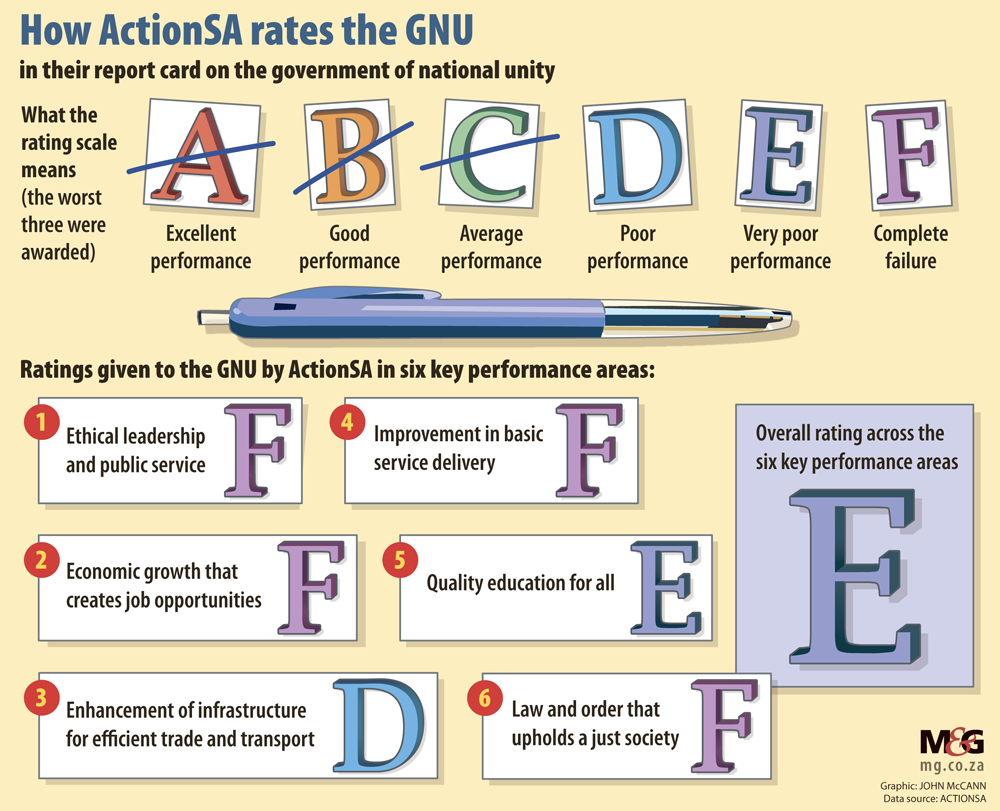
Earlier this week, ActionSA delivered a damning evaluation of the GNU, awarding it a series of failing grades on ethical leadership and public service; the economy; infrastructure; basic services; education and crime.
ActionSA chairperson Michael Beaumont said the party had developed its tracker — with an A grade reflecting an excellent performance, B good performance, C average performance, D poor performance, E minimal effort and F complete failure — “because the government, whose role it is to set the agenda and set the strategy of our country, has been silent on what our national KPIs [key performance indicators] are.”
ActionSA MP Alan Beasley painted a grim picture of unemployment and the economy, awarding the government an “F” grade.
“In South Africa, we have 8.3 million people unemployed. There are a further 3.5 million workers who have been discouraged who have given up looking for work. So, there are nearly 12 million South Africans that are unemployed — 12 million South Africans that are being psychologically murdered because of unemployment,’ he said.
Centre for Risk Analysis Executive Director Chris Hattingh was also critical in his analysis of the government’s performance over the past year.
“On the economic growth and employment metrics, the government of national unity has not yet shifted the needle in any meaningful positive sense. GDP growth in Q1 this year was just 0.1%. Last year, it was 0.8%, while population growth was 1.3%. That means real per capita GDP declined again — South Africans are getting poorer,” he said.
“Low growth is our new normal. Unemployment — including youth unemployment — remains high. While the rhetoric of the GNU has been positive, we haven’t seen that shift meaningfully in terms of real job creation.
“Electricity, fuel, transport — these costs keep increasing. Eskom may be a little more stable, but we still don’t have a competitive electricity market. And Transnet remains a major hurdle. It’s choking our export potential.”
Hattingh said governance deficits have persisted under the GNU.
“We haven’t seen ministers held accountable. Corruption cases from the state capture era are still dragging. There’s a lack of urgency in building a capable, ethical state.”
 (Graphic: John McCann/M&G)
Nelson Mandela University lecturer and political analyst Ongama Mtimka argued that focusing too much on short-term economic indicators obscured the coalition government’s key contribution – national stability.
“I think the biggest success of the government of national unity is to create a political context that has offered the country the best possible path towards stability compared to all the alternatives that were there in the election,” he said.
“The ANC government created a sense of certainty as far as political stability, and when it was toppled from being a dominant party, there were always lingering questions, to what extent would the political situation or arrangements arising from that create a path towards stability?”
“For South Africa whatever we are experiencing between now and 2029 to 2034 is a transitional political period, there may be shocks to the system where there are changes in power, so to have had a political arrangement that brings together parties that have been arch rivals to create a medium term development plan signifies a great leap forward.”
Mtimka argued that it would be “misplaced” to attribute successes to the GNU at this point.
“That would be misplacing cause and effect linkages because government departments are either building on initiatives that were started before consolidating them, or they are just starting to introduce some new things. So in that regard, there isn’t much by way of tangible outcomes that will be attributed solely to the era of the GNU,” he said.
Van Heerden agreed that the coalition government had brought stability but warned of the risk posed by radical opposition parties such as Julius Malema’s Economic Freedom Fighters and former president Jacob Zuma’s uMkhonto weSizwe (MK) party.
“The MK party is literally anti the Constitution. Because of the maturity of our democracy, they have the right to have those views and Julius Malema can sing “kill the boer” and clearly he does it not because there’s any underlying messaging that he’s trying to give, except that he just wants to piss off Afrikaners,” he said.
“Our democracy says you can say those things … but that MKP has two million members, predominantly from KwaZulu-Natal, that is a concern. Do those people genuinely not believe in the Constitution? Are they genuinely wanting to move powers to tribal authorities and take us back to the stone age? That is the reason why the ANC and the DA saw eye to eye, we have to keep those forces out of the mainstream.
But in its assessment this week, Action SA said the coalition government should not exist merely to ensure that the EFF and MK were kept out of government, something Steenhuisen has admitted was one of the motives for the DA joining the formation.
“It is not enough for the next five years to tell South Africa that we should be appreciative of what we’ve avoided. South Africans expect the GNU must govern, and it must deliver services, and it must deliver the changes that were promised during the election campaign,” ActionSA’s Beaumont said.
“What you really have is a government that is running in multiple directions all at once and in no direction enough.”
Dion George, the DA minister of forestry, fisheries, and the environment, said the GNU had created an atmosphere where departments are increasingly working across silos, “where ideas are strengthened through debate and collective intelligence” and this had helped his department get things done.
Among his “big six” strategic priority areas is protecting natural resources and wildlife and George said one of his department’s most significant achievements had been in the protection of the critically endangered African penguin.
“After learning about the sharp population declines and the human impacts causing them, I called for open, lawyer-free discussions that brought together conservation organisations like BirdLife South Africa and Sanccob [Southern African Foundation for the Conservation of Coastal Birds, industry leaders in the fishing sector and our departmental experts.”
This collaborative approach led to a court-ordered agreement to implement island closures around key breeding colonies, he said.
A coordinated approach has also led to successful prosecutions and a continued decline in rhino poaching incidents, and George said attention was also turning to species such as pangolins and abalone. The domestic trade of rhino horn, lion bone and lion parts is under consideration.
“The lives of these animals are not commodities. They are a vital part of our ecological and cultural identity.”
He noted that in the fourth quarter of last year, the agriculture, forestry and fishing sectors recorded a “remarkable” 17.2% growth, contributing two-thirds of the total GDP growth for that quarter. In the first quarter of this year, these sectors grew by 15.8%.
“These are not just numbers,” George said. “They reflect thousands of jobs and livelihoods sustained. We increased the number of fish species available to small-scale fishers by 36%, boosting income in coastal communities.”
The department’s harbour revitalisation programme has created over 2 300 work opportunities through expanded support for sustainable aquaculture, George said, adding: “We’re seeing green technology spark new enterprises along our coasts”.
The coalition government is still undergoing some steep learning curves, Van Heerden said, citing the example of the DA’s Basic Education Minister Siviwe Gwarube, who had described confronting hard trade-offs between paying for feeding schemes and filling teaching posts.
“She said she quickly learned that in government, you’re not choosing between right and wrong — you’re choosing between which ‘right’ matters more,” he said, adding however that there were strategic headways being made in portfolios like agriculture, under Steenhuisen, and the trade, industry and competition department led by the ANC’s Parks Tau.
“It is exciting times. South Africa was able to do this in a world where it is difficult for people to do this kind of coalition, reconciliatory politics. These parties were prepared to put their party policies aside and put the country first and so we must give the GNU a chance,” he added. — Additional reporting by Sheree Bega