Grave debate: Former deputy president David Mabuza died on 25 July this year. Photos: Defence Corporate Communications
A customary marriage from years past has come back to haunt the family of late former deputy president David Mabuza, with a woman claiming to be his wife and her daughter laying claim to his R44 million pension, dragging parties including the presidency to the high court.
The case, coming during Wills Week in South Africa, shows that Mabuza did not have a will when he died in July, while home affairs records show he was never married.
In Part A of the application, which is set to be heard in the high court in Mbombela next Tuesday, Mabuza’s daughter Tamara Silinda is trying to stop Alexander Forbes from paying the R44 million to Nonhlahla Mnisi, who was the second lady of the country when Mabuza was Cyril Ramaphosa’s deputy.
Silinda is also demanding that Alexandra Forbes pay her R40 000 monthly towards her basic maintenance, including clothing, transport and medical expenses. According to Silinda, she was dependent on Mabuza’s medical aid, hence her demands for her medical expenses to be covered from his pension money.
She is also demanding that Alexandra Forbes pay R127 990 towards her yearly tuition fees at the University of Cape Town pending the finalisation of the matter. Her mother, Emunah Silinda, is the first applicant in the matter and Tamara is the second applicant.
Mnisi has been cited as the first respondent, Alexandra Forbes as the second respondent, the Master of the High Court as the third, the presidency of the Republic of South Africa as the fourth, the government pension administrator as the fifth and Mabuza’s six other dependents as the other respondents.
Silinda argues that she is unemployed and not in a position to maintain herself and was entitled to claim maintenance from her father’s estate.
Silinda is also demanding that Mnisi grant Mabuza’s dependents reasonable access to the family home in Barberton, Mpumalanga where he was buried for the purposes of cultural and family rights to visit and tend to the former deputy president’s grave.
Mnisi has also allegedly prevented Mabuza’s dependents and his alleged customary wife from the family home by placing tight security at the premises.
Silinda is claiming that Emunah was married to Mabuza in terms of customary law and that the marriage is valid and subsisting.
“My mother was married to the deceased in terms of customary law and the marriage was never dissolved during the lifetime of the deceased.”
Mabuza, who served as the country’s deputy president from February 2018 to February 2023, died in July.
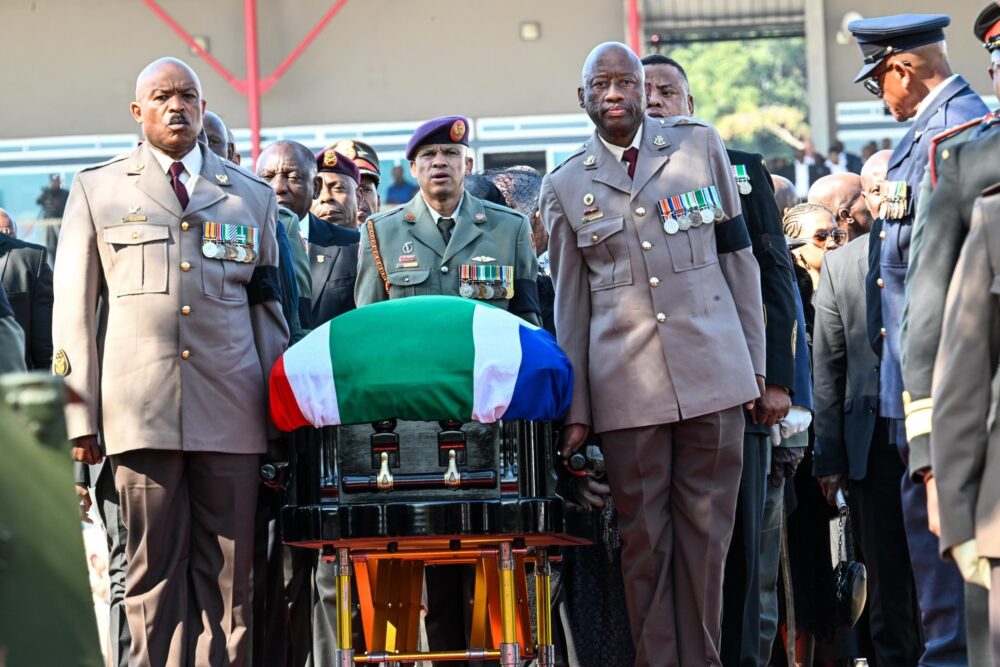 Former deputy president David Mabuza’s funeral.
A copy of his death certificate, attached to documents before the court, shows that he was never married and died of natural causes, raising questions about his marriage to the former second lady.
Silinda says Msini claims to be Mabuza’s wife and produced a marriage certificate obtained posthumously from the department of home affairs.
“We challenge the legitimacy of this certificate as no valid marriage could have been concluded or registered after death,” read the court papers.
“This background has set the stage for the legal discourse on the recognition of customary marriages posthumously, underscoring the profound effect of such recognition on the rights and dignity of women like my mother who are left behind,” Silinda said.
She argued that once the pension funds are wrongfully distributed, they would be left without any effective recourse, as recovery would be practically impossible. “Therefore, an interdict is the only appropriate and effective means to safeguard the applicant’s rights to prevent irreparable harm.
“I humbly submit that there is no avenue left for me, as the second applicant, to get my educational and personal needs met pending the finalisation of the estate. If the honourable court does not intervene, I will be left without food and income.
“The deceased estate will take some time to complete. It is well documented that he was a public figure. In dealing with the estate, it requires due diligence, and I submit to the honourable court that approaching the courts on urgency remains pivotal and the most available route to address the lengthy process that could derail any distribution as well as liquidation of accounts.”
In her court papers, Silinda also argued that if the application is not granted, she would be expelled from university and would be evicted from her accommodation and her car would be repossessed.
“At all material times, the deceased has been responsible for my upkeep. At all material time the deceased was responsible for all the household and living expenses and my mother was not required to make any contributions thereto.
“My biological mother is unemployed and unable to meet the obligations on her own.”