President Cyril Ramaphosa at the ANC's national general council earlier this week. (Delwyn Verasamy/M&G)
The ANC’s bid for renewal this week was haunted by allegations of corruption at its national general council (NGC), with the party being forced to defend itself against the deep rot in its ranks.
This came after president Cyril Ramaphosa’s political overview report, where he bemoaned the quality of cadres in the organisation, conceding that corruption was a major challenge in the party.
Ramaphosa conceded that corruption, criminality and factionalism within the party were a major headache.
National spokesperson Mahlengi Bhengu-Motsiri was forced to come to the defence of the party and was at pains to separate the organisation from individuals destroying its legacy.
Bhengu- Motsiri maintained that the ANC itself was “not corrupt”.
“I always say that if the ANC was a corrupt party – not individuals – we would not be poor. We would be tapping into the resources of the state as a governing party.”
With unpaid staff at its Luthuli House headquarters staging a protest on the first day of the NGC, the incident laid bare the financial position of the country’s biggest party; the sheriff seizing some of its property over unpaid debt and its workers receiving salaries late.
Asked by the Mail & Guardian for comment on the corruption allegations, Bhengu-Motsiri maintained: “You certainly can divorce corrupt individuals from the party or a company – something which is standard.
“We insist that the ANC is not a corrupt organisation. Individuals found to be involved in corrupt activities must face the full might of the law.”
While the spectre of corruption hung in the air at the NGC, the party this week also faced a crisis with its Tripartite Alliance partner, the SA Communist Party (SACP), refusing to budge on its decision to contest next year’s local government elections on its own for the first time since 1994.
Labour federation Cosatu is the other member and is also calling for a reconfiguration of the Alliance. Cosatu also wants the ANC to intensify its renewal campaign and hold errant members accountable.
Further, it wants the state to have capacity to provide quality public and municipal services to the working class and stimulate inclusive economic growth – creating decent jobs, tackling poverty, inequality, crime and corruption.
At the core of the escalating tensions between the SACP and the ANC is a call for the reconfiguration of the Alliance, set to shift key policy and political decision-making from the ANC national executive committee (NEC) to the alliance political council.
So shaky and fragile have Alliance relations become that the ANC has threatened SACP members about an imminent end to holding dual membership should the communists not reverse a decision to independently contest next year’s polls.
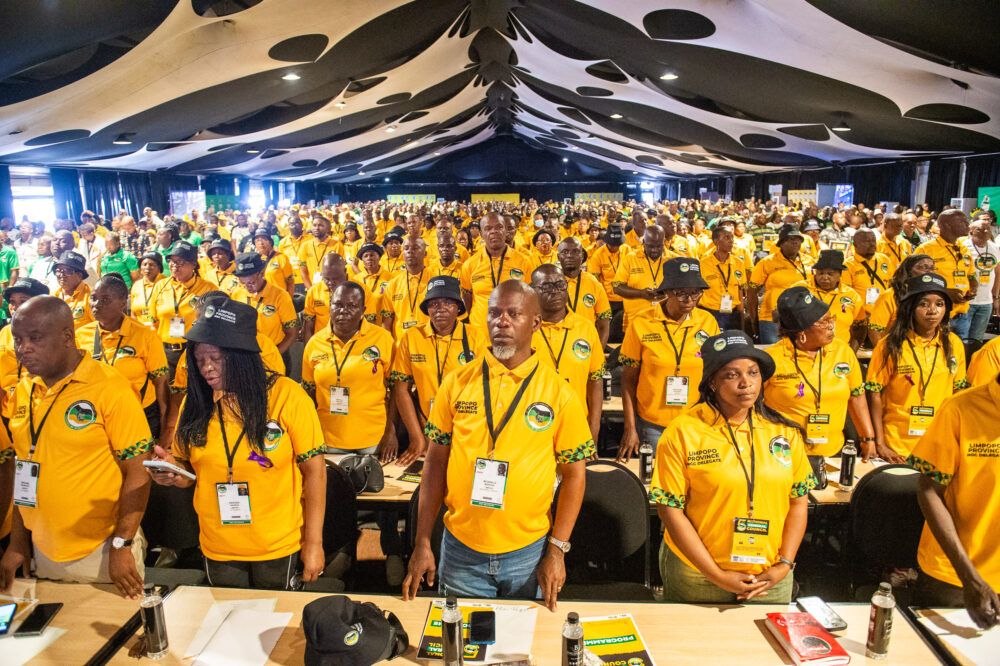 ANC delegates attending the NGC earlier this week. (Delwyn Verasamy/M&G)
With the SACP decision set to split the ANC vote in the 2026 local government elections – dealing the governing party yet another blow, after having been reduced to 40% votes in the 2024 polls – the SACP this week said failure to reconfigure the Alliance was the fundamental factor.
ANC chairperson Gwede Mantashe this week described the SACP move as “a suicide” and party secretary-general Fikile Mbalula told delegates attending the NGC that the NEC had rejected dual membership for SACP members unless it reverses its decision to contest elections.
Delivering the ANC mid-term report during the four-day NGC in Boksburg, Mbalula was unequivocal: “The ANC special NEC meeting on the 1st December, 2025 resolved it (dual membership) could no longer be allowed, lest the ANC harbour in its ranks sleepers who could work against the ANC from within.”
Speaking to the M&G, SACP spokesperson Mbulelo Mandlana said the Alliance faced challenges over the last decade “mainly on the basis that the strategic content of national transformation is not determined by the political decision-making structures of the Alliance”.
Mandlana said key decisions were “not even taken by the ANC itself, but rather by state bureaucratic entities and individuals who have overtime swayed the ANC structures to simply rubber stamp government decisions”.
The decisions, said Mandlana, were “not conceived or aligned in any serious way to the overall political logic that guides the revolutionary movement”.
“The policy content of the transformation project – as manifested by state actions – is detached from the overall objectives of the course for change.
“On the contrary, it manifests as actions to perfect what exists rather than fundamentally alter the organising logic and principles of what exists,” said Mandlana.
He added: “Following this realisation, the SACP has for over a decade been calling for a fundamental reconfiguration of the Alliance; this to change the decision-making process.
“The SACP wants to democratise the functioning of the Alliance, to maintain its progressive ideological orientation. We want to wrestle policy conception from liberal core to the movement and its correct political principles – preventing the radical proliferation of liberalism in the state policy space.”
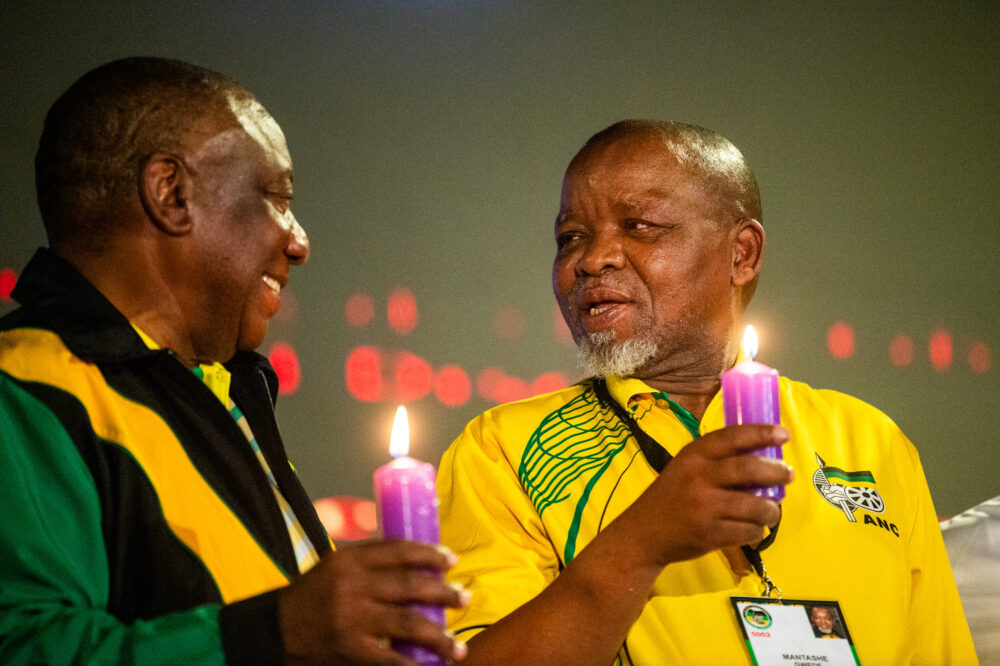 ANC President Cyril Ramaphosa speaking with chairperson Gwede Mantashe. (Delwyn Verasamy/M&G)
Blaming the ANC for non-cooperation, Mandlana said the reconfiguration of the Alliance has not occurred.
“We continue to pursue the idea of reconfiguration of the Alliance so that we can recast the methods of our political strategy, to abide by the objectives of our shared national democratic revolution. “The test of the strength of the Alliance lies in the implementation of the reconfiguration,” he said.
On the future of SACP ministers serving in the ANC-dominated GNU Cabinet, Mandlana said the executive government structure was “a product of the Alliance”.
“Any actions relating to the fate of any government official must be subject to Alliance engagement,” Mandlana maintained.
On why the SACP resolved to independently contest next year’s elections, he explained:
“We do not accept the phrase ‘going it alone’ because it implies self-isolation or enmity with progressives.
“The political terrain has evolved and these changes have a significant meaning for our struggle for socialism.
“The mass base of the working class has been increasingly isolated by the dominance of the bourgeois interests in the national political landscape.
“The national liberation movement has been overcome by dominance of these class interests – leaving the working class looking for scraps of power and influence and no longer empowered as the motive force of our revolution.
“The changing tack and strategy of the SACP is based on building concrete representation of the working class and interests in the local government sphere and the state.”
The SACP wanted to “begin to consolidate the working class as it seeks to build its power and bargain for political and economic advances – from a standpoint of a represented and internally active constituency.
“This working class power cements the national democratic revolution as something practical than an avenue of those sections responsible for suppression of the political prospects of the working class.
“In the final analysis this is about maintaining the revolutionary content of the national transformation project,” he said.
Mandlana denied reports that the ANC has given the SACP an ultimatum on contesting elections.
“On the contrary, the ANC has expressed its opinion, disagreeing with the choice of the SACP to go independently into the local government elections – for various reasons it stated.
“The ANCs disagreement with our decision to contest elections is known to us and we have nonetheless made a case to them as to the necessity of the SACP to embark on the path we have decided to embark on – a consequence of congress decision.”
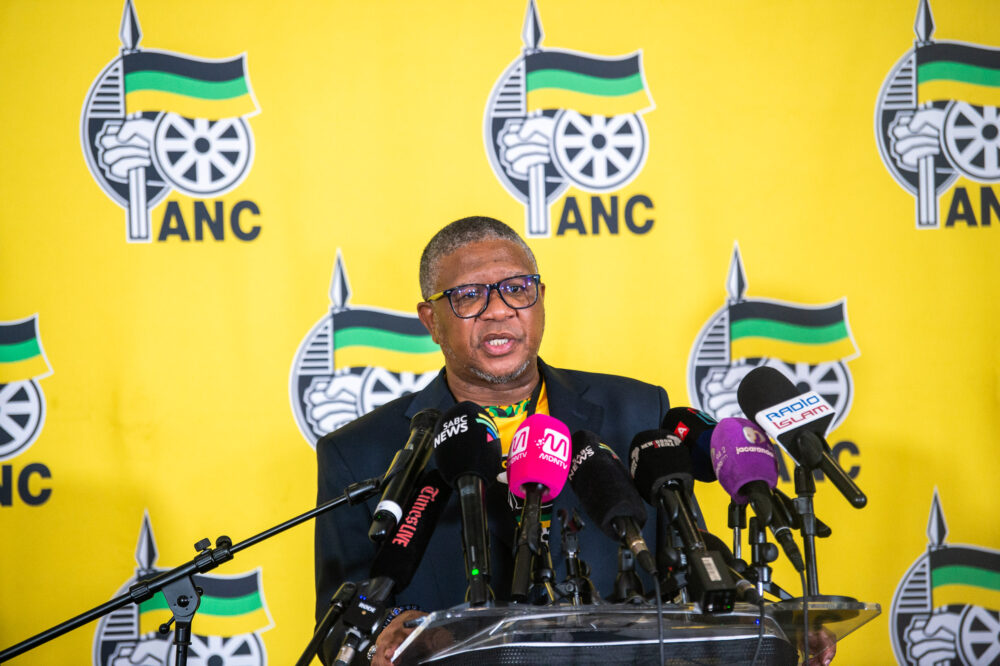 ANC SG Fikile Mbalula told delegates attending the NGC that the NEC had rejected dual membership for SACP members unless it reverses its decision to contest elections. (Delwyn Verasamy/M&G)
Asked about an incident of NGC delegates disrupting a speech delivered by the SACP’s first deputy general secretary Madala Masuku, he said: “We are concerned by that conduct.
“However, we do not intend to inflate the meaning of the reaction of some few delegates to the speech.
“We call on the leadership of the ANC to correct matters of discipline that arise from time-to-time when meetings of importance are held.”
Concerned about tensions within the Alliance, the Cosatu central committee mandated its leadership to engage with the leadership of the ANC and SACP – “to find ways to address matters of disagreement”.
Said national spokesperson Matthew Parks: “Cosatu discussed measures to ensure the Alliance is united and speaks with a single voice in the pending local elections.
“Cosatu is firm in its belief that under the Alliance, South Africa has achieved historic victories.
“The Alliance remains the most important political vehicle to improve the lives of the working class.”
Parks said Cosatu was “concerned that the Alliance is not speaking with one voice”.
“At times, Alliance partners are speaking past each other. Cosatu affiliates were clear at our central committee that these matters that may divide us must be addressed in a manner that unites us.
“The central committee wants Alliance partner concerns resolved. Shouting at each other will not assist. Cosatu values its relationship with both the ANC and the SACP and is firm in the need for the Alliance to continue and to be strengthened.
“We have requested that an urgent Alliance political council be convened to find a path – achieving this as a matter of the highest priority,” said Parks.
He conceded that the Alliance has experienced challenges, “like any family”.
“But the principles uniting the Alliance remain sacrosanct.
“We will not support anything that can weaken or divide the Alliance. Key to uniting the Alliance is its reconfiguration, ensuring that government and public representatives are held accountable for their actions – including the implementation of the ANC and the Alliance’s elections manifestos.
“The reconfiguration of the Alliance is long overdue and key to this is to ensure that it provides strategic leadership to the government at all levels,” said Parks.