MEC for human settlements Tasneen Motara
Officials say Thuto House student accommodation demonstrates what can be achieved when entrepreneurial talent is partnered with government institutions.
Gwen Nkosi Co-owner of Greyline Holdings, the company which built Thuto House student accommodation, said when the project only existed on paper, many saw risk.
She said the Gaunteng Partnership Fund (GPF) and National Empowerment Fund (NEF) saw the potential in student accommodation located in the township and would be close to modern amenities such as Soshanguve Crossing Mall, Tswane University of Technology and other TVET colleges.
The residence was completed in 2024 with a 424-bedroom capacity. Over a year later, Thuto House has an 80% occupancy rate, housing 366 students.
The project’s funding scheme included blended finance with the GPF and the NEF. Officials said the funding provided investment where the private sector was not willing.
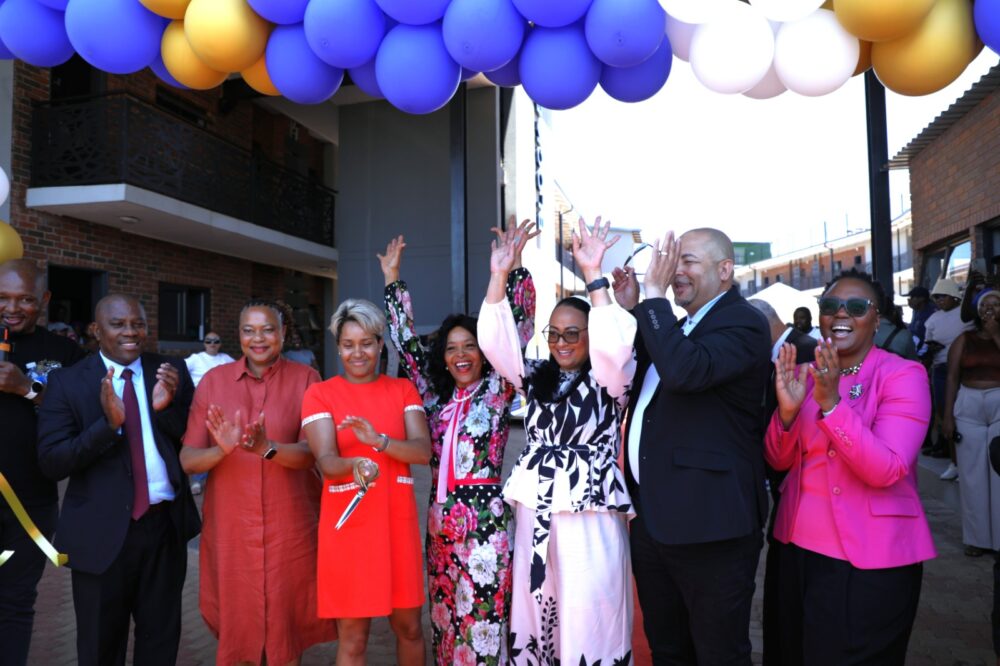
At a recent launch ceremony of the student residence, beneficiaries said the building supports a balanced student life. They said proximity to the mall, TUT and other TVET colleges makes daily life easier, convenient and safe.
Unveiling the residence plaque, MEC for human settlements Tasneen Motara said the project funders were setting a leading example that demonstrates what is possible when the government aligns capacity with empowerment.
Motara said parents can sleep comfortably at night knowing their children are safe. “Housing and education are inseparable. This project recognises that reality,” she said.
Gauteng has a demand for close to half a million beds, said Motara, highlighting the need for more student accommodation. “We stand ready to enter into more agreements,” said Motara.
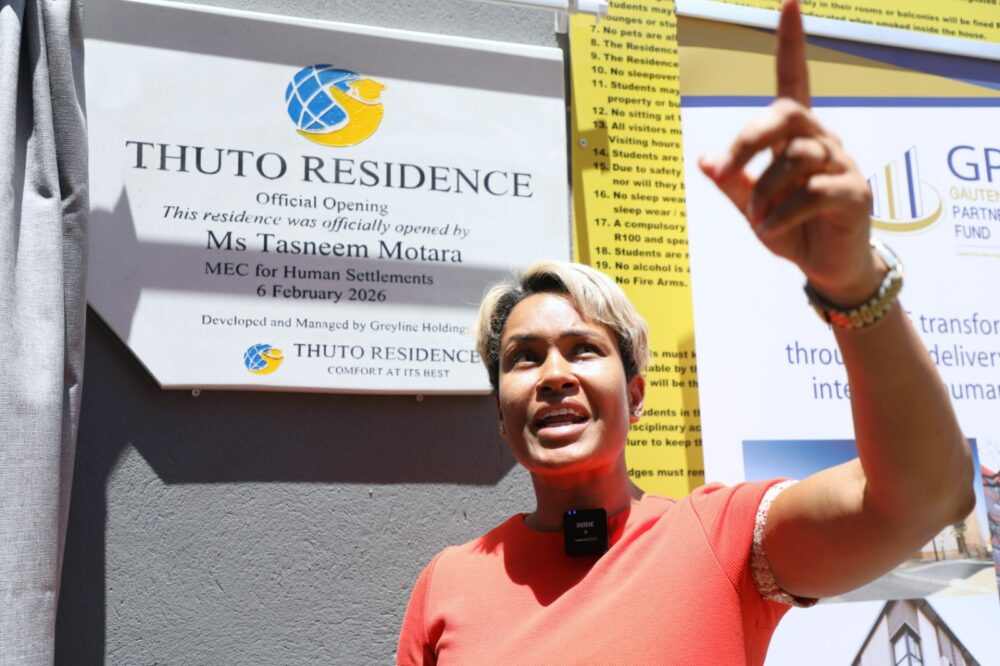 MEC for human settlements Tasneen Motara
Thuto House forms part of the province’s goal to reduce inequality in the townships, said Motara, by shortening the distance between school and living, and improving academic outcomes. “We are proud that this project is located in Soshanguve, a township with a rich history and potential,” she said.
Motara said the project sends a message to the youth that the province believes in them, adding she hopes the project will be the foundation of an extraordinary journey in township transformation.
Tswane’s member of the mayoral committee for Human Settlement Alderman Maluleke, said the project not only provides accommodation but also safety, which enhances the learning environment for students to excel in their studies.
Mziwabantu Dayimani, NEF Chief Executive Officer, said TUT had over 19,000 registered students, and that more than half don’t have accommodation.“Government had to intervene and figure out how to turn the crisis into an opportunity,” he said.
“Someone had a vision that in Soshanguve, there will be another student accommodation,” he said.
Dayimani said the project creates “a sustainable income-generating project in the township”. It covers socio-economic objectives in safety and affordability. He said the residence’s proximity to modern amenities and the university will improve academic success.
He said the project falls squarely within the NEF objective. Established in 1998, the NEF promotes black-economic participation. The fund provides financial and non-financial support to black-owned and managed businesses.
Thutho House is in a township where there is high demand in an underserved area, said Dayimani.
He said that when government entities work together, they can achieve outcomes envisioned in the National Development Plan, adding that the project provides capital to first-generation black-owned property initiatives.
The student accommodation created over 120 jobs during the construction period. The NEF aims to develop more affordable and safe student accommodation in other universities and townships.
Dayimani said the project is an example of how vacant land can be made productive.
Lindiwe Kwele, Chief Executive of Gauteng Partnership Fund (GPF), said the student accommodation is more than bricks and mortar, but a catalyst for dignity and inclusive growth. She said student dignity was a non-negotiable for the GPF.
Thutho House captures the spirit that student success is not confined to lecture halls, said Kwele. She said that the project ensures security, stability, self-worth and mental well-being, which contributes to the overall student success.
As an agency of the Gauteng Department of Human Settlements the GPF pools “various resources from the private and public sector to accelerate the realisation of decent, affordable rental housing close to amenities and economic opportunity.”
Kwele said the project encapsulates the property sector’s epithet that “location is everywhere”. Situating Thuto House closer to a mall and the university removes the barrier of unsafe conditions, she said.
Facilitating lending in the affordable housing space forms part of the core business of the GPF. Its Commercial Housing Fund promotes the participation of experienced housing developers and rental property owners in the affordable housing market.
Kwele said the government’s funding derisks the project for developers looking to invest in the townships, which encourages further investment. She said outcomes are that the residence gives students back the hours lost commuting.
The project is a broader shift in developing quality, purpose-built accommodation that serves as a long-term asset that anchors economic activity in the townships, said Kwele. “Success of this magnitude is not a solo effect”.
The construction company said the project boosted local employment and supply chains. Greyline Holding Co-owner Nkosi said the project showcases what is possible when development financial institutions take the lead.
NEF board member Muhammed Bhabha said Thuto House is a manifestation of the fund’s aims to empower black people and echoed the reinforcement of what can be achieved when government institutions work together. He said the project chips away at the notion of a divided and exclusive economy.
“To us, it’s not just brick and mortar, it is about investing in the skills that will make our economy grow,” said Bhabha.
GPF board member Craig Cornish said the project represents the type of development the Gauteng province needs. He said safe and secure student accommodation is essential for economic success.
Cornish commended the project’s sustainable returns while transforming the township.
“When a project is not supported by the community, it never reaches the completion phase,” he said.
He said the project transfers township real estate. GPF acted as a catalyst for structural transformation, said Cornish, highlighting the Fund’s resolve in placing township assets in the hands of those who live and are rooted in township communities.