Non-starter: The Greater Lanseria Master Plan in 2020 outlined a city that intended to house between 350 000 and 500 000 people. Yet there is not
much to show other than large areas of open land and growing informal settlements. Photo: Delwyn Verasamy
This year marks the ninth State of the Nation address (Sona) delivered by President Cyril Ramaphosa since assuming the country’s top job in 2018.
The reaction to his annual speeches has been mixed over the years, as has his delivery on the promises and commitments made.
The Mail & Guardian rolled back the recent years and looked at the progress — or lack thereof — the president has made over the past eight years.
Daydreaming (2019- 2020)
In June 2019, Ramaphosa’s Sona marked the beginning of the sixth democratic parliament and was centred on growing South Africa together as the country celebrated
25 years of democracy.
It was how the president closed his address that sparked bemusement among South Africans.
He outlined his ambitious dream of a smart city.
“Has the time not arrived for us to be bold and reach beyond ourselves to do what may seem impossible?” the president asked.
Skyscrapers, schools, universities, hospitals and factories would form part of this city — a dream Ramaphosa invited all to share in and become a part of building.
He doubled down on the dream in his 2020 address when he announced that a new smart city would be developed in Gauteng’s Lanseria area in the next decade.
In November 2020, The Greater Lanseria Master Plan outlined a city that would house between 350000 and 500000 people.
However, six years later, there is not much to show other than large areas of open land and growing informal settlements.
National Development Plan
The core of Ramaphosa’s first Sona centred on a return to the blueprint for the country’s development until 2030, the national development plan (NDP).
“The economy is not growing. Not enough jobs are being created. This is the concern that rises above all others. It affects everyone,” he noted, adding that the NDP should be “at the centre of our national effort”.
To realise the vision 2030 outlined by the NDP, Ramaphosa set out five measurable targets: no person in South Africa would go hungry, the economy would create two million jobs for young people, economic growth would outpace population growth, every 10 year old would be able to read with understanding and violent crime would be halved, if not eliminated.
Again, this was more aspirational than anything else.
But in 2020, just before the Covid-19 pandemic hit, Ramaphosa did offer more practical solutions in his Sona.
He focused on inclusive economic growth, stressed the need for improvements in early childhood education and the expansion of technical and vocational education and training to grow youth employment and outlined measures to combat gender-based violence and strengthen policing.
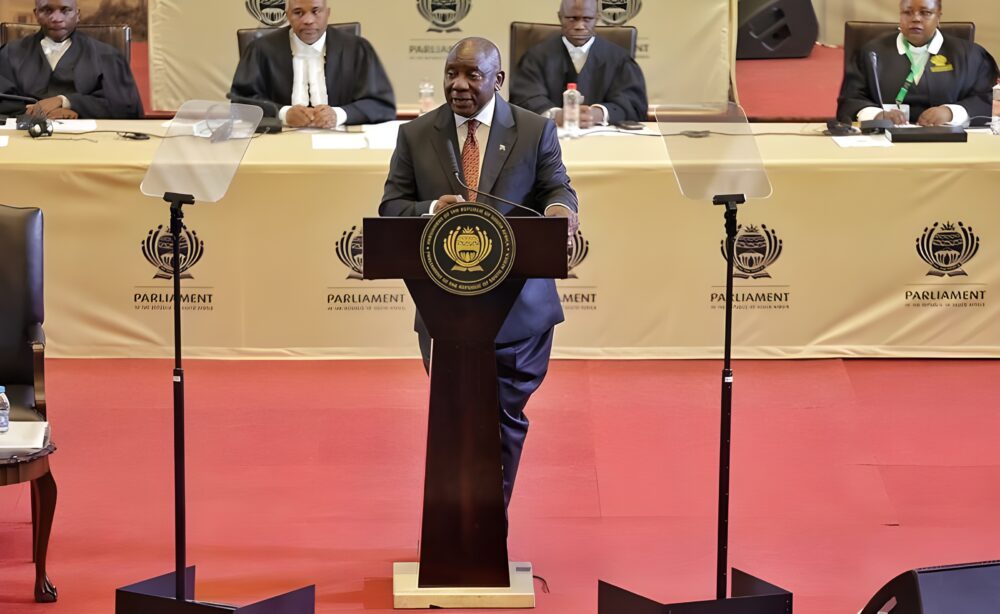 President Cyril Ramaphosa.
Photo: Government ZA
President Cyril Ramaphosa.
Photo: Government ZA
Successes and failures on pre-Covid promises
Last week, the M&G reported that South Africa was facing a deepening hunger crisis, with millions of households skipping meals, compromising nutrition and resorting to harmful coping strategies because of rising food prices, unemployment and inequality.
Between 2019 and 2023, the country’s severe hunger rate rose from 6.4% to 8%, leaving roughly a million more people going days without food.
Data from Statistics South Africa in the third quarter of 2025 showed that overall national unemployment stood at 31.9%, with youth unemployment at 43.7%. That meant more than 4.5 million young people were without jobs.
In his 2020 address, Ramaphosa launched the Presidential Youth Employment Intervention which aimed to accelerate, coordinate and enhance pathways from learning to earning. By 2025, the programme had put 5.64 million young people on the National Pathway Management Network and created more than 1.9 million job opportunities.
Surviving the pandemic and keeping the lights on (2021-2023)
In March 2020, the world was locked down due to the Covid-19 pandemic. Many of Ramaphosa’s addresses until 2023 were centred on the pandemic response and recovery.
Who could ever forget our monthly family meetings?
The Sonas were like interventions during a family crisis. Focused on damage control and recovery, a problem kept lurking in the background — Eskom was in dire need
of a plan to keep the lights on for South Africans.
Ramaphosa assured the nation in 2021 that Eskom was making substantial progress with its intensive maintenance and operational excellence programmes to improve the reliability of its coal fleet.
He said the government was working closely with the power utility on proposals to improve its financial position, manage its debt and reduce its dependence on the fiscus.
In 2022, the president told South Africans that the rapid expansion of South Africa’s generation capacity was under way.
Ramaphosa detailed that several new generation projects would be coming online over the next few years but South Africans continued to suffer as load-shedding became more consistent than potholes.
In 2021, there were 75 days of load-shedding. In 2022, the number increased to 205 days and in 2023, South Africans experienced a record high of 325 days of load-shedding, which was ramped up to stage six on 67 of those days.
It was only in the 2023 Sona that Ramaphosa declared a state of disaster over the energy crisis to empower government responses to severe electricity blackouts, which he described as an existential threat to the economy.
Ramaphosa then appointed Kgosientsho Ramokgopa as minister of electricity.
The success of the electricity minister
Ramokgopa immediately gave South Africans updates on the Energy Action Plan which aimed to fix Eskom, buy as much power as possible to close the electricity shortfall, enable businesses and households to invest in rooftop solar energy, allow for private investment in generation and transform the electricity sector.
Under his leadership, the return of key power stations such as Kusile, the extension of the Koeberg nuclear power station’s licence for another 20 years and efforts to integrate renewable energy sources have significantly reduced load-shedding.
By the end of 2025, Ramokgopa had achieved more than 196-consecutive days without load-shedding for the year and more than 400 days of intermittent power supply.
The country’s Generation Recovery Plan, aimed at improving energy availability and reliability, has resulted in a 71% average in the Energy Availability Factor.
Electioneering and standing firm in the face of a bully (2024 and 2025)
In his 2024 Sona, Ramaphosa vowed to end state capture once again before South Africans voted.
“We will not stop until every person responsible for corruption is held to account. We will not stop until all stolen money has been recovered,” he said.
“We will not stop until corruption is history.”
However, what was notable was that when the president made the comments, several of his comrades in parliament were implicated.
As of 2025, while numerous individuals have been implicated and more than R11 billion in assets have been recovered, there have been few major convictions in South Africa’s state capture cases. Only four cases yielded guilty verdicts.
In 2026, much of the attention surrounding Sona related to US President Donald Trump suspending donor aid over policy differences with South Africa and false claims of a white genocide — and how Ramaphosa would respond.
While the president acknowledged that the US decision to cut funding was putting treatment for people living with HIV at risk, he stood firm.
“We are a resilient people. We will not be bullied. We will stand together as a united nation,“ Ramaphosa told the nation.
One thing he assured us was that even though there was a lot remaining to be done regarding unemployment, crime, gender-based violence and poverty, he would protect the sovereignty of the nation and not sell it
for aid.
After Ramaphosa’s 2026 address, he and his government must be just as brave and forthcoming with South Africans about the issues we face.