Creating a movement: Two of Septober Energy’s co-founders Flames Shilowa (Vusi Hlatywayo) (left) and
Sound of Xee (Xolisa Tshomela) (right). Photo: Supplied
Septober Energy is hard to categorise. Formed in 2023 in the wake of loss, the Johannesburg–Cape Town–spanning collective has quickly established itself as a fluid, multigenerational space where DJs, archivists, scholars and experimental musicians converge. Less a fixed crew than a living ecosystem, Septober Energy operates as what co-founder Naledi Chai describes as “an umbrella for other collectives,” one that privileges collaboration, curiosity and deep listening.
At its heart, the project is both homage and intervention: a memorial to a fallen friend and a deliberate reimagining of how Black sonic histories can circulate in the present.
The collective’s name is not accidental. Septober Energy takes its cue from the sprawling 1971 double album Septober Energy by the British jazz/progressive rock big band Centipede, a once-off musical experiment produced by Robert Fripp under the direction of Keith Tippett.
For Chai, the reference was less about nostalgia and more about method.
“I came up with the name and I was kind of listening to that project at the time,” she explains. “It was interesting for me that they kind of pulled all these artists from different parts of music, from different parts of the world, from different parts of sound and got them together to make this record.”
That spirit of unlikely convergence became the blueprint.
“I thought that it would be fitting for us to do that,” she continues, “because we were also kind of gathering musicians, DJs, writers, scholars, academics and bringing them into this vinyl collecting space where they could come in and explore the sound of other DJs and explore their own sounds.”
If the name carries archival weight, the collective’s story of origin is deeply personal. Septober Energy emerged shortly after the death of their friend and collaborator Malesela “Joey” Modiba, also known as Lirubishi (and sometimes Joy Mode), who passed away in 2023.
“Septober Energy came about as sort of a commemoration or like a getting together of DJs and musicians,” Chai says. “We formed it after we lost our friend in the community, Joey.”
The timing was deliberate and emotional.
“Shortly after we buried him, we kind of got together,” she recalls. “It was sort of in memory of Joey, because this is definitely something that he would have done. This is something he would have made himself. This is something that he would have wanted.”
What might have remained a once-off memorial instead crystallised into an ongoing platform.
Septober Energy was formally established by three co-founders drawn from intersecting archival and DJ communities: Naledi Chai, Xolisa Tshomela and Vusi Hlatywayo.
The trio emerged from the orbit of Fly Machine Sessions and Globalize Yourself Stereo (GYS), two research-driven music collectives whose members were already in conversation before Septober Energy took shape.
“I think that we all lead in our own individual capacities,” Chai notes. “But there are founders and co-founders, the people that founded Septober Energy — the people of Fly Machine and the people of GYS — and that is myself, Xolisa and Vusi.”
 Livhuwani Ramalivhana (Soul Br_th_r) (left) along with Septober Energy co-founder Naledi Chai (Mantra Zeph) (middle) and Sphiwe Radebe (Rilla) (right). Photo: Supplied
Leadership, however, is intentionally diffused.
Unlike traditional music collectives, Septober Energy resists the idea of a stable roster. Its structure is deliberately porous.
“I believe that Septober Energy is an umbrella for other collectives,” Chai explains. “Within Septober Energy, there are other crews and collectives that operate under that umbrella, so people can come and go really as they please.”
Among the key affiliated formations are Fly Machine Sessions, Globalize Yourself Stereo (GYS), Gorilla Grave Studios, Black Intellectual Praxes and Future Nostalgia.
“There’s Fly Machine Sessions under Septober Energy. There’s GYS, there’s Gorilla Grave, there’s Black Praxis,” Chai says. “So there’s a lot of collectives within this collective that form this collective.”
The fluidity is philosophical as much as practical.
“I don’t think that even Septober itself is a permanent space,” she adds. “It’s a moving space and whatever it becomes later, then it becomes that. We don’t necessarily want to be married to any ideas.”
Much of Septober Energy’s intellectual backbone comes from Fly Machine Sessions, which Chai describes as a collective of “archivists and sonic historians”.
Their work digs into under-heard South African recordings, particularly traditional Black music that never entered the mainstream archive.
“We really go deep into the traditional South African music that didn’t get a chance to be played,” she says. “We collect all that music on vinyl and cassette and whatever visual material that we can find that reflects Black life of the time.”
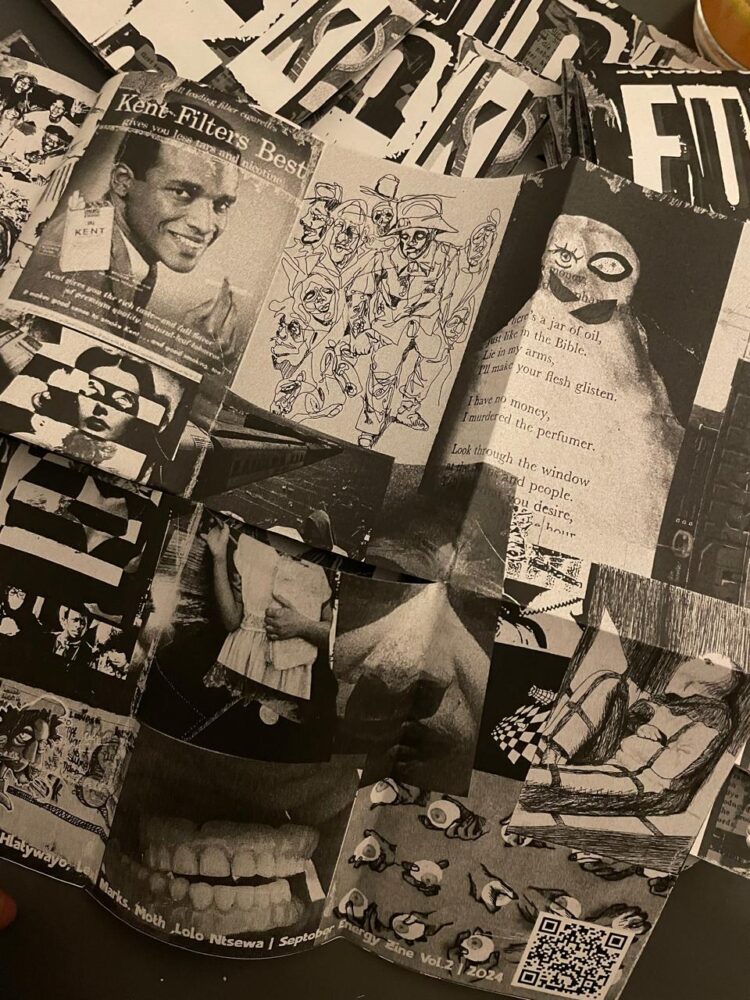 Septober Energy zine second edition. Photo: Supplied
This is not nostalgia mining. It is analytical listening.
“We were interested in how the Venda were making music in the 1950s and 60s, how the Tsonga were making music,” Chai explains.
“All of that music has never been popular but it’s actually such a rich texture of sound.”
“If you listen carefully and you listen over and over, you start to understand the early formations of electronic music in South Africa,” she says. “I feel like that sound gets left out of a lot of conversations around electronic music.”
In this sense, Septober Energy functions as both party and pedagogy.
True to its namesake’s spirit of unlikely musical convergence, Septober Energy’s events deliberately engineer unfamiliar pairings.
“We have a back-to-back setup,” Chai explains. “We’ll put two people together who wouldn’t normally go together and we just let them sort of play together in the space.”
The goal is emergent language.
“We kind of see the language of the call and response that they’re shaping together within that two-hour, three-hour slot,” she says. “That’s also a very interesting way to foster collaboration between people who would have never otherwise met.”
Their programming regularly blends turntablism, broadcast experiments, electronic music, DJ sets, live noise performance and academic interventions.
One of Septober Energy’s most ambitious recent activations was Return Signal Radio, staged in collaboration with the Goethe-Institut in Johannesburg.
The event exemplified the collective’s interdisciplinary ethos.
“Our last event was actually quite different from the events that we’ve done before,” Chai says. “It was like a live broadcast and we had people from different disciplines come in.”
Participants included members of Black Intellectual Praxes, who staged what Chai describes as “a very interesting radio play style presentation”.
“They gathered old recordings of freedom fighters like Frantz Fanon,” she explains.
“They would ask the question in real time and then play the old interview as if it was happening right now.”
The programme also featured a Venda sonic history talk by collaborator Libuani, a Sesotho radio-play presentation by Thuli Majozi and an improvised harsh noise performance led by Chai.
While Septober Energy is intentionally open-ended, several women have become notable presences within its orbit. These include: Nombuso Mathibela, Noma Kunene, Thuli Majozi and Boitumelo Pitso.
Septober Energy shows no signs of slowing. The collective’s next major activation, Wildflowers, is scheduled for 27–28 March at the Afrikan Freedom Station in Sophiatown.
Like the collective itself, the event draws from historical precedent.
In this case, the 1970s Wildflowers loft-session recordings spearheaded by American jazz figure Sam Rivers.
“Wildflowers is also one of those productions that brought together artists from different backgrounds,” Chai explains.
“Sam Rivers basically gathered artists from all over America and set them up in abandoned lofts in New York and they would be in there for days just improvising.”
Septober Energy staged its first Wildflowers edition last year and hopes to make it recurring.
“We thought it would be great to do a continuation,” she says. “If we could even do it annually, that would be great.”
Perhaps the most accurate way to understand Septober Energy is to accept its refusal to sit still. It is part memorial, part research lab, part dancefloor intervention. And entirely in motion.
What began as a gesture of remembrance for Malesela “Joey” Modiba has become something more elastic: a platform where archives breathe, unlikely collaborators meet and South Africa’s buried sonic histories are coaxed back into circulation.