Scepticism: Democracy depends not only on institutions but on public trust that they work for citizens. Yet
many South Africans feel excluded. Photo: Delwyn Verasamy
South Africa has maintained a relatively stable democratic system for 30 years, amid institutional, economic and governance challenges. The country has held frequent multiparty national and local elections.
However, growing dissatisfaction among citizens regarding how democracy functions makes it crucial to examine the factors fuelling the discontent.
Political parties are an integral part of the institutions that shape democracy in South Africa, well before voting takes place every five years. They are involved in mobilising supporters, advocating policies and influencing public opinion, which collectively establish the foundation for electoral processes and governance.
Evidence indicates that citizens are disengaging from the parties that are supposed to represent them. As coalitions become the norm and traditional loyalties to political parties fade, the key issue shifts from the organisation of the party system to how South Africans perceive political parties.
The 2022 Afrobarometer survey highlights a concerning trend. The percentage of South Africans who are dissatisfied with “the way democracy works” reached 70% in 2022. Simultaneously, the proportion of those who do not feel close to any political party increased from about 53% in 2018 to 63% in 2022.
Together, the figures suggest that the dissatisfaction with democratic outcomes is accompanied by a growing sense of disconnection from political parties. Fewer citizens trust any party to improve the situation, posing a considerable risk to the overall health of the democratic system.
Voter turnout has dropped significantly, from 86% of eligible voters in 1994 to only 49% in 2019. In the 2024 election, only 59% of registered voters turned out, representing only 41% of the eligible voting-age population.
Instead of channelling their dissatisfaction through voting for different parties, many are turning to alternative forms of political engagement, such as protesting and attending local council meetings.
Experts observe that ANC supporters have largely opted to skip voting on election day rather than voting for opposition parties, viewing them as ineffective or divisive. At the same time, others are stepping back from politics entirely, convinced that no party speaks for them and voting makes no meaningful difference.
Figure 1 illustrates the changes in perceptions between 2016 and 2022.
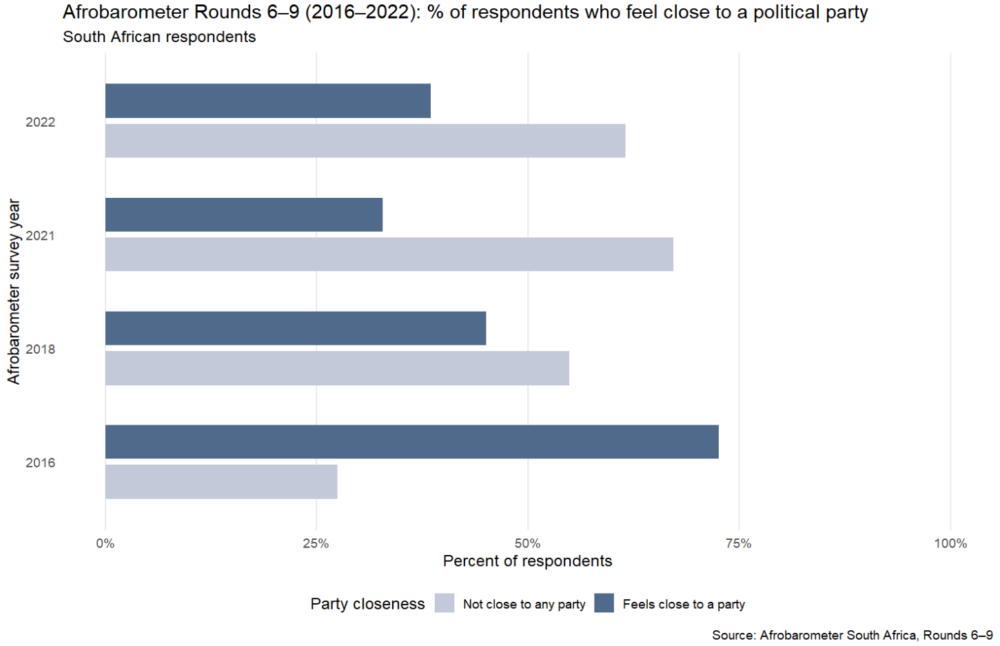
In 2016, just over 73% of South Africans reported feeling close to a political party. By 2021, the figure had fallen to 32%, before recovering slightly to around 37% in 2022. Even with that modest improvement, 55.3% in 2022 said they did not feel close to any political party.
The decline cuts across generational lines and is especially sharp among young people
Figure 2 demonstrates this.
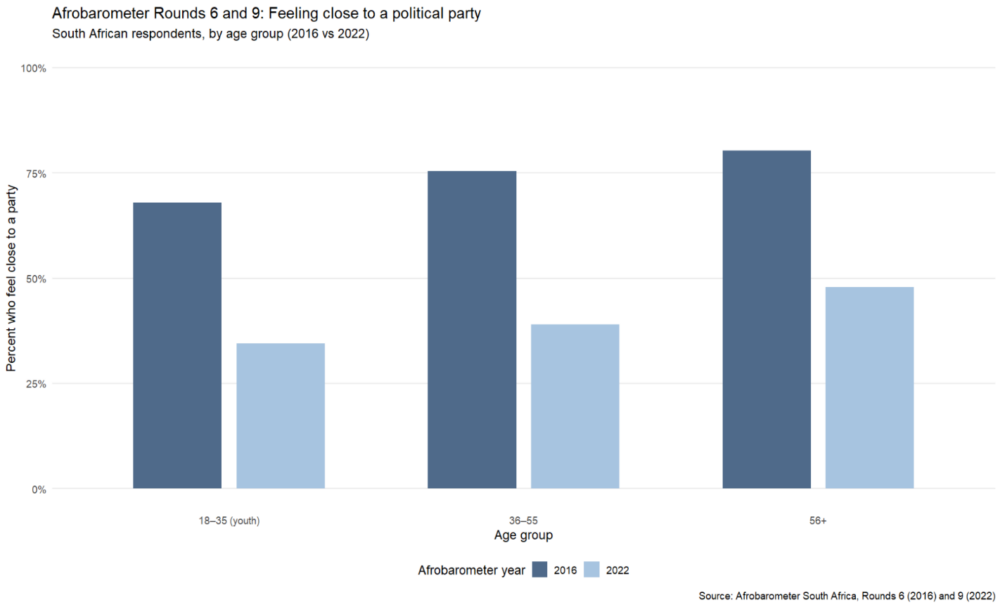
In 2016, approximately 68% of those aged 18 to 35 felt connected to a political party, whereas 75% of those aged 36 to 55, and 80% of those aged 56+ did. By 2022, the figures had almost doubled in the opposite direction to about 35%, 39% and 47.8%, respectively. With young people now sitting at the bottom of the ladder, this raises concerns about future voter participation.
It is crucial not to misinterpret citizens’ growing disillusionment with democracy as the decline of South Africa’s party system as an institution. The system in which political parties compete by formal standards remains highly “institutionalised”.
Political scientists interpret this as meaning that parties are stable, recognisable entities and elections remain the primary means of gaining power. For example, in many democracies, the long-standing dominance of major political parties illustrates their stability and central role in the political process.
South Africa ranks relatively high on international measures of party system institutionalisation, scoring around 0.8 on a scale from 0 to 1.
The overall trend depicts a party system that continues to function, yet the connection between voters and political parties is deteriorating at a notable pace.
The trends are concerning, as they relate to how the system, fundamental to upholding democracy, can be useful if those for whom it was designed do not participate and what this means for democratic prospects in South Africa
The country has moved from one-party dominance to a fragmented political field but this has not boosted voter enthusiasm — instead, scepticism has grown.
When no single party can command majority loyalty, politics can become a scramble for pluralities and coalition arrangements that may either foster inclusive governance or lead to instability and detachment from the electorate’s mandate.
Local politics makes these attitudes tangible. Only 13% of all municipalities received clean audits in 2022/23 and 16% in 2023/24. The Auditor-General highlighted persistent failures in financial management, with several municipalities unable to account for basic spending. This is a reminder that financial accountability remains the exception rather than the rule.
The Madlanga commission is exposing alleged collusion between politicians, police and organised crime, highlighting how deeply corruption can infiltrate the state.
This is happening alongside factional battles within the ANC and continuous rifts between them and other political parties. While politicians argue over billboards and point fingers at one another over who wastes more money, citizens are left with load-shedding, water shortages and crumbling municipalities.
This further reinforces the impression of parties’ focus shifting away from the demands of the citizens to simply trying to gain and maintain power.
As the 2026 local elections approach, what matters most is not campaign slogans but what has happened between elections.
The twin erosions of democratic satisfaction and party attachment are not just a theoretical concern but have real effects on accountability and stability. South Africans are not “giving up on democracy”. In principle, most want a democratic system. But many are giving up on the particular version of democracy they experience.
Elections run the risk of losing their representative value if voter turnout continues to decline. This is not only a crisis of trust but also a reflection of a long-standing concern about the country’s proportional representation system, which makes elected officials more responsive to party leadership than to voters.
The tension has shaped debates on electoral reform since the Van Zyl Slabbert commission, which highlighted the need for better accountability measures and a stronger connection between citizens and their representatives.
Public confidence that votes matter is the fundamental component of democracy and it is weakening. The democratic structures remain in place but the relationship between voters and their representatives is eroding. Despite an increase in the number of parties holding power, many South Africans appear to feel no better represented.
Reversing this requires urgent action. To appeal to disillusioned voters, political parties must overcome their fragmentation and demonstrate their credibility as viable alternatives for citizens.
This necessitates expanding their approach by showing they can govern effectively and what their capabilities are in doing so, re-engaging the public by listening, selecting credible candidates and demonstrating that politicians are more than “seat-fillers”.
Accountability and tangible results are essential: people want real improvements in services, jobs
and anti-corruption efforts. This means pinpointing institutional weaknesses that undermine democracy and development and offering concrete solutions.
While a stable party system can strengthen democracy, it can also breed complacency when parties prioritise protecting their positions over serving the public. In such cases, institutionalisation might serve not only as a tool to stabilise democracy but also as a weapon to stifle it, leaving voters feeling unrepresented.
The real challenge is restoring the bond between voters and the parties seeking their support.
Democracy depends not only on institutions but on public trust that they work for citizens. Yet many South Africans feel excluded.
While the party system remains “the only game in town”, parties must ensure it serves citizens, not just politicians. The key test is whether they can rebuild enough trust to sustain a democracy that people believe in, not merely tolerate.
Owami Tshuma is a junior data analyst at Good Governance Africa’s Governance Insights and Analytics Programme.