Facilitating dialogue: The Goodman Gallery in Johannesburg.
On a weekday afternoon in Johannesburg, the doors of Goodman Gallery are open in the way they have been for decades. Inside, a new exhibition by Hank Willis Thomas fills the space. For Liza Essers, it is a familiar kind of milestone.
“He’s actually the first artist that I took on when I took over the gallery,” she tells me. “We’ve been working together for about 17 years.”
There’s something fitting about that continuity. As Goodman Gallery approaches its 60th anniversary, the story is not only about longevity but about the accumulation of relationships, decisions and positions taken over time. These relationships have shaped what the gallery has become six decades into its existence.
Founded in 1966, amid apartheid, Goodman Gallery opened at a time when South Africa’s cultural institutions were largely segregated.
From the beginning, it refused that logic, exhibiting artists of all races and creating a space that challenged the exclusions of the moment. Over time, it became associated with artists who would come to define 20th-century South African art.
The history anchors the gallery today, even as its footprint has expanded far beyond Johannesburg.
 Liza Essers. Photo: Anthea Pokroy
For Essers, who took over the gallery in 2008, the legacy was something she encountered first as an outsider. “It was this amazing space to imagine, a space to dream, a space to learn, a space to grow,” she says, recalling her early visits. “Every time I walked into the gallery and had the privilege of seeing a show, it transformed me in that moment in a way that I had never experienced from anything else.”
What followed was less a gradual extension of that experience outward. If the gallery had once been primarily focused on South African artists, Essers’ tenure has been marked by a deliberate broadening of its scope geographically, intellectually and commercially.
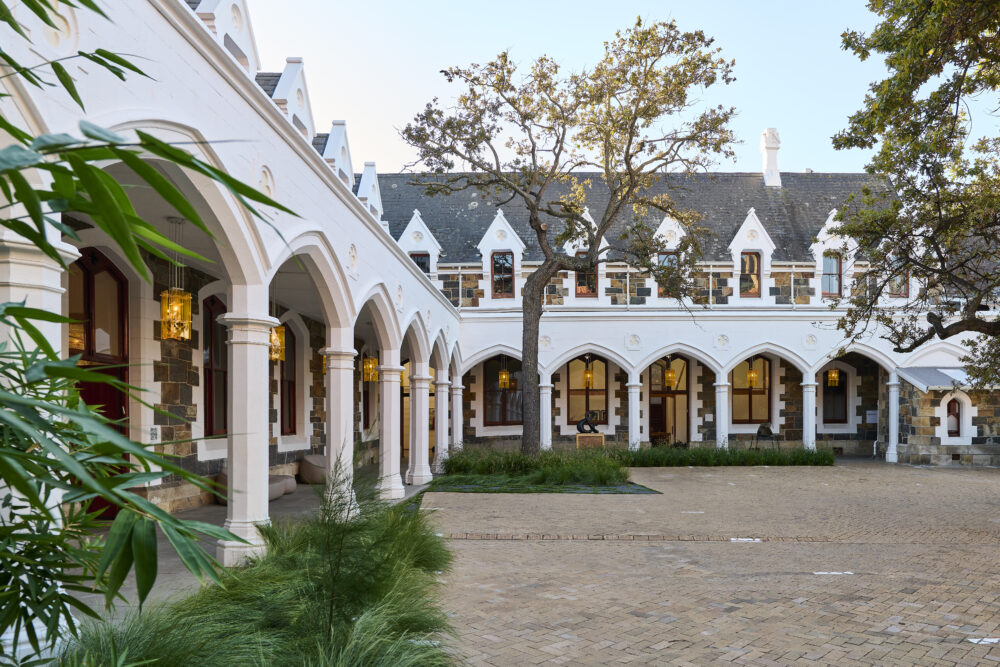 Shared narrative: The Goodman Gallery in Cape Town.
Today, Goodman Gallery operates across Johannesburg, Cape Town, London and New York. Its programme includes artists from across Africa and the wider Global South, alongside established international figures. The shift, however, was not simply about scale.
“It was about opening the conversations,” Essers says. “Allowing the space to open for broader conversations.”
The conversations have been structured, in part, through three long-running curatorial initiatives that shape the gallery’s programming.
The first, Working Title, functions as an incubator for emerging artists, offering a platform without necessarily folding them into the gallery’s commercial roster. It is, in many ways, an attempt to preserve something of the gallery’s earlier identity as a cultural institution rather than a purely market-driven entity.
“It’s a space for young artists to maybe have their first shows and to springboard them into the international art world,” Essers explains.
The results are visible in the trajectories of artists who have passed through the programme, some of whom have gone on to exhibit internationally, including at major biennales. The emphasis here is less on immediate return and more on long-term development; a slower, less predictable kind of investment.
If Working Title looks forward, the South South initiative looks laterally, connecting artists and ideas across regions that share postcolonial histories. “It’s been my life’s ambition to open the conversation of the Global South,” Essers says.
“Not just the South African art world or the Brazilian art world but to really think about the broader conversation around shared histories and narratives.”
The third initiative, In Context, turns inward, focusing on the dynamics of place. How identity, geography and history intersect. Previous exhibitions under this banner have explored themes of diaspora, belonging and race, often through collaborations that extend beyond a single location.
Together, the strands form the intellectual backbone of the gallery’s programme but they also reflect a broader tension that has defined Goodman’s evolution: how to expand globally without losing a sense
of grounding.
“I don’t know what an African perspective is per se,” Essers says. “But I think it’s a broader global majority perspective.”
That framing is deliberate. While Johannesburg remains the gallery’s base, its programme resists being confined to a single national identity. Instead, it situates itself within a network of artists and ideas that move across borders, shaped by shared conditions rather than fixed geographies. The expansion into international markets, including London in 2019 and New York in 2023, has been part of that strategy but it has not been without risk.
“It’s very risky, financially. But it felt important that we brought our artists into the main conversation of where art history is being written.”
That “main conversation” tends to be centred on Western institutions, a reality that continues to shape the global art market. For galleries based in the Global South, participation often requires a physical presence in those centres, even as they seek to challenge their dominance.
Goodman’s approach has been gradual, growing “as we’ve been able to self-grow”, as Essers puts it, rather than through rapid expansion.
If the gallery’s outward growth has been measured, its internal relationships have been notably enduring. Alongside newer names, it maintains long-standing ties with artists such as William Kentridge and Sue Williamson, as well as the estates of figures like David Koloane and David Goldblatt.
“They really are partnerships,” Essers says. “Long-term relationships and friendships.”
Sustaining the relationships involves building careers over time, connecting artists with curators, institutions and collectors, ensuring that their work enters public collections and critical discourse.
“It takes a big team, a lot of effort from the gallery to push those careers forward,” she says.
That work, largely invisible to the public, is what underpins the gallery’s presence in major exhibitions and museum shows across the world. At any given moment, multiple Goodman artists are exhibiting internationally, a reflection of both the gallery’s reach and its network.
Yet the gallery’s role is not only to promote artists but to hold a certain kind of space. One that has, at times, placed it in tension with political and social pressures. In 2012, Goodman Gallery resisted calls to censor an exhibition, a moment that Essers frames less as a dramatic stand and more as an application of principle.
“We do not believe in censorship,” she says. “Freedom of expression is fundamental to our constitution and for a democracy.”
The position extends to the artists. Whether engaging with political issues directly or indirectly, they are afforded the autonomy to take their own stances, even when the positions are contested. “The gallery is not a political platform,” Essers notes. “But we provide the space for many different perspectives.”
This distinction, between platform and position, is central to how Goodman navigates its role in relation to social change. Rather than advocating a singular viewpoint, it facilitates dialogue through exhibitions, talks and collaborations.
Over the years, that has included conversations on topics ranging from migration and identity to environmental concerns and public health.
Parallel to this, the gallery and its artists have supported various social initiatives, including healthcare projects and infrastructure development in underserved communities.
The efforts, while not always visible within the gallery walls, form part of a broader understanding of what it means to operate as a cultural institution in South Africa.
As Goodman approaches its 60th anniversary, the multiple threads including historical, commercial and cultural are being drawn together through a series of projects that look both backward and forward.
An archival timeline, set to launch this year, will map key moments in the gallery’s history, offering a way to navigate six decades of exhibitions, collaborations and milestones.
A new digital platform reflects a shift in how audiences engage
with art.
“The art world has shifted significantly,” Essers says. “People are consuming things very quickly, online.”
The challenge, she suggests, is to create digital spaces that retain some of the depth and immersion of physical exhibitions. To “bring back the space to imagine and the space to think” even through a screen.
At the centre of the anniversary programme will be a major exhibition later in the year, spanning the gallery’s various locations. Details are limited for now but Essers describes its guiding idea simply: A gathering. “It’s about coming together,” she says. “Shared voices, shared perspectives.”
It’s a modest description for what is, in effect, a summation of the gallery’s trajectory from a single space in apartheid-era Johannesburg to a networked institution operating across continents. And yet, for all the expansion, the core ambition remains relatively unchanged.
“I hope that we will continue to be a site of assembly, a catalyst, a collaborator,” Essers says. “A socially conscious platform.”
In a cultural landscape increasingly shaped by speed, scale and visibility, that kind of continuity can be difficult to maintain. Institutions evolve, markets shift, audiences change. What remains are the choices made along the way about what to show, who to support, when to speak and when to hold space.
Sixty years in, Goodman Gallery’s history is not a single narrative but a collection of these decisions, layered over time. Some were shaped by circumstance, others by conviction. Together, they form a record not only of an institution but of the contexts in which it has operated. And the conversations it has chosen to enter.
The anniversary, then, is less a conclusion than a pause. A moment to look back, to take stock and to consider what it means to continue.