Fighting fire: Wildfire response in South Africa remains heavily dependent on state resources and a limited volunteer base. Photos: Supplied
South Africa’s 2025 fire season should give us a reason to pause. Not because it is unprecedented but because it is increasingly familiar.
More than 90 000 hectares have burned across the Western Cape since November. In both the Eastern and Western Cape, wildfires in the Kouga and Overberg municipalities have led to evacuations, road closures and major emergency responses.
Fires have run simultaneously through the Cederberg, Overstrand, Overberg, Franschhoek and Mossel Bay, stretching fire services across difficult terrain and difficult weather. Homes have been destroyed. Communities displaced. Crews have worked for weeks without respite.
This was not an isolated season. It reflects a pattern already evident in recent years.
The conditions that drove these fires are no longer exceptional. High temperatures, prolonged dry spells and strong winds are now recurring features of South African summers.
Combined with heavy fuel loads, the spread of invasive alien vegetation and expanding settlement into fire-prone areas, fires are burning faster and with greater intensity. Authorities estimate that most fires this season were started by people, through negligence or intent.
Climate change did not ignite the fires but it shaped the conditions under which they spread.
The National Disaster Management Centre has classified severe weather and its environmental impacts as a national disaster. Although the declaration focuses largely on flooding, its implications are wider. It reflects recognition that extreme weather events are increasingly systemic, with cascading effects.
Fires, floods and storms are no longer discrete hazards. The Western Cape government’s proposal to declare the current fires a provincial disaster underscores this convergence of risk.
South Africa’s approach to wildfire management has not adjusted at the same pace.
Wildfires were historically treated as events largely confined to rural or conservation areas. While losses were often severe, they were distant from towns and cities. The 2017 Knysna fires challenged that assumption but they were widely treated as an exception rather than as a structural shift.
The current season suggests otherwise. Fires are now pushing into the wildland-urban interface, where residential areas sit alongside dense, flammable vegetation. Many of these settlements lack defensible space, evacuation planning or infrastructure designed to withstand wildfire conditions. Wildfire risk is no longer a predominantly rural concern. It has become an urban one.
International experience offers a clear parallel. Fires in Canada, California, southern Europe, Australia and Chile have increasingly moved into suburbs and peri-urban areas. In 2023, Canada evacuated approximately 330 000 people during its worst fire season on record.
South Africa is now seeing similar dynamics, shaped by local land-use patterns and vegetation but driven by the same underlying climatic pressures. Fuel load remains one of the most significant and least consistently addressed risk factors. Invasive alien vegetation burns hotter and faster than indigenous species, generating intense heat and wind-driven embers that place homes well ahead of the fire front at risk.
Clearing programmes in many high-risk areas have been underfunded, inconsistently implemented or allowed to lapse. Fuel has accumulated over years.
The measures required to reduce this risk are well established. Prescribed burning, mechanical clearing and the maintenance of firebreaks form part of standard integrated fire management practice. What has been lacking is sustained implementation.
Prevention rarely attracts attention or immediate political reward. Its success is measured in events that do not occur. As a result, it is often deprioritised until after losses have already been incurred.
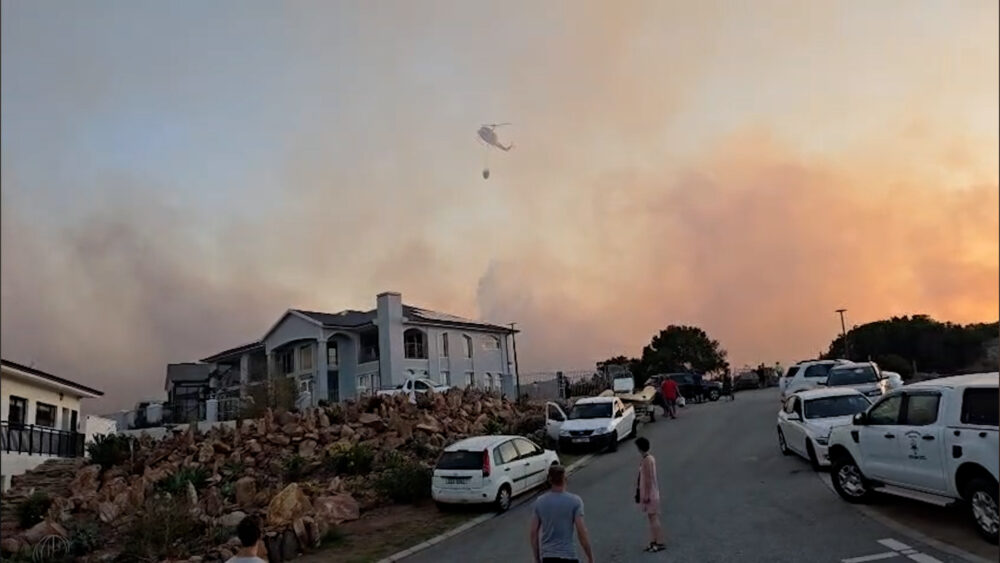
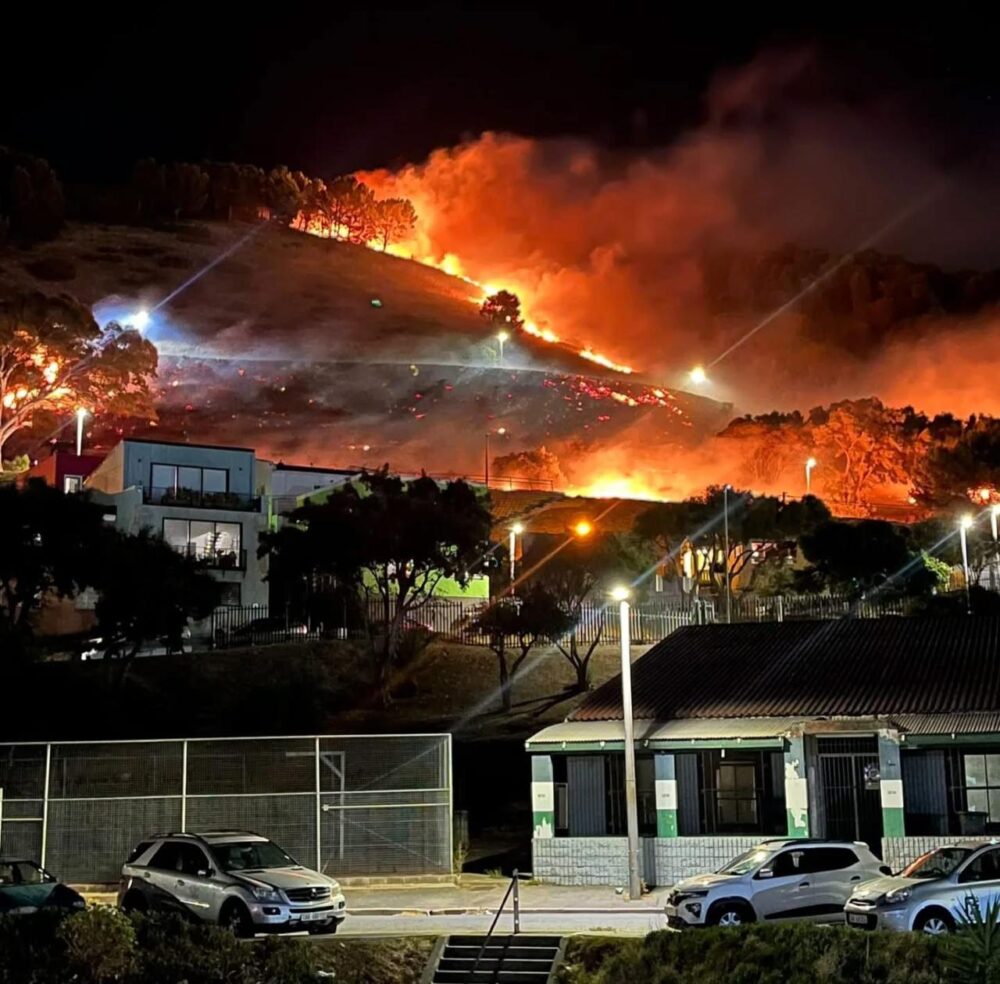 Outpaced: Fires have run simultaneously through the Cederberg, Overstrand, Overberg, Franschhoek and Mossel Bay since November, stretching
fire services across difficult terrain and difficult weather.
Some progress has been made. The Western Cape has, over several fire seasons, invested in improving inter-agency coordination, joint planning and on-scene command during large incidents. These efforts have reduced operational friction during complex fires and demonstrate the value of coherent coordination. They also highlight the unevenness of preparedness across provinces.
South Africa has largely adopted the Incident Command System for managing large wildfires. This provides an important foundation for managing complex emergencies.
However, recent fires have, in some cases, exposed limitations in how ICS is applied in practice, particularly during prolonged incidents and when fires cross municipal and provincial boundaries.
Weaknesses in interoperability, escalation and unified command increase operational risk as fire seasons lengthen and multiple incidents occur simultaneously. Strengthening ICS through consistent application, improved resourcing, regular multi-agency exercises and stronger national integration is necessary if coordination is to keep pace with changing fire behaviour.
This season has also revealed broader structural gaps. Urban fire services are not always fully integrated into wildfire planning. Aerial resources are often discussed during emergencies rather than planned and funded as part of long-term capacity.
Early-warning systems and fire danger indices exist but their reach and practical impact vary.
Current SAWS FDIs do not account for vegetation density, type or dryness, i.e. flammability, in a given area.
Communities are increasingly exposed to wildfire risk. Preparedness cannot be limited to emergency warnings and evacuations issued under pressure. It requires sustained public engagement on developing defensible spaces around houses, household-level risk reduction, evacuation routes and decision-making thresholds. Unclear or inconsistent guidance during evacuations carries serious consequences.
Wildfire response remains heavily dependent on state resources and a limited volunteer base. Internationally, disaster fires are increasingly addressed through an “all-of-society approach” that includes the private sector. Expanding private-sector participation in prevention, preparedness and response is becoming increasingly important as risks escalate.
What remains largely absent from public debate is a sustained focus on prevention as disaster-risk reduction. Fires are still treated primarily as emergencies rather than as foreseeable outcomes of land-use decisions, vegetation management and climatic trends. The national disaster classification points toward a more preventive approach, but this has yet to be fully reflected in policy and practice.
Internationally, wildfires are now understood as a core climate-adaptation issue, alongside floods and heatwaves. South Africa’s experience places it firmly within this global context.
Domestically, responsibilities remain fragmented across spheres of government. Land-use planning often proceeds with limited consideration of fire risk. Invasive vegetation management lacks consistent funding and enforcement, particularly on private land. These gaps are evident each time suppression efforts are outpaced.
In 2024, 33 people died in wildfires in South Africa. Treating such losses as inevitable reflects a growing normalisation of risk. Climate projections point to longer fire seasons and more extreme conditions. Without structural change, the question is no longer whether fires will threaten towns and suburbs but how frequently.
Fire will remain part of South Africa’s landscape. Whether it continues to escalate into a recurring national disaster will depend on decisions taken now.
Trevor Abrahams is managing director of Working on Fire.