The River Club precinct in Observatory, Cape Town may be “privately owned” but the history it holds belongs to humanity and to the Khoi and San people, who once inhabited the area for thousands of years.
(David Harrison/M&G)
The battle over the controversial multibillion-rand River Club mixed-use redevelopment in Cape Town, which has American multinational technology company Amazon as its anchor tenant, is heading for court, opponents say.
The R4.5-billion project includes residential units, office and retail space, a hotel, gym, restaurants, conferencing, schools and event space.
Last week, the City of Cape Town approved the upmarket development proposed by the Liesbeek Leisure Properties Trust (LLPT), describing it as a “significant boost” to the city’s economy and sustainable development that “balances ecological conservation and urban development”.
But Leslie London, the chairperson of the Observatory Civic Association, said the site, which already has a golf course, pub, golf shop and conference venue and is owned by the LLPT, is considered spiritually significant by the Khoikhoi as a site of first resistance to settler domination, and is environmentally sensitive, but that this was being “ignored” by authorities.
“It needs to be restored in a way that recognises its significance — historical, environmental and spiritual significance,” he said. “The current development simply imposes a huge, massive mega-development and then retrofits various plans to make it possible to build on the floodplain.”
The association is raising funds to take legal action against the project’s approvals. Over the years, it has partnered with more than 60 organisations, including local residents, civic and nongovernmental organisations and Khoikhoi groups, to fight the River Club redevelopment.
The association said this will enable planning for proper measures to rehabilitate the course of the historic Liesbeek River “and prevent it from being filled in to allow an artificial river to be created in its place”.
“It will enable us to stop the placement of 150 000m2 of concrete on a 14.7-hectare site that will reduce our resilience in the face of climate change,” said London.
The LLPT said several hydrology and climate experts have confirmed the redevelopment will not be significantly affected by flooding, “nor will it have any effect on the city’s resilience in the face of extreme hydrological events or climate change”.
Several parties had appealed the rezoning (11 appeals) and the environmental authorisation (22 appeals), among which Heritage Western Cape, which had described the project as “unlawful”, and the city’s own environmental management department. But in February, the Western Cape minister for environmental affairs and development planning dismissed the appeals against the environmental authorisation issued in August 2020.
The environment department stated that filling in the Liesbeek River compromises its potential for groundwater recharge when it rains, including the Cape Flats aquifer, which is not in line with the climate resilience principles for water security.
“Filling in a major water body is also not in line with best-practice water-sensitive spatial planning principles. Infilling the river (and converting it to a landscaped stormwater swale) is strongly opposed because this is one of the city’s high faunal sensitivity biodiversity conservation areas that has to be conserved and managed as such in perpetuity,” said the department, and would compromise the functionality of the Raapenberg wetlands and associated fauna.
London has sent two letters to Amazon chief executive Jeff Bezos urging him to reconsider Amazon’s involvement in the “environmentally destructive” project that prioritises “greed over the protection of heritage”, but has received no response.
The city of Cape Town said it would be highly beneficial to the local economy to have a corporate entity of Amazon’s profile headquartered in Cape Town. “Furthermore, as global interconnectivity improves, so does competitiveness for the African market.”
The city said it envisaged that 5 239 jobs would be created in the construction phase, with the project creating up to 19 000 indirect and induced jobs (those generated by local spending on goods and services by employees).
“One of the overarching goals of the city’s municipal spatial development framework is sustainable development that balances ecological conservation and urban development,” said the city. “This imminent development strikes that balance, with a combination of well-located residential and commercial opportunities, the rehabilitation of the degraded riverine corridor, improved links with surrounding ecological resources such as the Raapenberg wetland and the establishment of a high-quality green space that will be accessible to the public.”
But London said the project is opposed by Khoikhoi groups “for whom the areas should be a provincial if not national heritage resource, and is slated for inclusion in the National Khoisan Liberation trail and potentially on the list to be a Unesco heritage site”.
Jody Aufrichtig, the spokesperson for the LLPT, said it was proud that the redevelopment could contribute to improving Capetonians’ quality of life and ability to “sustainably live, work and play in our beautiful city together”. The LLPT, he said, had “engaged” extensively and openly with various organisations, including those for and against the redevelopment, over many years.
“The LLPT has transparently met and in many instances exceeded the requirements of all relevant legislation and policies. The final appeal authorities in both the province and the city have confirmed this,” he said.
“We are proud to be incorporating developer-subsidised inclusive housing in close proximity to economic opportunities as part of our private development. We have also consulted closely with the First Nations Collective who have given their vociferous support for the project and its celebration of First Nations heritage for the first time in Cape Town.”
There is extensive pollution, environmental and ecological degradation on the privately owned River Club site, Aufrichtig said.
“As part of the redevelopment, vast cleaning and rehabilitation projects will be undertaken at the developer’s cost to restore this important natural resource so that it can be enjoyed by the public and, more importantly, by endemic species.”
The city said the development would honour Khoikhoi heritage through an indigenous garden, a heritage eco-trail, a garden amphitheatre for use by the First Nations and public, symbols central to the First Nations narrative, naming of internal roads inspired by the First Nations narrative and a cultural, heritage and media centre for the First Nations and the public.
In December, the First Nations Collective described this as a significant victory. “[T]he reclaiming of a space for memory, cultural practice, communications and the showcasing of the best of talent in an area — rich in heritage — from which their forebears were forcefully dispossessed by a colonial authority 400 years ago. This space, which indigenous leaders have christened as a liberated territory, will be located right in the centre of the River Club project.”
But Tauriq Jenkins, the supreme high commissioner for the Goringhaicona Khoi Khoin Traditional Indigenous Council, under Paramount Chief Aran, in its appeal against the environmental authorisation said the Liesbeek valley became an occupied territory in 1659.
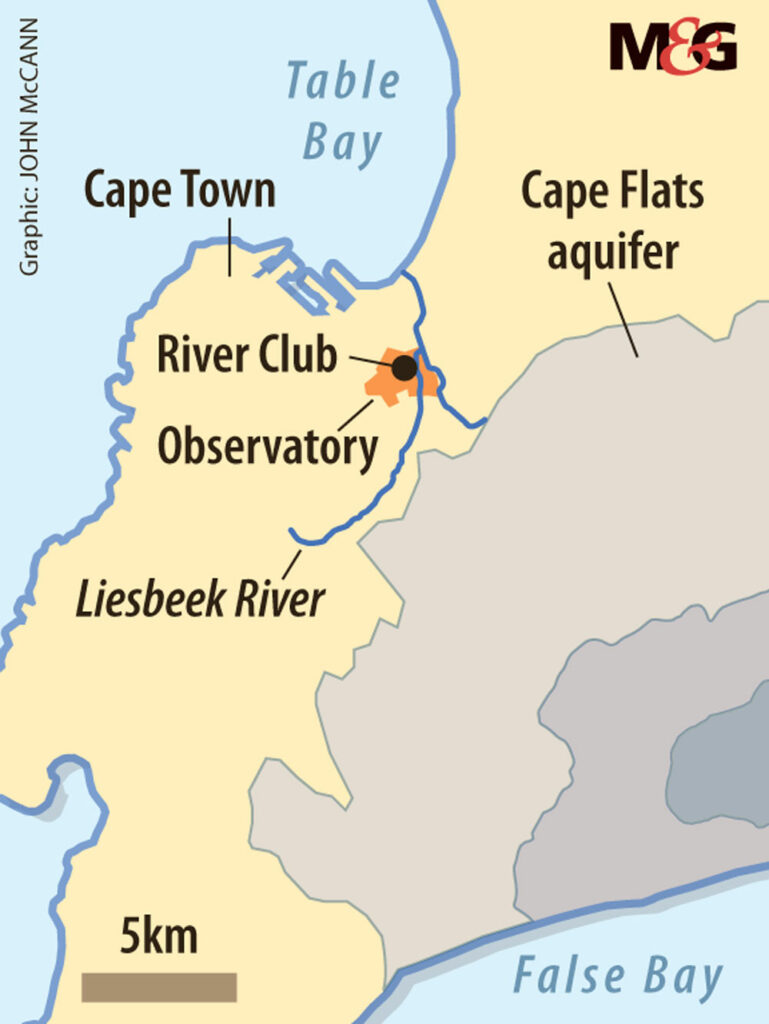 (John McCann/M&G)
“Just as in 1510 when we overcame D’Almeida, we now line by the riverbanks once more in readiness to defend against another threat to our motherland. Another threat to our rivers and another to our sense of place. No concrete block will ever serve as our manumission,” he said.
“Hotels and high-end apartments do not emancipate us from economic slavery but reimpose black labour stuck in an apartheid syndrome of workmanship that serves a capricious master of luxury and holiday-making. Not here. This is a place of deep spiritual meaning and of revolution … It is where colonial conquest began. And where it was defeated. Ours is a heritage site, not the proposed individualised dream of a privatised Idaho with gyms and waterworks.”
Jenkins said it was “poison to our sacred confluence, poison to our fish, bird life and animals, poison to the soul of this space. We say no to the concrete on the floodplain, to infill of the river, to the loss of memory to a mall with hotels. We will not bid the kingfisher farewell.”
[/membership]