Red tape and poor performance have stumped a number of South African companies looking to enter the potentially lucrative market in Nigeria, Africa’s biggest economy. Retailers Woolworths and Mr Price, hotel group Sun International and, most recently, Shoprite, have all thrown in the towel.
Others have persisted and reaped the rewards, including MultiChoice, which, according to the JSE-listed pay-TV group, has contributed about R22.5-billion to the Nigerian economy since launching the first digital satellite broadcasting service in 1993.
The DStv parent company’s foothold in Nigeria serves it well. The West African country contributes to the 11.4-million MultiChoice subscribers outside of South Africa. Market research forecasts that, by 2025, Nigeria will overtake South Africa in pay-TV subscribers, contributing close to 11-million on its own. For the year ending March 2021, the group raked in R8.8-billion in profit, a more than 35% increase compared to the year before.
But last week, Nigeria’s regulators reared their heads again, this time accusing MultiChoice of owing R63-billion in taxes.
Red tape, black gold
Nigeria’s Federal Inland Revenue Service (FIRS) said on Thursday last week it had asked some banks to freeze accounts belonging to MultiChoice. By its own account, the group is one of the largest taxpayers in Africa, having paid direct cash taxes of R4.1-billion.
MultiChoice denied the allegation in a note to shareholders, saying it had not received formal notification of the matter.
“The matter is apparently based on unfounded allegations that MultiChoice Nigeria have not fully disclosed all existing subscribers to authorities,” the company said. “We have engaged openly with FIRS … We believe that this matter will be amicably resolved.”
Its shares tumbled close to 8% that day.
A far worse decline was suffered by MTN shareholders in August 2018, after the Central Bank of Nigeria ordered it to repay about R119-billion because it had not got permission to repatriate funds between 2007 and 2015. MTN’s shares crashed 19.4%.
Abuja-based economist Adedeji Adeniran said Nigeria’s regulatory crackdowns were not unique to South African companies, and were part of the government’s plans to mobilise revenue outside the dominant oil sector.
Petroleum represents more than 80% of Nigeria’s total exports revenue. Recent volatility in the oil industry, triggered by the sudden fall in global demand caused by Covid-related lockdowns, has had huge implications for the country, Adeniran said.
“We need to change the strategy in terms of building alternative channels for government revenues,” he said. “We can’t depend on one source that is so unpredictable.”
Oil’s dominance also reduces the incentive to risk investment in non-oil sectors, Adeniran added. “We have seen this oil dependence affecting almost every sector of the economy … So what governments have done over the last 10 years is to try and change that.”
Tit-for-tat
On top of fiscal pressures, fraught business relations may have coloured the way Nigerian regulators deal with South African companies. “MTN had issues. We had Shoprite and now we have MultiChoice,” Adeniran said. “And there has been a kind of tit-for-tat over the past years.”
Souring diplomatic relations left Shoprite facing a public backlash in Nigeria. In 2019, in the wake of xenophobic violence in South Africa, the grocer’s stores in Nigeria’s commercial hub, Lagos, and the capital, Abuja, had to close amid attacks.
At the end of last year, Shoprite exited the market, citing operation-knocking Covid-19 restrictions and currency-induced inflation surges.
Adeniran noted that in 1999 the two countries established the Nigeria-South Africa Bi-National Commission to strengthen bilateral political, economic and trade relations.
“The first meeting of that commission was held in 2012, which just shows that the political will for something like that is lacking,” he said.
South African economist Nomahlubi Jakuja agreed there has been little political will from both Nigeria and South Africa, two of the biggest economies on the continent, when it comes to building strong business relations.
“Nigeria and South Africa have always competed instead of working together,” she said. “It has always been about competition rather than collaboration.”
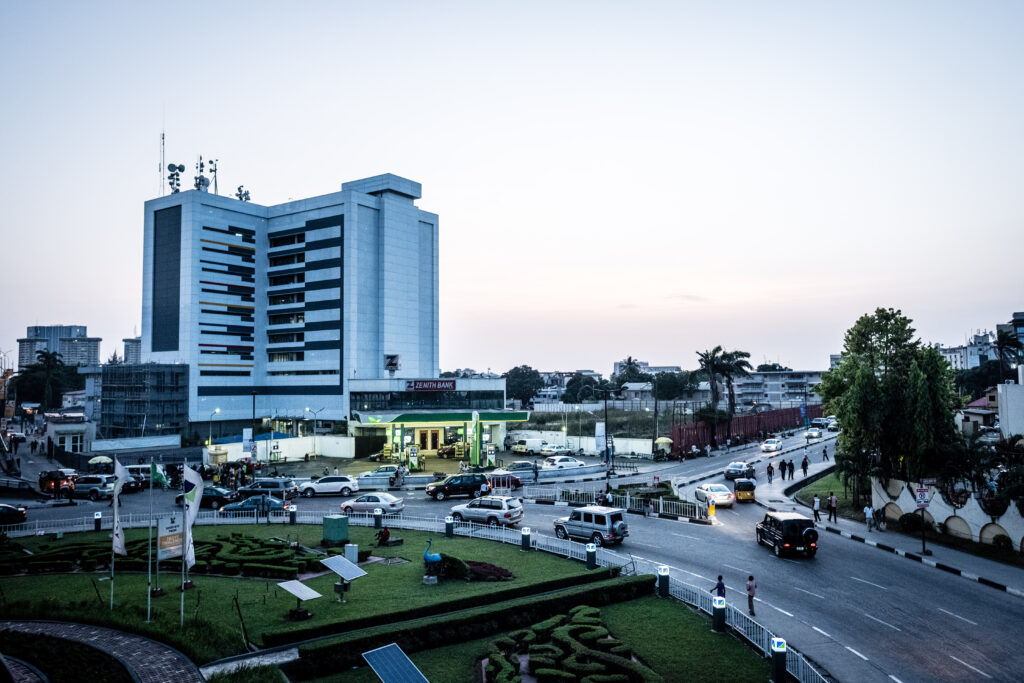 The MTN Group Ltd. Nigeria headquarters office stands at Golden Plaza in Lagos, Nigeria, on Monday, Nov. 13, 2017. MTN is focused on laying the groundwork for an initial public offering of its Nigerian business and should complete the process in the next six months, Chief Executive Officer Rob Shuter said. Photographer: Tom Saater/Bloomberg via Getty Images
‘Kings of the castle’
Jakuja noted that South African businesses are, for the most part, insulated from the type of market dynamics alive in Nigeria.
“There is high inflation in Nigeria. There is currency volatility, which makes planning and creating certainty within the business environment very difficult,” she said.
“And then on top of that, you have to deal with the governments that will slap you with fines to get more money out of you.”
South African investor and trader Simon Brown said South African companies fail to adapt to the business environment in Nigeria.
“A CEO [chief executive] sits here in South Africa with a very successful business. And they kind of see themselves as the king of the castle. They think they sort of know it all … They kind of assume because they have done well in South Africa, they can do well anywhere else,” he said.
South African companies “assume that the market and the culture and the red tape will be very similar and that they can easily work their way through it. They forget that it has taken their entire career to master the South African market.”
Brown was doubtful that strained bilateral relations between the two African giants had had a major effect on South African companies failing to perform in Nigeria.
“Companies pretty much have to stand and operate on their own two feet and adhere to the regulations in the markets that they operate.”
[/membership]