Premier Alan Winde called for the investigation after a court judgment indicated senior police officer had worked with members of the 28 gang. (David Harrison/M&G)
Three-year-old Andrea Jordaan was shot dead while playing outside her home in Belhar on the Cape Flats on 6 July. Three people opened fire on the house in a drive-by shooting in what appears to have been a retaliatory attack.
“My uncle is part of a bende [gang],” says Rushka Hassen, Andrea’s mother.
The uncle is a 26s gang member who was released from prison three months ago and was living with Hassen’s family.
Hassen says that on 5 July the 26s shot a member of the 28s gang, who struck back the next day. An adult and a child were injured.
In June last year, seven-year-old Taufiq Johnson was sleeping in his home on Red River Street in Manenberg when 29 shots were fired at the Wendy house in the garden. Taufiq took a bullet in his back, but later recovered, his mother Shafieka Johnson said. The attack was apparently a case of mistaken identity.
Not everyone is as fortunate as young Taufiq.
Recent infighting between members of the American gang in Manenberg resulted in dozens of deaths. According to one gang member, the fight is a drug turf one. Multiple people at the local taxi rank confirmed this, but did not want to elaborate.
According to recent crime statistics, 904 people were murdered in the Western Cape between January and March. Of the top 10 murder locations in the country, six are in the province. Khayelitsha is in fourth place with 61 murders, followed by Mfuleni, Kraaifontein, Delft, Nyanga, and Gugulethu.
Murders have rocked the Cape Flats. On 15 May, 11 people were gunned down in Khayelitsha and, on 23 June, seven were killed in Gugulethu. These shootings are related to extortion rackets.
“The manifestation of gangs in the townships has been mainly that of extortion, with the Somali people having to pay protection fees,” says Khayelitsha Development Forum chairperson Ndithini Tyhido.
Because Somalis face language barriers and most of them are undocumented, gangs have become their only source of security because they cannot report crime to the police.
“In 2008, after sporadic xenophobic attacks, the Somalians needed to build relationships in the community to protect them. It was thought it would go away. But now it has developed into a fully fledged criminal operation,” says Tyhido.
“What happens now is the territory becomes smaller, while gangs want to expand, then that’s where you find intra-gang violence, where these mass killings come about.”
Despite the Guptas and Boko Haram gangs dominating primary extortion areas in townships like Khayelitsha, Gugulethu, Nyanga and Philippi, smaller gangs have emerged to claim their share.
Their extortion extends beyond the Somalis and spaza shops to other businesses and residents. This control, says Tyhido, includes shopping centres, corner barber shops, informal fruit and vegetable traders, backyard dwellings, households and early childhood development centres to the type of hairstyles women choose or the sneakers men wear.
Victims of crime: Rushka Hassen (right), mourns the loss of her three-year-old daughter Andrea (left), who was shot in gang-related violence three weeks ago. (David Harrison/M&G)
The rampant extortion rackets are part of a “corrupt evil system” that includes religious leaders, councillors, police and syndicates, a resident, who has lived in Khayelitsha since 1985, told the Mail & Guardian on condition of anonymity.
Residents are mere pawns in this system, the resident said, referring to illegal land invasions in townships.
“The first thing you will see when people grab land is a Somali shop and a church. The plan has been designed of who will be in charge of that territory.”
Are police the solution?
Not so, says the resident, calling this suggestion “a joke”.
“I know for a fact that there are policemen that are working with these guys, supplying them with information and weapons.”
Tyhido says the Khayelitsha Development Forum works with the police.
“Up to this point we’ve been working really well with SAPS [South African Police Service]. Remember, these types of crime are intelligence-driven. But we cannot downplay the issue of policing resources in the Western Cape,” he says, referring to cameras and patrolling vehicles.
“Rotten apples in the police service are a damper for the community’s confidence in the police. The majority of [police] men and women really value their work. But also, there are those moronic officers who do not value human life.”
In response to alleged police corruption, the police service’s provincial spokesperson, André Traut, said: “Our strong stance against corruption among police ranks is the counter for any threat that it may pose to fight gangsterism in this province. Police officers on the wrong side of the law are dealt with.”
Phindile George, the secretary of the Khayelitsha Site B community policing forum, argues that extortion will only be defeated if people start reporting cases to the police and tangible information is received, “so this is a work in progress to build community trust”.
One way to rebuild trust is to work with shop owners, and have joint meetings with residents, the police and the community policing forum,” says George, adding, “The problem is very deep, there is a strong underground network that has been built over time and people are scared to even talk to SAPS.”
The Anti-Gang Unit (AGU) of just under 200 police officers, established in 2018, aims to dislodge and disable gangs in identified neighbourhoods.
“That includes the disabling of the illicit economy and criminal governance of gangs, as well as drug and firearm supply lines,” the AGU’s head, André Lincoln, told parliament in late March.
He said the four “operational concepts” implemented in addressing gang violence were intelligence, visible policing, detection and community mobilisation.
Asked whether police interventions on addressing gang violence had changed over the past 10 years, Lincoln told the M&G that the National Anti-Gangsterism Strategy had been introduced in 2016, incorporating human development, social partnerships, spatial design and the criminal justice process.
For Tyhido, the solution to gang violence includes a societal approach.
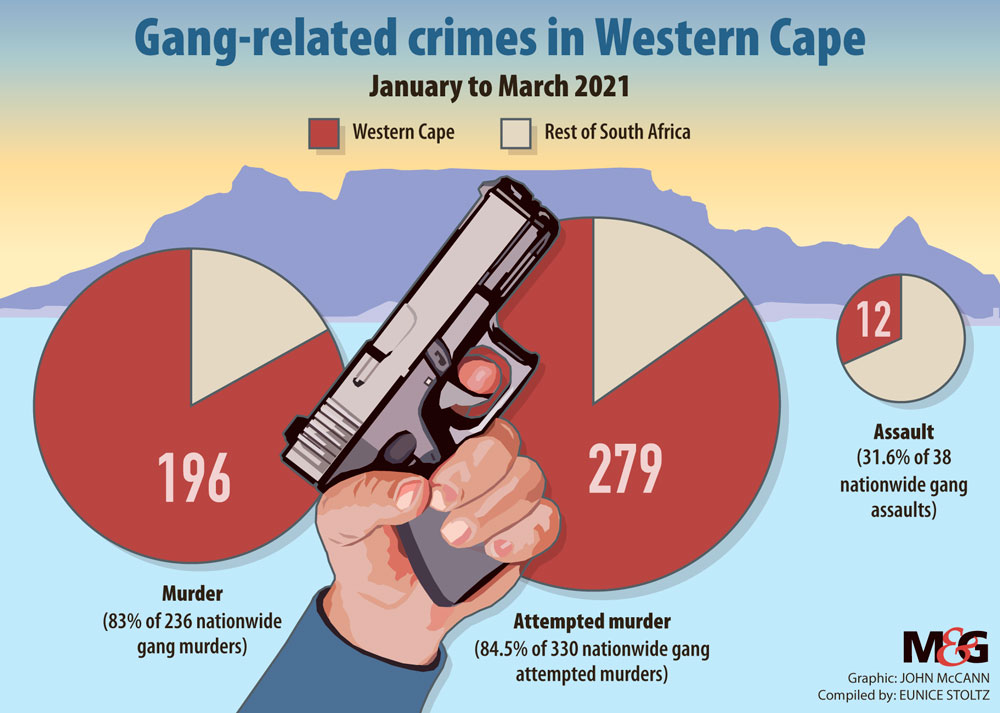 (John McCann/M&G)
“Township boys need to be diverted away from a life of crime to something positive and fresh. As the KDF [Khayelitsha Development Forum], we believe we need a township development or socioeconomic development programme that is practically implementable,” he said.
The resident, who is active in projects to empower the youth, says the best time to start the journey with young people is when they are still in primary school or, at the latest, in grade eight in high school.
“If there’s no one mentoring them, we might just lose them, you know, we might just lose them within this corrupt evil system,” the resident says.
[/membership]