At risk: South Africa, home to the world’s largest population of rhino, is critical to the conservation of this species, which are targeted by poachers. (Gianluigi Guercia/AFP/Getty Images)
Plans to end canned lion hunting and the sale of lion bones from captive lions is a new draft policy position on the management of South Africa’s iconic wildlife species.
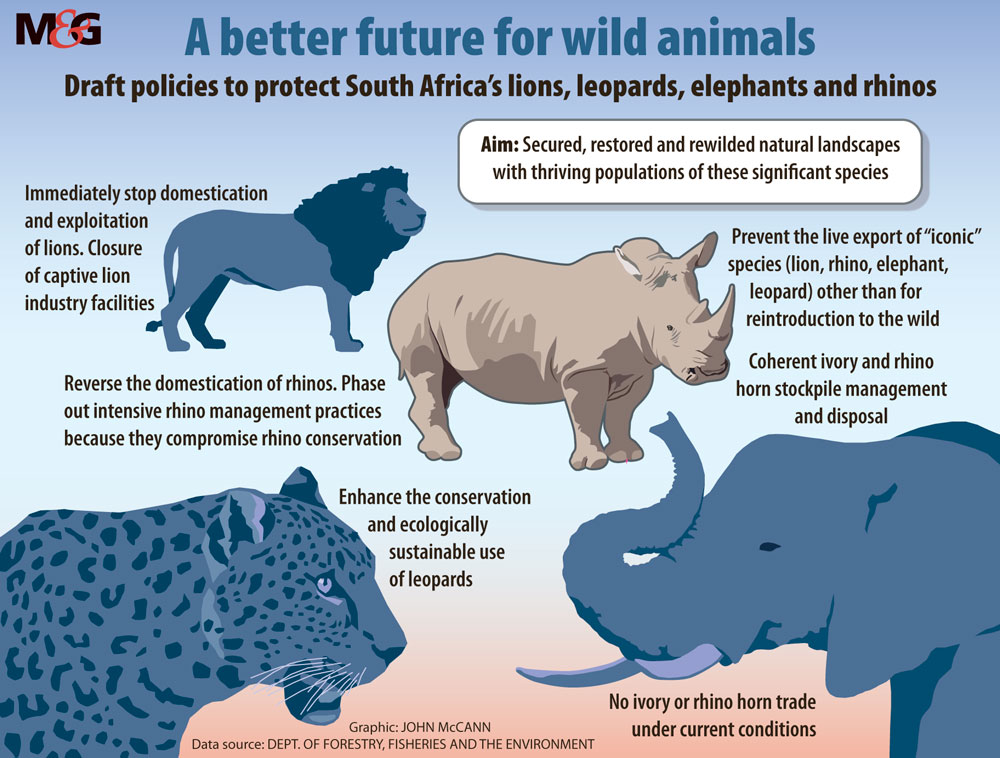
The draft, released last month by Forestry, Fisheries and Environment Minister Barbara Creecy, on the conservation and sustainable use of lion, leopard, rhino and elephant outlaws the domestication of lions and plans to shut down captive-lion facilities.
The draft notes the international sale of rhino horn and ivory won’t be backed “as long as current specified circumstances prevail”.
It also details how the intense farming of rhino will be reversed, while the “conservation and sustainable use of leopard will be enhanced”.
Leopards are free-roaming outside protected areas, and are critical to ecosystems as apex predators. They are also “an important component of international hunting packages, making such packages internationally competitive,” according to the draft.
There is widespread illegal killing of leopards as “damage-causing animals” with no incentives for landowners to protect the species, which have religious and cultural significance.
Bool Smuts, the director of the Landmark Foundation, an NGO focused on leopard and predator conservation, says the “persistent objective to continue hunting leopards” has been ignored in the “brouhaha” over the captive lion issue.
“It’s been demonstrated over and over in science that the species [leopard] is on a persistent and continued decline,” he said, adding that the state has no control over the situation regarding hunting, joyride hunting and alleged damage-causing animal management.
“We’re talking about populations of somewhere between 3 500 and 6 000 individual adult animals left in the entire country, which they want to go and trophy hunt,” says Smuts.
“Everyone wants to stand on the podium and brag about the captive lion [decision] but they [captive lions] play zero role in conservation.
“They’re taking their eye off the real conservation issue: free ranging, wide ranging leopards being hunted because the government is obsessed with commodifying these animals.”
The draft policy — public comments on which closed this week — on the conservation and sustainable use of elephant, lion, leopard and rhino flows from a recent high level panel report on the management, breeding, hunting and trade of lion, leopard, rhino and elephant.
It is geared to achieve “secured, restored and rewilded natural landscapes with thriving populations” of the Big Five as “indicators for a vibrant, responsible, inclusive, transformed and sustainable” wildlife sector, according to the draft.
It says that despite South Africa’s reputation as a global leader in conservation, there are still reported incidents and perceptions of irresponsible, unethical and unsustainable conservation practices with these species, especially in terms of animal welfare, according to the draft.
This negatively affects the country’s conservation reputation and “does not bode well for the country’s international standing and development objectives”.
Captive lions a threat
The draft says commercial lion business involving intensive and selective breeding, handling, canned hunting and bone and other derivative trade, threatens the country’s reputation “with associated political and economic risks”.
This includes the negative effect on the market for photo-tourism, hunting industry and tourism.
“The captive-lion industry does not represent ecologically sustainable use, providing very little economic activity or jobs. There are major concerns over work conditions and safety of workers and tourists, and zoonotic risks,” the document says.
The industry does not contribute meaningfully to transformation, nor to the conservation of wild lions, while the trade in lion parts “poses major risks to wild lion populations and to stimulating illegal trade”.
Maryn Goldblatt, chief executive of the South African Predators Association, said: “Just remember, our industry brings in capital from our lions and everything that will go with it, not just the jobs of the guys working on the farms, but what about the community around these farms? They all benefit.
“We legally bred these lions with permits from the government and we, the breeders, are the ones that are protecting the lions.”
Rhino reservations
The draft noted that although privately-owned rhino captive breeding operations have conservation value and are suitable potential sources for replenishing depleted wild populations, the sustained use of intensive management practices compromises this. “It is desirable to move them out of deemed captive breeding situations and back into accepted wild managed or wild conditions as soon as practically possible.”
The pro-trade Private Rhino Owners Association has argued that there are now no incentives for private reserves, home to 55% of the national herd, to continue with their rhino conservation efforts.
Although international trade in legal rhino horn and elephant ivory could provide a substantial income to support conservation and security costs, it is not feasible in the near future because of constraints by Cites (the Convention on International Trade in Endangered Species), “who are unlikely to pass a trade proposal”, says the draft.
There are also “legitimate concerns” regarding laundering illegally obtained ivory and increased involvement of organised criminal syndicates.
Dr Jo Shaw, the senior manager of the wildlife programme at the World Wildlife Fund (WWF) South Africa, says South Africa remains at a critical point for rhino conservation because it houses most of the world’s remaining populations.
“The ongoing poaching pressure from these embedded organised crime networks remains probably the single biggest challenge and has really increased the costs and risks of conserving rhinos.
“This policy process has been important in that it clarifies that legal trade in rhino horn is not going to be a quick fix for rhino conservation.”
 (John McCann/M&G)
Better deal for wildlife
Wildlife rehabilitation expert Karen Trendler says: “It’s a very exciting and progressive policy and is fully supported broadly but there are obviously some elements there are concerns with,” adding this includes expanding the country as a trophy hunting destination for its iconic wildlife species.
“The inclusion of welfare and well-being, the fact that it’s now recognised as being a critical component of conservation management, and the intention to take the one welfare approach — the interconnectedness between animal, human health and well-being and biodiversity — is so exciting and also this move to wildness, away from intensification and commodification, is fantastic,” she says.
The draft signals a new approach. “But there are huge hurdles ahead in terms of getting the policy accepted and the regulations in place, taking into account there are such an array of opinions and there will be legal challenges but it’s a start,” Trendler says. “We’ve shifted quite substantially to a better deal for wildlife.”
The WWF’s Shaw says the high level panel process outlines a substantive review of sustainability, including addressing welfare and well-being of the animals.
“Then, critically for conservation, needing to look beyond individuals to populations and promoting wildness or rather these extensive wildlife systems in conservation practice … with these iconic species playing their role in functioning ecosystems.”
Achieving the draft policy’s vision will be dependent on building strong partnerships between the state, the private sector, local communities and nongovernmental organisations, to “re-imagine” protected areas and wildlife conservation, Shaw says.
“There are still some questions around financing, particularly with the Covid-19 effect on tourism and ensuring that the necessary governance structures are in place,” she adds.
[/membership]