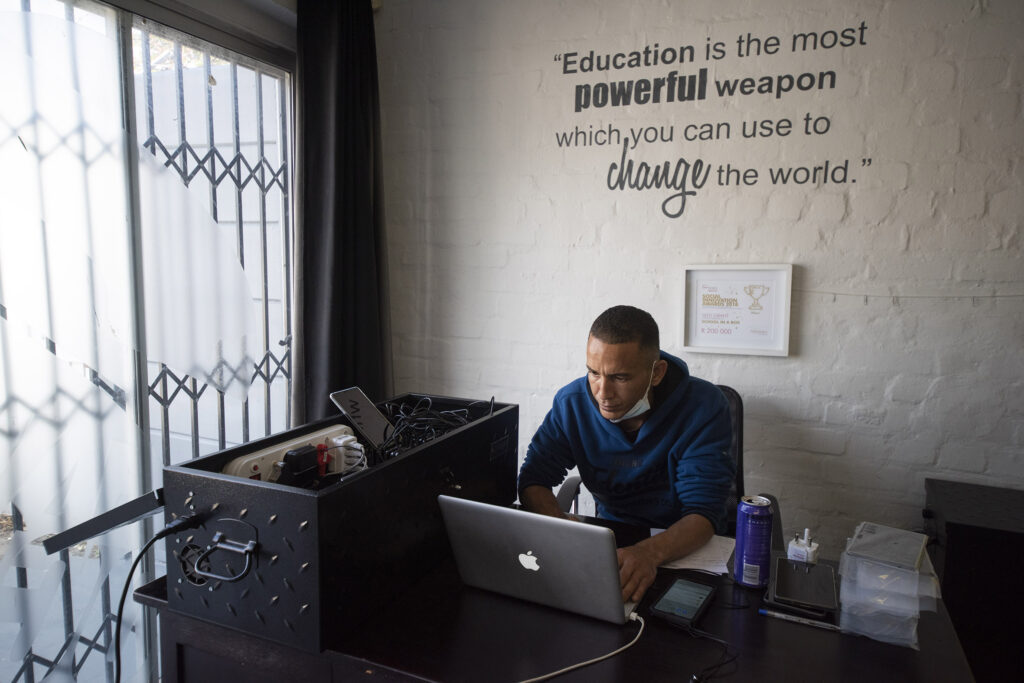
IT guru Bryan Fisher (left) keeps the tablets up to date for learners such as Dilshaad Lentjies, Daniel and Abigail Simons (above, from left).
Photo: David Harrison/M&G
Access to quality education not only opens the door to opportunities for the rest of students’ lives, but is often a way out for learners whose immediate environment is hostile or mired in crime, domestic violence and poverty.
When Daniel Simons, a grade four pupil at Searidge Primary School in Mitchells Plain in the Western Cape, was bullied in grade one, he says he immersed himself in schoolwork.
“I did not care about that stuff, all I did was [school] work. My teacher, Mrs Lewis, told me: ‘Don’t focus on them, you just need to focus on learning,’ ” the young boy remembers, adding that the reason why he was bullied was that he was not “clever enough”.
A few years later, as a grade four learner, with a glowing report card “showing three sevens and one six,” Daniel proclaims that “learning is my favourite thing to do”.
His sister Abigail and another student, Dilshaad Lentjies, share Daniel’s enthusiasm for learning. Like her brother and like Lentjies, Abigail’s favourite subject is mathematics and she too boasts a good report card featuring a list of sevens and sixes.
The Simons children and Lentjies all live in an area generally known for its high crime rate, low-income households and domestic violence. And they have all come a long way from a not-so-promising start academically.
All three learners are beneficiaries of a supportive study group in Tafelsig called AK Snapshot, which uses School in a Box as a primary method to help children learn.
School in a Box is a nonprofit organisation founded in 2015 and provides educational support to schools, teachers and learners with the use of a small, rectangular box, which gives users access to learning content aligned with the national Curriculum and Assessment Policy Statement (Caps), books in all of South Africa’s 11 official languages as well as additional resources such as past exam papers to practise on.
This virtual learning method circumvents the limited access in poor South African residential areas to amenities such as internet access, electricity and schooling infrastructure. Using only the box, which has a built-in uninterruptible power supply system and provides data to be shared among several tablets, beneficiaries can learn despite the lack of electricity and internet.
“School in a Box was created to bridge the gap between those who have access to quality resources and those who don’t,” explains head of operations Noma Moyo.
“We believe that only once we have engaged the hearts and minds of the next generation and instilled a love of learning across our entire educational ecosystem, will we be able to alleviate poverty and equip tomorrow’s graduates to be productive and successful citizens.”
 Takeaway message: School in a Box provides consistent access to learning materials, says Andrew Koopman.
Andrew Koopman founded and runs an after-school programme, the AK Snapshot Study Group. He and his students are some of the most enthusiastic beneficiaries of the School in a Box concept. Koopman currently has 24 students using the tablets in his after-school programme.
Access to additional learning material has helped learners catch up with schoolwork they were not able to do because of the Covid-19 pandemic, which has greatly disrupted South Africa’s school calendar since schools first closed during the lockdown of March 2020, Koopman says.
The study group also acts as a support structure for many children who now feel that they belong somewhere.
According to Koopman, the children who attend his after-school programme are assured of making the cut to attend local high schools that require high primary school grades for admittance.
“We are so prepared and excited for next year because I know our children are going to be way ahead, because of this system we have,” he says.
While school learners elsewhere have suffered a drop in performance due to the Covid-19 crisis, Koopman’s students have maintained consistently high marks. The reason is simply: they have had continuous access to quality learning material.
The learning tablet “gives learners a new way to experience learning. We have seen hundreds of learners improve their marks from hard work and consistent access to the system,” School in a Box’s Moyo says.
Recently the nonprofit organisation expanded its reach into other African countries and aims to develop a full school offering, incorporating Caps-aligned content from grade R to grade 12, including teacher lessons and resources. This is in addition to the more than 22 000 resources it already offers at almost 100 learning centres.
“Children who previously failed in school now excel with multiple distinctions. It is a wonderful tool that caters for all types of children,” Koopman says, referring to both extroverts who find it easy to ask questions aloud, and introverts, who can simply go back to the explanatory video on the tablet.
The study group, however, has a holistic approach to teaching, which recognises that one cannot solely place a tablet in front of a child and expect him or her to learn on their own, Koopman stresses.
“It is also what goes behind that, the motivation and inspiration, to bring out the child’s full potential. We develop their social skills and public expression. And we don’t create a classroom effect, there’s noise and children are speaking … helping each other … to have an environment that is conducive for learning,” he says.
The Simon children and Lentjies are all dedicated users of the learning tablet.
“If I was not learning, I wouldn’t be able to do the things I want to do in the future,” says Abigail, who is determined to become a healthcare worker when she grows up.
Lentjies says she wants to become a lawyer and enjoys learning different subjects. She believes if she was not so involved with the study group, she would most likely have followed her friends who roam the streets and “do bad stuff”.
Daniel, who dreams of becoming an architect, believes learning helps him to improve “not only myself but improve others too”.
He mentions a friend with whom he studies: “He always comes to me to help him do his homework, and I help him, but sometimes I tell him he must help himself also. He asks a lot of questions and I cannot give him the answers always, because that means he is not learning. That is why he must practise.”
Asked what they are going to do for the summer holidays, because they have finished with exams for the year, Daniel answers matter-of-factly: “We can learn the stuff we are going to do next year.”
[/membership]