A member of the Royal Eswatini Police Service (REPS) raises his baton as he speaks with affiliates of the Trade Union Congress of Swaziland (TUCOSWA) as gather in central Manzini, during a pro-democracy protest part of a national shutdown organised by union members and civil servants in Africa's last absolute monarchy. (Photo by Michele Spatari/AFP)
Eswatini Prince Sicalo Nkopolo Dlamini will go into mediation with investigative media house Swaziland News on 31 January next year after a failed bid to urgently interdict the publication.
The application was brought to the Mbombela high court following a damning investigation which revealed an alleged royal plot to procure guns in South Africa for planned security operations against protesting Eswatini citizens.
The matter involving the eSwatini defence and security secretary, Prince Sicalo and Swaziland News editor Zweli Martin Dlamini will head into mediation following consensus among the parties in the Mbombela high court.
Sicalo, who is the son of King Mswati III and responsible for procuring state arms, approached the Mpumalanga high court to urgently interdict Dlamini and his publication — registered in South Africa — from reporting on stories; and removing a previous story, deeming it to be a violation of his privacy and defamatory. However, Dlamini’s court affidavit argues that until the merits of a defamation case are argued in court, Sicalo cannot force the publication to remove its story or prevent further reporting.
The story related to an investigation published on 23 November 2021 in which Swaziland News reports that Sicalo allegedly travelled to South Africa on a citizen passport (not diplomatic) to meet security agents who would allegedly assist him in procuring guns for the Eswatini monarchy who are clamping down on dissenting voices in that country.
The article quotes an unnamed security agent as well as the secretary general of eSwatini’s largest opposition party, the People’s United Democratic Movement.
The kingdom of Eswatini was thrust into chaos earlier this year when thousands of protestors took to the streets to demonstrate against Africa’s last absolute monarch, calling for democratic reforms.
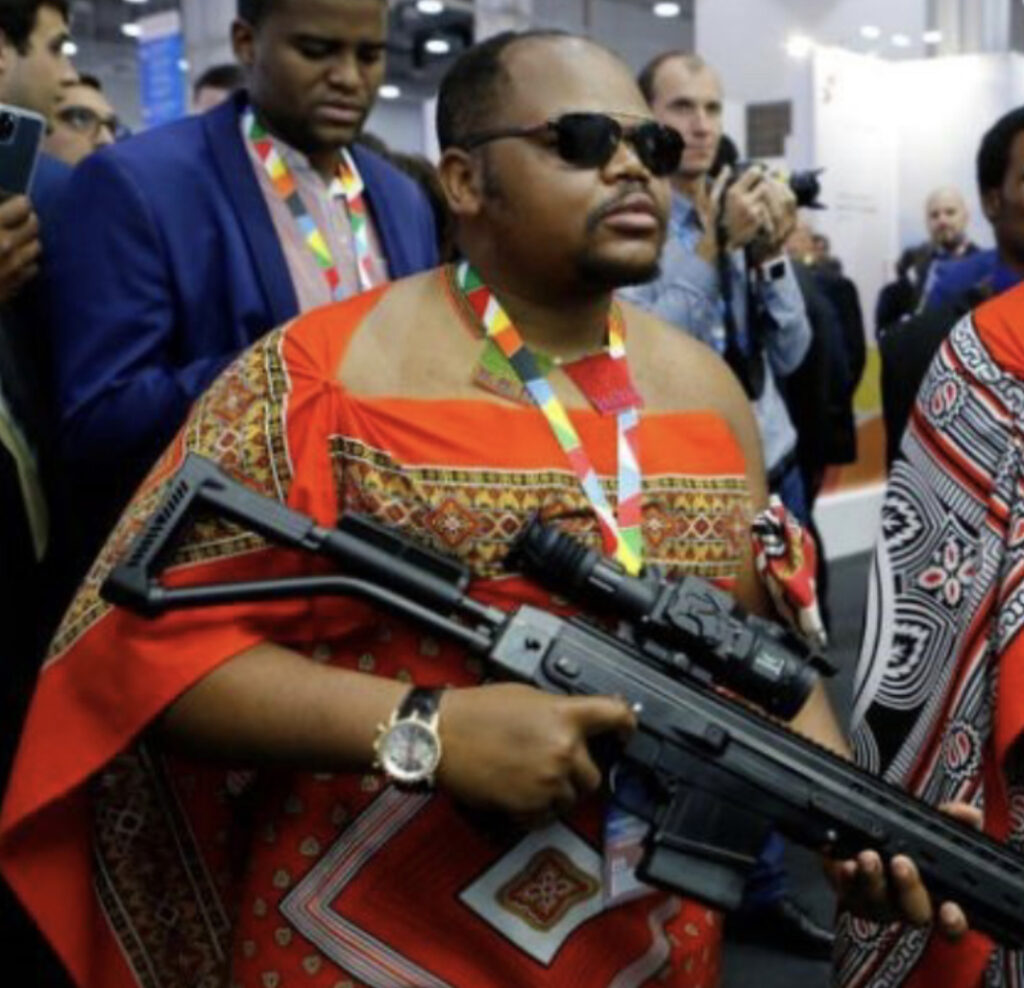 Prince Sicalo Nkopolo Dlamini.
The defence affidavit includes an annex of a preliminary Human Rights Commission report that said 46 demonstrators were killed by security forces during the protests.
“The application constitutes an abuse of process and its true intent is to silence the respondents and stifle the freedom of the press so as to curb any criticism of the current regime, amid increasing calls for democratic reform,” the affidavit submitted to the Mbombela high court reads.
Swaziland News reported that it had obtained electronic evidence through security sources that suggests that Prince Sicalo was given a budget to buy guns to be used against unarmed citizens amid the political unrest.
Dlamini’s responding affidavit also states that the applicant, Prince Sicalo, should pay the respondents’ legal costs based on the defence of truth and public interest, and the reasonableness of the publication to rebut the presumption of unlawfulness on its part, among other things.
“The suppression of journalists and the freedom of the press in Eswatini is a tactic notoriously employed by the present regime. The present application is an example of an attempt to suppress the media in Eswatini.”
The high court has heard how Dlamini and his wife have been abducted and tortured; threatened and intimidated, forcing him to flee his home. This has been followed by contempt of court charges for other “meritless” cases brought before the Eswatini courts by the monarch.
The Swaziland News investigations on the prince did not stop when the application was argued in November. Days later on 25 November, the publication reported that state security was planning a heavily armed military operation for a planned local election, called Tinkhundla, in Siphofaneni in the Lebombo region of the country.
The publication also claims that civil society groups counted more than 100 reported deaths of demonstrators during the June protests.
An Amnesty International report timelines the events that unfolded in the Kingdom of Eswatini in 2021, starting with the mysterious death of law student and activist Thabani Nkomonye. A commission of enquiry was instituted by King Mswati III a week after the student’s death, but according to the human rights watchdog, has since “gone cold”.
This was followed by widely circulated petitions calling for an end to police brutality and a subsequent decree by the acting prime minister, banning all protests and deliveries of petitions.
By 25 June 2021, Amnesty International said a heavy crackdown on dissent began with state security forces using excessive force. During this period eSwatini was characterised by large clouds of smoke from torched buildings, sporadic heavy gun fire and the constant sight of state security helicopters hovering over various communities.
Exactly a month later, two members of parliament were detained under “frivilous” terrorism charges resulting in mass protests in October, and the deaths of more than 80 people at the hands of state security. Two nationwide internet blackouts were reported in this period.
On 13 November 2021, Dlamini reported for the Mail & Guardian that “even after a preliminary investigation into the extent of the violence meted out to the people of Eswatini by the troops of King Mswati III, the total death toll has still not been confirmed”.
At the time, Sabelo Masuku, the commissioner of the Human Rights Commission, clarified that the findings were merely a preliminary verification to establish facts on what happened and was not necessarily a full report.
[/membership]