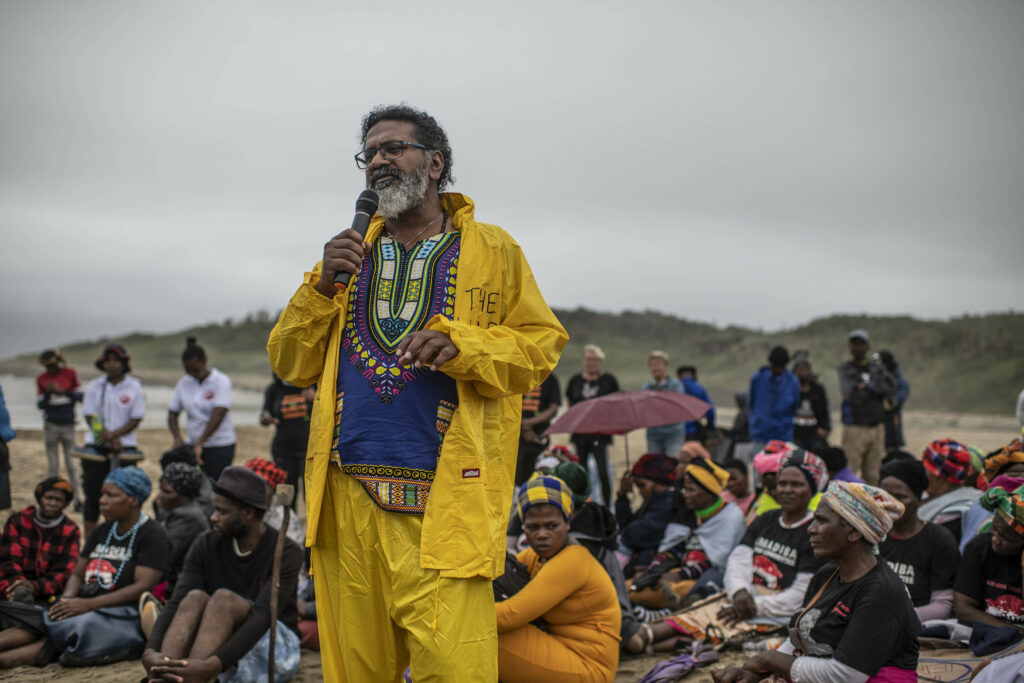
United in opposition: An anti-Shell protest at the Mzamba Estuary united protesters across race and class. (Photos: Paul Botes/M&G)
Sunday morning, 5 December 2021, and it’s a helter-skelter drive from the KwaZulu-Natal north coast to the northern tip of the Wild Coast region of Pondoland for a protest action against fossil fuel behemoth Shell.
Nothing has settled since earlier in the week when the Eastern Cape high court dismissed an urgent application to interdict Shell from conducting 3D seismic surveys in the Transkei exploration area from 1 December. Shell intends spending the next four to five months in search of oil and gas. According to the environmental management plan the exploration will include underwater explosions and discharges at 220 decibels at intervals of 10 to 20 seconds for 24 hours every day.
The ocean and all that live in it — and those who depend on it for material and spiritual sustenance — are in danger.
Everything is up in the air. The Mail & Guardian is travelling with members of Natural Justice, the paralegal and advocacy nongovernmental organisation which, together with various community organisations, had failed in its first interdict attempt. Another, brought by traditional healers, local fishers and organisations seeking sustainable development of the Wild Coast, will prove more successful on 17 December, when an interdict is finally granted.
Over the past few days there have been stop-start attempts to get a boat out to where the Shell vessel is, about 40 nautical miles offshore, to confront it with nonviolent direct action — and to monitor it. This may still happen, it may not. The activists’ boat may launch from East London, or it may not. The M&G may be on board, we may not.
There are communities and organisations mobilising as a groundswell of support — across class and race — is growing within South Africa in opposition to the exploration. A unity of purpose that a fractured and fractious country very rarely demonstrates.
On the drive to Xolobeni, Katherine Robinson, in charge of Natural Justice’s communications, is putting out a call to action on social media, urging people to “donate, protest, boycott or petition”.
The NGO’s executive director Pooven Moodley is trying to connect with Desmond D’Sa of the South Durban Community Environmental Alliance, who is driving along the N2 towards Xolobeni dropping off placards and posters with communities protesting in gatherings on beaches along the way.
It’s getting late and we keep missing each other.
Thousands have gathered along South Africa’s coastline; from Salt Rock on the KZN north coast all the way through cities such as East London and Gqeberha, down to Cape Town and at beaches such as Muizenberg. Hundreds of thousands of people have signed a petition against the exploration.
The message for Shell to “go to hell” is clear.
Where so much continues to divide the country this new protest, which is set to grow in 2022 as the legal and political battle between Shell and communities intensifies, suggests a unity of purpose very rarely seen among South Africans.
The solidarity is welcome, but there are caveats, as Robinson points out while we cut through south Durban’s muggy, grey air; thick with the smell of benzene from the nearby refineries and petroleum storage facilities. The port expansion into the former Clairwood racecourse site and surrounding areas — unsuccessfully opposed by communities — is evidenced by banks of containers at various new logistic hubs.
Robinson says: “For a lot of white middle-class people this protest is about nature, their access to clean recreational beaches and the ocean. The challenge for us is to ensure that people realise it’s also a human rights struggle, it’s about livelihoods, potential forced removals and black activists’ lives being threatened.”
This is a recurrent theme over the next few hours.
We abandon the plan to meet D’Sa and head straight to the Wild Coast Sun, a casino resort established following the forced removal of indigenous communities and creation of nominally “independent” homelands — where South African laws about gambling did not apply — during apartheid.
Through the abstracted noise of slot machines delivering feigned winnings to illusionary punters and the casino’s carnival lights we go, into the resort, past its private pool and down to the beaches below.
Heading towards the Mzamba Estuary, where the protest is being held, we cross protesters who are returning home: A couple with their adult son picking up plastic and other bits of litter along their way; some hippies here, some surfers there. They are all well-intentioned, friendly, middle-class and white.
It’s a thirty-minute walk to get to the estuary. We start to jog.
Kaz Wilson, who started the Nature’s Voice Africa Facebook page in opposition to Shell’s exploration, and Dominic Mitchell, a development economist, stop to chat.
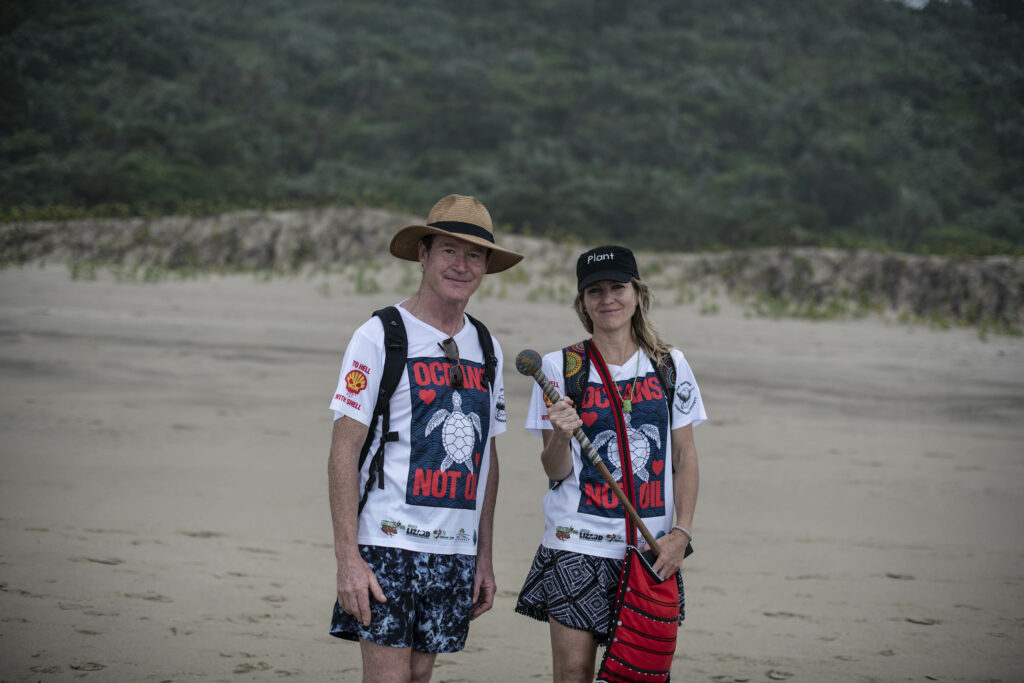
They have driven down from Hillcrest, a suburb in west Durban. Mitchell is adamant that this kind of “social and environmental solidarity with communities directly affected by the threat of mining” is essential at a time of volatile climate change.
“You cannot compare the few hundred jobs projected from mining with the loss of livelihoods and the threats to the way of living that people along this coastline face,” he says, adding that there are more obvious, and greener alternatives to economically invigorate the area. Projects that optimise the natural beauty and biodiversity in the area.
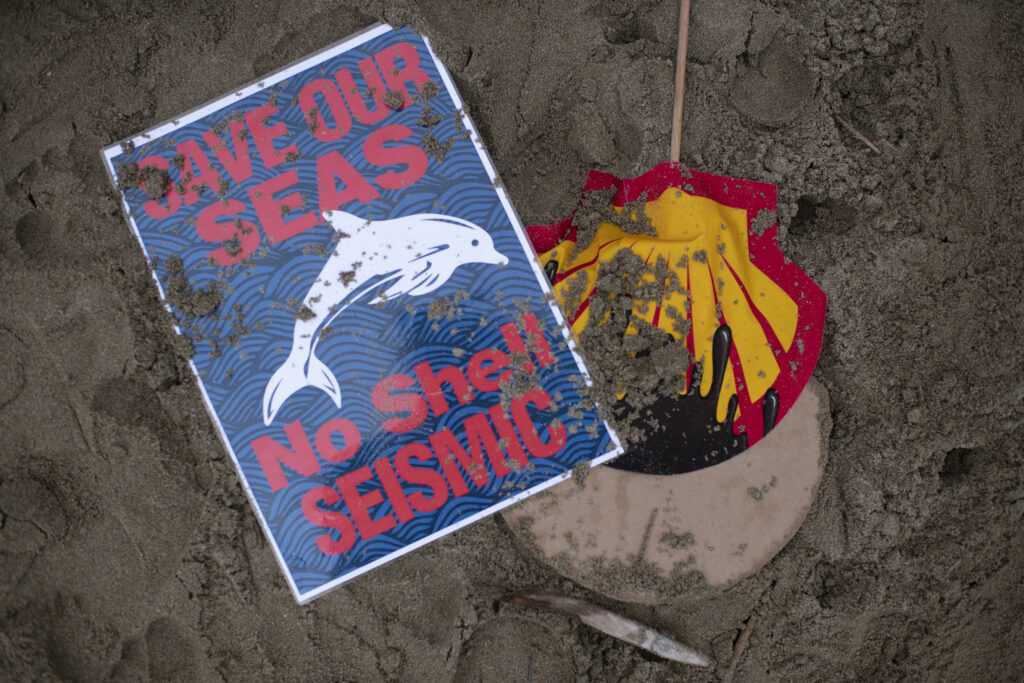
There are a group of about ten figures in the distance. Is this the protest? Has it dissipated already? We jog faster.
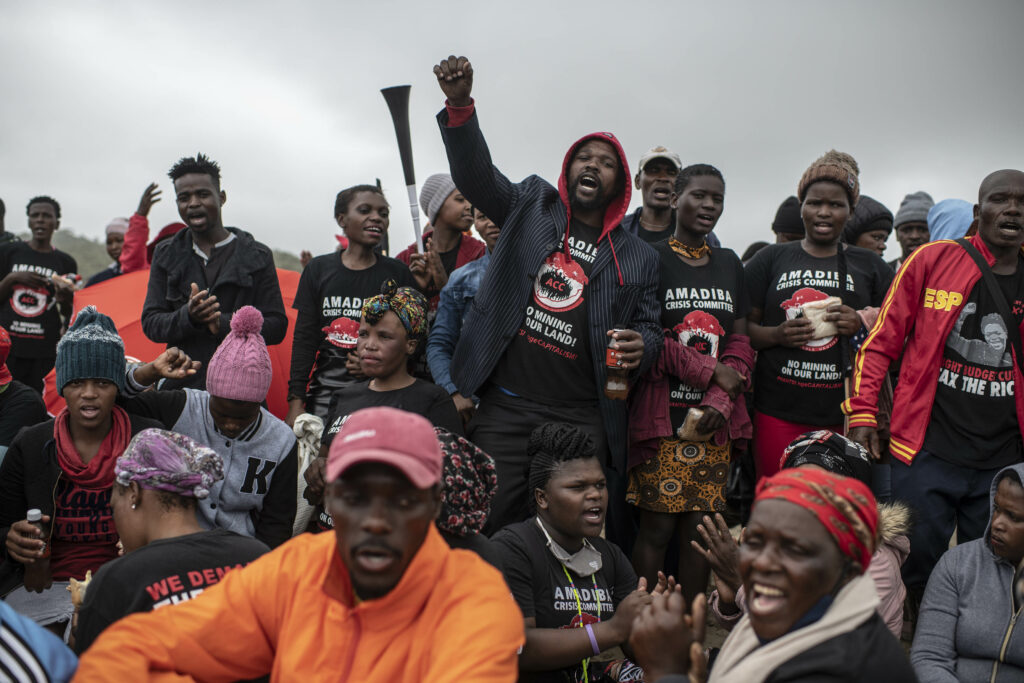
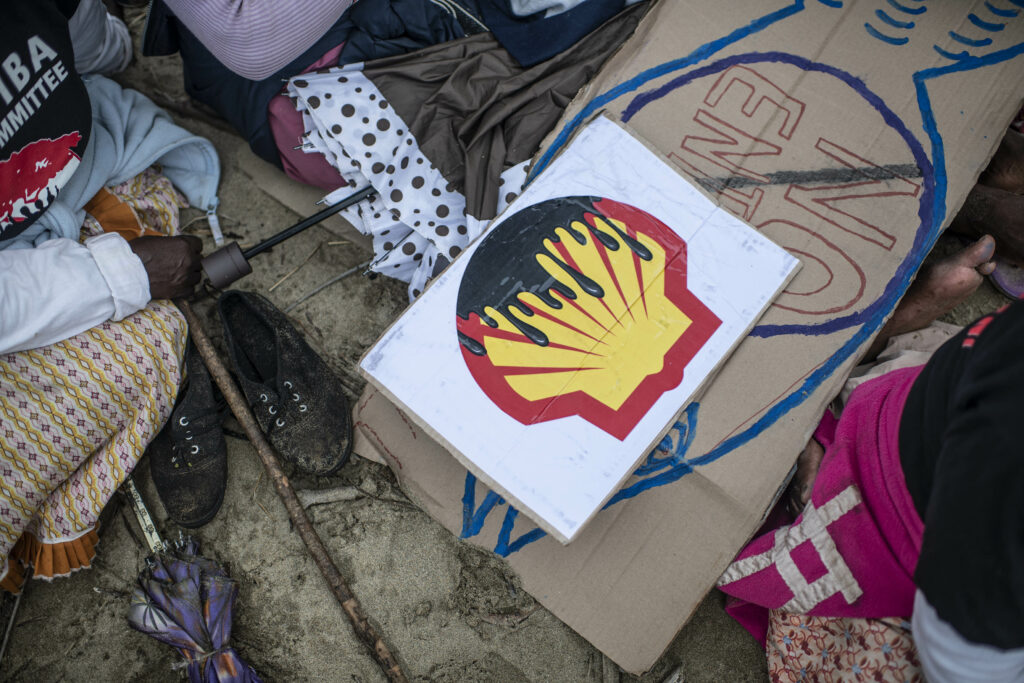
Rounding a rocky corner of the beach, we find about 300 people, mainly residents of the Amadiba area of Xolobeni, gathered, imbizo-style, in a circle.
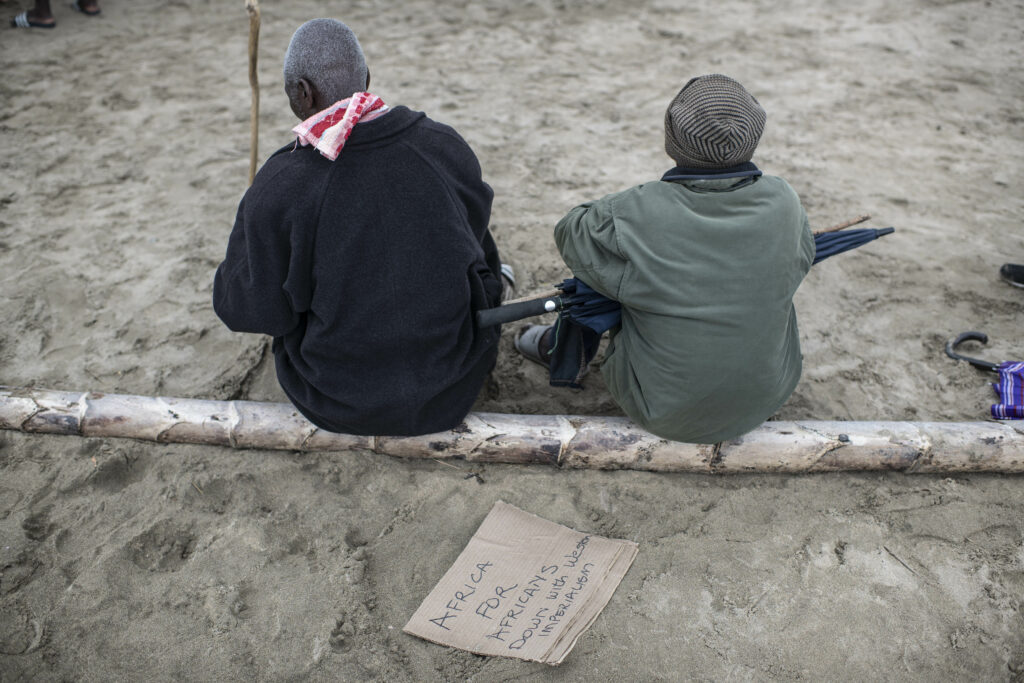
There are young children and old men and women. Some of the elders have receding memories of the Pondoland uprising in response to the apartheid state’s Bantustan policies of the 1950s and 1960s.
There are adult activists who have been hardened by more recent struggles: successfully against dune mining in Xolobeni, against the N2 expansion into the area, and now against the proposed smart city which will join all the coastal towns and villages between Port Edward in the north and Port St Johns in the south — some of South Africa’s wildest and most beautiful coastline.
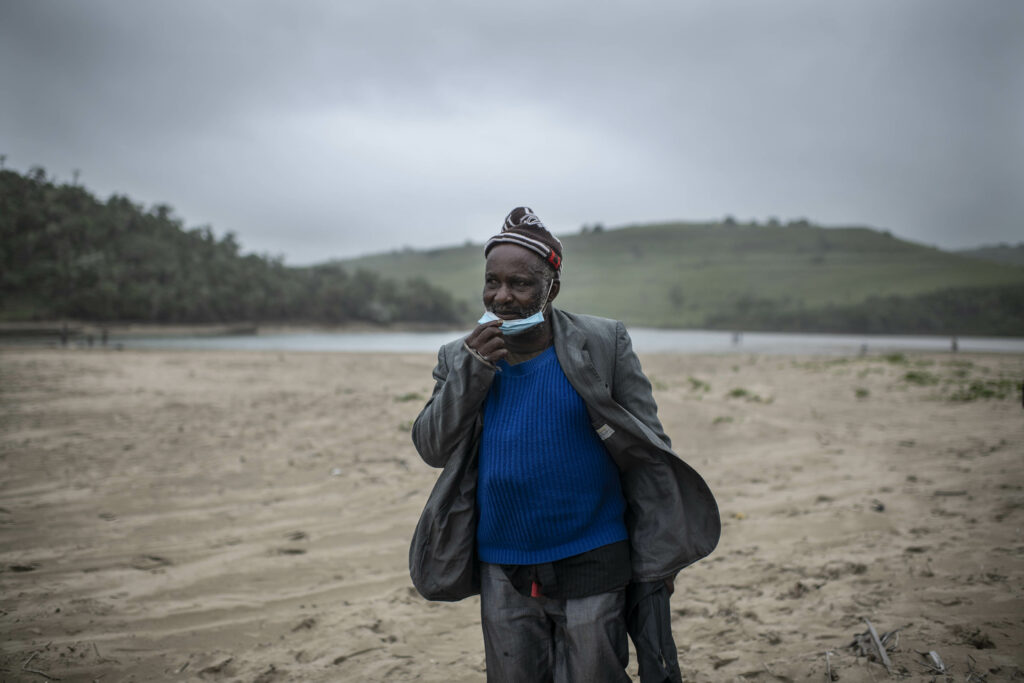
Eighty-five-year-old Mashona Dlamini’s eyes have cataracts as grey-blue as the suit he is wearing. But they see into both the past and future. He tells me he has a vague recollection of the Pondo revolt, but that more recent struggles burn into his present: “I am tired of all the fighting this community has to face because our government takes decisions for us,” he says. “Why don’t they come to speak to us?” he asks, bemoaning where he will find crayfish and fish to eat when the marine life is affected by the exploration.
At the centre of the imbizo circle are Xolobeni community activists Sinegugu Zukulu, the director of Sustaining the Wild Coast, and Nonhle Mbuthuma, a founding leader of the Amadiba Crisis Committee, which was formed in 2007 in response to the threat of dune mining.
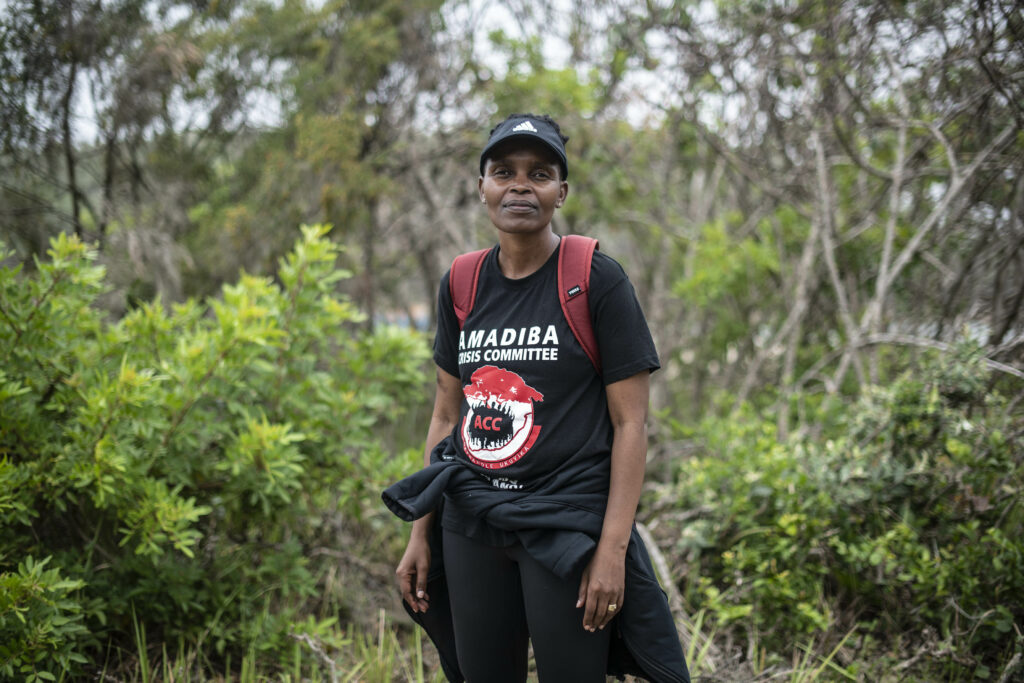
Mbuthuma is in fiery mood as she addresses the imbizo, recalling the resistance to authority and the imposed development projects that has characterised this community’s struggles: “This mining is part of a ploy to take the land from us,” she says. “This is the only land that the apartheid government couldn’t take from the people. It is the only land where we can live in an indigenous way and if we allow the exploration for oil to happen, then our way of life will end,” she says.
Natural Justice’s Moodley is easily recognisable in yellow fisherman’s raincoat and pants, which his partner has embellished with Shell logos transformed into zap signs in black marker on the drive down. Zukulu spots Moodley’s arrival and invites him to address the gathering.
Moodley outlines the findings — and his disagreements — with the first high court ruling and promises to take the battle against Shell to the constitutional court, if required: “We’ll take this fight to the end because our lives depend on it!” he tells the crowd. They respond with a respectful and witty “Siyabonga, Mashebe” (thank you, bearded one).
Later, during a quieter moment, Mbuthuma allows herself to be weary.
Her community has faced relentless attacks on their lives and livelihoods by government and multinational corporations. Comrades have been murdered because they opposed a certain type of development in the area.
In 2016 Amadiba Crisis Committee chairperson Sikhosiphi “Bazooka” Rhadebe was gunned down in front of his young son. He sustained eight bullets to the head.
Mbuthuma herself has faced death threats. She says her communications were hacked because she is considered a “stumbling block” to other people’s plans for a community they refuse to consult with.
She says that the state “hates” communities who organise themselves and wants to make decisions on their behalf. “The system always pushes our communities into a corner,” she says.
Mbuthuma questions why the government is allowing Shell to prospect at a time when it is clear that finding greener alternatives to fossil fuels, and the damage their extraction and usage has on the environment, is essential to saving the planet. She asks the question that looms over every government-sanctioned project in South Africa: Which politically connected individuals will benefit?
In a press conference four days later, Minerals and Energy Minister Gwede Mantashe cravenly accused protesters of representing racist colonial interests: “We consider the objections to these developments as apartheid and colonialism of a special type, masqueraded as a great interest for environmental protection.”
A former miner, Mantashe has demonstrated no imagination or foresight during his tenure to incentivise the re-skilling of mineworkers for greener energy production.
As we speak, Mbuthuma’s passion escalates. Her words mark people in power, like Mantashe, as the neocolonial quislings: “The land is our identity. We know ourselves, who we are, because of the land. The land feeds us, it buries our dead, it’s where we connect with our ancestors. Our ancestors reside here, in the ocean, and when we want to connect with God we come here and talk to them …
“Spiritually, the ocean is our healing space, so if you destroy the ocean you destroy the connection between us and our ancestors, you pollute the water, which is part of our traditional medicine and we also have the churchgoers, the religious people who come here for baptism. If the water is polluted, where will they go?” she asks.
Later, on the drive back to Durban, Moodley talks about the potential for legislative and constitutional changes to ensure that people’s lives, livelihoods and the environment they exist in are protected.
He talks about his own childhood, growing up next to a coal-fired paper mill in Mandini in KwaZulu-Natal, where the smoke was sometimes so thick it would obscure neighbours’ homes, and its effects on his respiratory health and that of his friends: “Every time I take a breath, I am reminded of what fossil fuels do,” he says.
Moodley says companies like Shell, despite committing to various zero emissions targets with the 2035 climate deadline in mind, are using this “window of opportunity” to print money from fossil fuels while they can — especially in the developing world.
This rapacious short-sightedness is a consequence of late capitalism and the individualistic mindset it has bred, says Moodley. It is also feeding an increasing sense among the ultra-rich global one percent, especially the masterminds behind Big Tech companies, people such as Elon Musk and others, that the Earth can be used up and discarded — along with the majority of the people on it — like a chocolate bar wrapper.
While he is mournful that “centuries of activism has only got us to where we are today”, Moodley remains optimistic. He is buoyed by the burgeoning opposition to Shell’s activities across race, class and gender to “try get us out of this mess”. He says activists are depressed and tired and need to be “reinvigorated” by new solidarity.
Moodley talks about all the elders, the “indigenous wisdom keepers” — from Pondo people in Xolobeni to Aboriginal people in Australia and Mohawk people in the US — with whom he has been meeting and consulting over the past decade.
“We are faced with the greatest existential question of our time,” he says. “Science tells us that we have until 2035 as a point of no return to fight climate change, but all the cosmologies of all these indigenous wisdom keepers suggest we have much, much less time. It is urgent that we act now, build solidarity and intervene together,” he says.
Moodley says that walking on the beach to join the protest earlier in the day, he was reminded of the time he had spent learning from the elders at Xolobeni in 2019, participating in their rituals and ceremonies.
“I was imagining that if this protest was happening in the city the energy would be a harsh anger, but here on the beach it’s a calmer intensity,” he says.
“It took me back to 2019 and I wondered whether the solutions we seek can be found in the traditional knowledge that we so quickly ignore? I’m reminded of a Nigerian elder I met. He has passed on, but his favourite saying was: ‘Times are urgent, let’s slow down.’”
[/membership]