Members of South Africa's Ukrainian Association sing and chant slogans while holding anti-war posters during their protest in support of Ukraine in front of the Department of International Relations and Cooperation (DIRCO) in Pretoria, on March 1, 2022. - Ukraine is finding it hard to get its message across in southern Africa, where there remains affection for Moscow dating from the apartheid era, the Ukrainian ambassador in Pretoria said.
Like Ukrainian envoys around the world, Ambassador Liubov Abravitova is striving to rally support for her invaded country. (Phill Magakoe / AFP via Getty Images)
The invasion of Ukraine has put Pretoria in a foreign policy conundrum that will not go away because Russia’s attack on a sovereign neighbour is changing the world order with every falling bomb.
It was made plain, as the international affairs ministry and the presidency contradicted one another this week, that there is confusion not only about what to do but about the reasons for doing it.
The pressure to resolve this is growing and will continue to do so as sanctions against Russia multiply and President Vladimir Putin heads towards pariah status in the eyes of many.
Which bombings to condemn?
Professor Stephen Friedman, the director of the Centre for the Study of Democracy at Rhodes University and the University of Johannesburg, said he approved of the government’s decision not to support the UN resolution — that Russia “immediately, completely and unconditionally withdraw all of its military forces” from Ukraine — but the conflict, and the foreign policy choice for Pretoria, raised questions of principle and consistency.
“I think it is entirely appropriate to do what the government has done. Why is it taking sides if you abstain and it is not taking sides if you vote for the resolution? If you vote for the resolution, you should be supporting the other side.
“The point in terms of the morality of this issue is that the bombing of Ukraine is totally unacceptable but so is the 70-year occupation of Palestine, and so is the bombing of Iraq, so is, to get back to Palestine, reduction of Gaza to rubble … the Saudis are bombing Yemen.
“What are the rules that decides what is a bombing that gets sanctioned, and one that does not get sanctioned?”
There are only two explanations, he said, and neither are profound or palatable.
“There are people around the world who are saying we are white Europeans and you don’t bomb white Europeans, you can bomb Yemenese and you can bomb Palestinians.
“The other argument is that the EU and the US don’t like it, it is a bad bombing, and they like it is a good thing … I don’t think we should sign on to that either.”
Friedman said he believed the world was entering another Cold War, and needed to face the fact that the first was never about ideology but about territory.
“Now surely the only principled decision on that is what used to be called nonalignment. And non-alignment is not sitting on the fence, it is saying either all bombings are unacceptable and bombings should be sanctioned and we stick to the United Nations Charter, which says that you can’t do that, or it is anything goes.
“At the moment we are asking to sign on to a situation where the Americans and the Europeans decide what is acceptable and that becomes the moral standard and everyone has to vote for that, and I don’t think that is okay.”
He added that it was plain that there were differences of opinion in South African ranks, noting that foreign policy has been inconsistent for 27 years, but that it partly stemmed from a disconnect between politicians and diplomats.

Ruling party’s stance
The lack of clear principle extended to Brics (Brazil, Russia, India, China and South Africa) membership.
“What does Brics consist of at the moment? Dictators and right-wing loonies. So we should not be there, but we also should not be cheerleaders for Biden and the Europeans, just as we also should not be cheerleaders for Putin and the Chinese.”
The ANC’s national working committee (NWC) held a meeting this week where its position on the Russia invasion was discussed. It was partly fuelled by last week’s statement by the department of international relations minister, Naledi Pandor, who called for Russia to withdraw its troops from its neighbour.
The Mail & Guardian had previously reported that the ANC officials rushed into a meeting on Monday to address Pretoria’s position on the war. This came as the West was trying to place Russia in a stranglehold of sanctions.
In its statement, the NWC, a body that deals with the day-to-day administration of the ANC, reiterated the party’s stance promoting a peaceful and diplomatic resolution of the conflict in line with the precepts of the UN Charter.
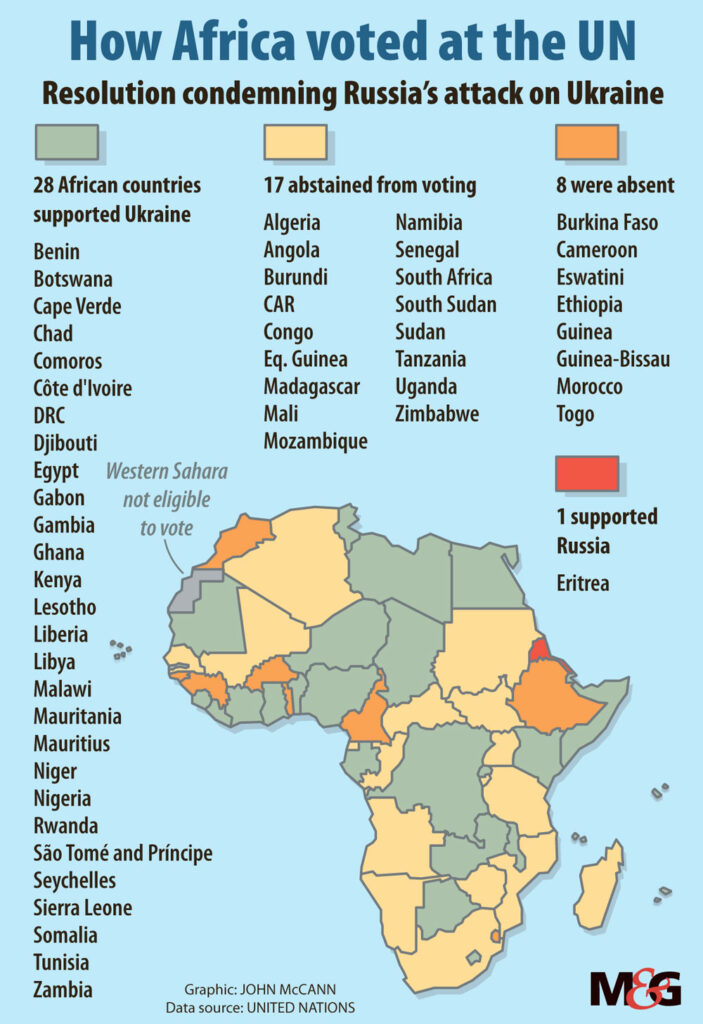
Pretoria drew criticism on Wednesday when it chose, not entirely unpredictably, to abstain from the UN general assembly vote to reprimand Russia over its invasion of Ukraine.
Ambassador Mathu Joyini said the South African government was concerned that not all situations of conflict have received the same attention.
“It is necessary that we devote equal attention to other long-standing conflicts where the UN Charter and human rights are being violated. In conclusion, South Africa endorses the statement issued by the African Union Commission expressing concern at the treatment given to African nationals and people of African descent at the borders of Ukraine, some of whom are not allowed to cross and move to safety. We urge European countries to take steps to resolve this situation as all people have a right to cross international borders during times of conflict,” she said.
SA’s many policy voices
The Ramaphosa administration has come under fire from different sectors in the country for failing to deliver a strong message denouncing the invasion of Ukraine.
In contrast, the Democratic Alliance’s Cape Town mayor, Geordin Hill-Lewis, announced that the city hall would be lit in the colours of the Ukraine flag to show its solidarity with that country’s capital.
He said the decision was primarily one of one capital extending solidarity to another, although it coincided with the DA’s official position. He added that he deplored the ANC’s “Soviet nostalgia” on the subject.
Some of the responses on social media to the DA gesture point to Friedman’s questions on consistency.
There was a flood of Twitter messages asking Hill-Lewis whether he was prepared to light up city hall in solidarity too with Palestinians enduring Israeli rockets.
Clayson Monyela, the spokesperson for the international relations department posted on Twitter: “Consistency in our foreign policy endeavours is critical.”
ANC leaders say the party and its government are caught in the middle of a dilemma, grappling with loyalty to its historical allies in the former Soviet Union and the dominant West.
The former Soviet Union supported the fight against the apartheid regime. While visiting Moscow in 1999, Nelson Mandela expressed his appreciation to the Russian people for their solidarity with oppressed black South Africans.
The Soviet Union trained many in the ANC’s Umkhonto weSizwe military wing.
A national executive committee (NEC) leader said that when taking the decision to abstain in the UN vote, the government had to consider funding it receives from the US and although they appreciate Russia’s position, the party cannot make a decision to support it when there is still a national debt crisis.
“Some of the people we owe are the IMF, World Bank. Once you show them a middle finger they can kill your sovereign wealth and rate you to zero, making your country unbankable to immediately take your SOEs. We must make a calculation internationally, the people we owe are the West.”
The NEC leader said there was a strong view in the ANC that the West and Nato were the aggressors in the war in Ukraine, a belief that was shared by another NEC member who argued that South Africa is held at gunpoint by its Western trading partners.
“Ourselves, China and others who rely on both countries decided to abstain for the safety of our people. The issue of war crimes is a non-starter. America has not accounted for Hiroshima and Nagasaki. America has attacked more than 100 countries, more than 40 presidents who were couped out and disbanded so they are the last people to tell us about that. At the same time we don’t want to fight them to say we are with Russia because of their funding and taking them head on without proper financial backing [it] may just collapse us,” the NEC leader said.
A South African diplomat with inside knowledge of the South African position on the Ukraine war applauded the use of a multilateral organisation such as the International Criminal Court (ICC) to investigate war crimes carried out by Putin against the Ukrainian people.
The diplomat criticised the ANC’s stance on the ICC as “plainly ridiculous”.
The party had resolved to withdraw from the Rome Statute, arguing that the ICC was biased against African heads of state. This has not happened and commentators think President Cyril Ramaphosa is letting the resolution die a quiet death.
But another senior diplomat believes the ICC would be the best resolution to the conflict. Although the diplomat argued that Russia is not entirely wrong and may be justified in retaliating against Nato, the war crimes that Putin may be committing must be investigated and those responsible held accountable.
[/membership]