26 January 2022. Tsediso Raleholi shows a photograph of her 10-year old daughter Mapula. Mapula drowned in a mine dam on Durban Deep over the Christmas holidays. (James Puttick)
The image that lingers in Cora Bailey’s mind of that warm January day when Mapula Raleholi, 10, drowned in Durban Deep, is of the child’s mother, Mamatseliso, standing alone waiting for her body to be unearthed.
“It’s so awful imagining being a mother and seeing that big earth-moving machine in the water hauling up mud and wondering when your child is going to be part of that,” said Bailey, the founder and director of Community Led Animal Welfare (Claw), which provides veterinary care to indigent people on the West Rand. “It’s just dreadful.”
She recalled how a group of children had run to Claw’s offices in the crumbling ruins of Durban Deep, near Soweto, in the afternoon of 8 January, to tell her that a child had “disappeared” in a body of water while swimming with friends.
“At the mining works, there are two deep, enormous dams of rainwater and other water that’s gathered. Often, kids go swimming there,” Bailey said. “What I remember the most is that there were a lot of other people there but the mom, who is a tiny woman, was standing on one side alone, clutching her body … At any time, I was expecting to see a little body coming out with all that mud.”
Mapula’s body was recovered later that evening under a roadside that runs between the two water bodies.
Weeks later, inside her dark, cramped shack, Mapula’s grieving mother scrolled on her phone for a photograph of her daughter.
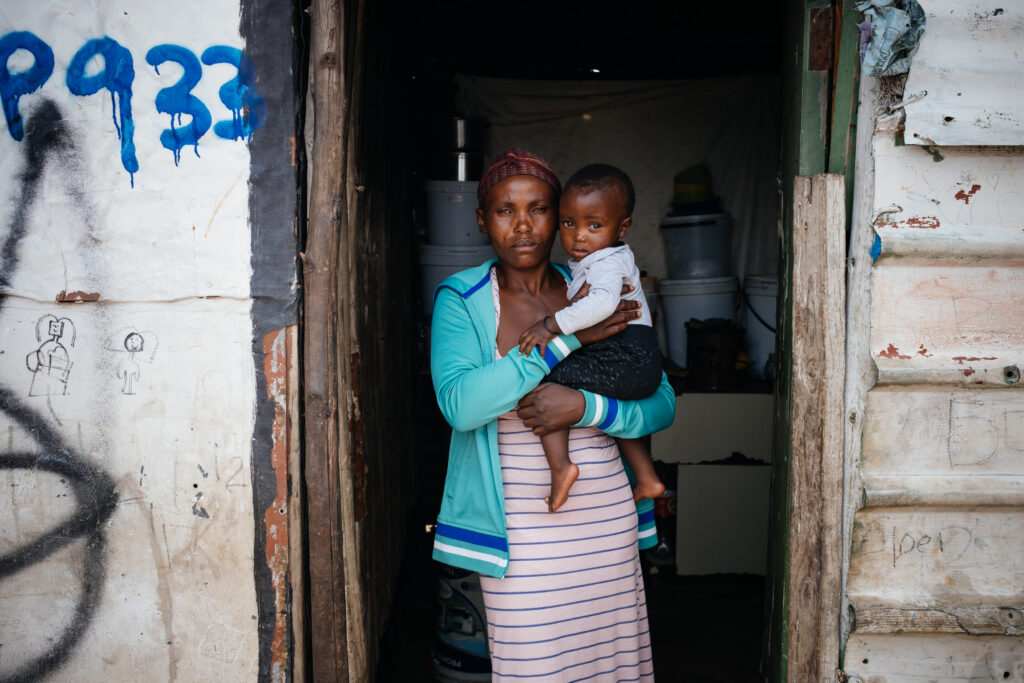 26 January 2022. Tsediso Raleholi and her son Retabile at her home in Matolesville, near Durban Deep in Gauteng. Raleholi recently lost her 10-year old daughter Mapula when she drowned in a mine dam at Durban Deep over the Christmas holidays. Photograph: James Puttick.
“She was a happy girl and I was expecting much from her,” said Raleholi, with a faint, tired smile.
“She loved school and the teacher liked my child very much because she was one of the best students. When she played with her friends, she would often take her school books and pretend to be the teacher.”
She said Mapula drowned in a “mining dam” a few hundred metres from their front door and Amatshe Mining should have done more to secure the site.
“I did not know she was going swimming there that day. It was very chaotic and confusing when people came and told me she was missing in the water … If that dam was not there, my child would still be alive. It’s not fenced and there are no warning signs.”
But Eddie Milne, the director of Amatshe Mining, which runs an aggregate operation in Durban Deep, said the child’s drowning did not happen in a mining dam.
“It’s not a dam, it’s a normal depression in the land, which was filled with rainwater,” he said. “It fills up and then it goes down. Kids go swimming there. You cannot control it or police it. Our security has caught kids there, given them hidings and we’ve taken them to their parents.”
Amatshe Mining has deep ties with the Sol Plaatje residents, which led to its financial support for the bereaved Raleholi family, he said. “They told us this family is destitute and that they don’t have any money to pay for the funeral. So we paid the funeral costs directly to the funeral parlour, which was R9 600. Outside of that, they asked us for food and for anything else for the family,” for which Milne said he paid a further R5 000 from “my own pocket”.
A sombre Godfrey Makomene, of the Johannesburg Mining and Environmental Forum, said: “The dam looks shallow, but it becomes very deep. That’s how kids drown.
“Before the establishment of this mining operation, there were no dams here and there was no open water like this. They [Amatshe Mining] created the dams for their processing plant and don’t look after them,” he said angrily. “They don’t put up any fences or warning signs … These mining companies just do as they please. The department of mineral resources must hold these mining companies accountable … but do we even have a government anymore?”
Makomene said Milne had previously worked for Mintails South Africa as a director and chief financial officer. “Look at how Mintails destroyed everything. How can we expect something better from a person that was running the company that left such an environmental mess?”
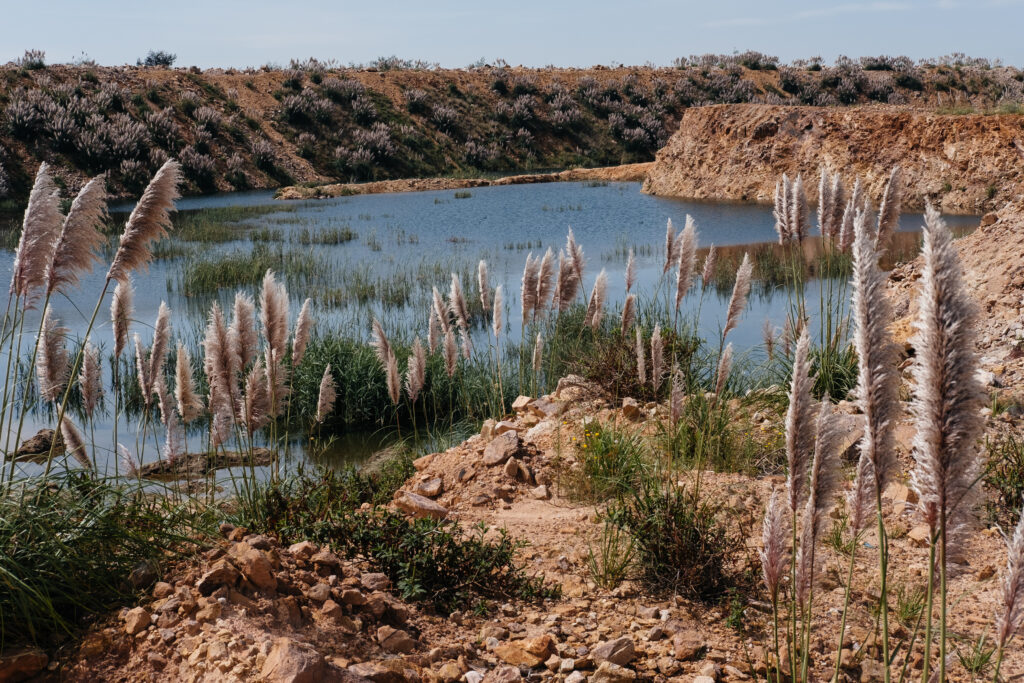 26 January 2022. Dams that form on unrehabilitated mines, such as this one at Amatshe Mine (formerly owned by Mintails) near Krugersdorp in Gauteng, pose a significant drowning danger to children who live in communities located nearby. High rainfall and hot temperatures over the 2021/2022 Christmas holidays led to the drowning of three children in mine dams over this period. Photograph: James Puttick.
Mintails South Africa was part of the Mintails group of companies, a gold mining and tailings processing company listed on the Australian Stock Exchange, whose local operations were liquidated in 2018.
It had touted itself as a mining rehabilitation venture but instead gouged a trail of ecological destruction across Krugersdorp and Randfontein.
This includes unrehabilitated reclaimed tailings storage facilities, polluted and toxic dams, clusters of cavernous open pits 30m to 40m deep and acid-producing stockpiles of waste.
Mintails had an unfunded environmental liability of R460-million. A 2018 report from the parliamentary portfolio committee on mineral resources noted how the company had “saved barely R20-million for all its responsibilities”.
Mariette Liefferink, the chief executive of the Federation for a Sustainable Environment, said the environmental catastrophe was allowed to unfold because there was no oversight or enforcement by authorities. “This has resulted in ecological degradation, pollution and significant safety risks.”
Citing his former role at Mintails, Milne said had he worked hard to get rehabilitation guarantees in place. “That the company didn’t approve them and do the work that needed to be done created an opportunity for me to walk away as well.”
He resigned from Mintails in 2017.
Amatshe Mining now holds surface and underground mining rights at Mintails’ former operations.
“The fact that I’ve come back to this and accepted these liabilities actually shows there’s a different mind view,” said Milne.
Liefferink said Mintails unlawfully conducted open cast mining operations from 2014 to 2018, creating open pits. Most of these pits, adjacent to Kagiso, are filled with water after the company struck the aquifer.
“The parliamentary committee reported to the national assembly in 2018 that a number of drownings occurred in these pits,” she said.
After Mintails’ liquidation, these pits were abandoned until the beginning of last year when the ownership of these pits was transferred to Amatshe Mining — and remain unfenced, with no access control or warning signs.
Liefferink said the drowning of a child was reported in December or January in one of these pits.
Milne said such mining areas “are away from parent’s eyes. Children have freedom to roam in these areas. And obviously when it’s hot, and in school holidays specifically, the kids come and swim in these ponds. They don’t have the necessary skills, training or coaching that will give them the skills not to drown.”
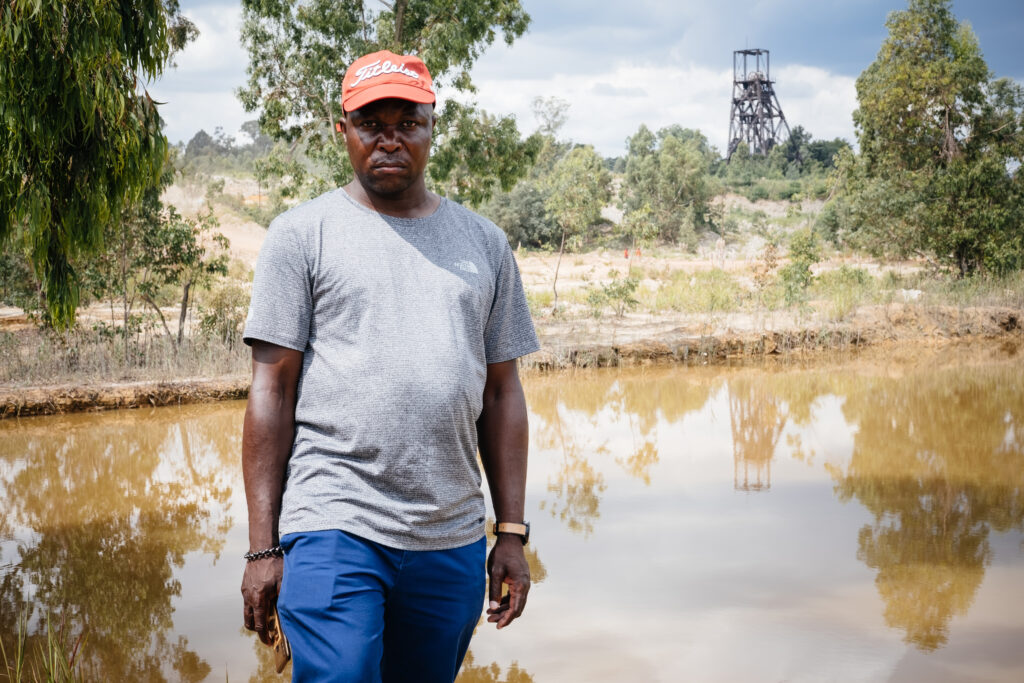 26 January 2022. Chairperson of the Johannesburg Mining Environment Economic Forum, Godfrey Makomene, 50, at Durban Deep in Gauteng, near to where 10-year old Mapula Raleholi drowned in a mine dam over the 2021/2022 Christmas holidays. Photograph: James Puttick.
Milne said Amatshe Mining has had discussions with the local residents. “We’ve asked them to provide us with berm patrollers to make sure we’ve got a presence on site that will address any kids coming to swim at any given stage. It won’t happen overnight. You need to mobilise equipment, cash and do a range of other things.”
On 7 January, Thabang Zulu, 11, drowned in a deep body of water adjacent to a defunct mine dump in Slovoville, Soweto, while swimming with friends.
On 20 January, Nasri Trollip, 9, and Wyatt Peters, 7, drowned while swimming in DRDGold’s rainwater containment paddock in Reiger Park in Boksburg, Ekurhuleni. According to its statement, “The existing conditions compel the mine to consider the issue of securing the facility on an integrated basis to eliminate the risk to vulnerable members of the Reiger Park community.”
Hassen Lorgat, of mining watchdog Benchmarks Foundation, said it demanded a transparent system of tracking the mine tailings with citizen oversight. “This is the first step towards keeping them accountable and avoiding unnecessary death as what happened in Reiger Park recently.”
In KwaZulu-Natal, the Zululand Anthracite Colliery disaster — when coal slurry dam collapsed, releasing toxic waste into the Umvalo River — shows that “animals, plant life and humans are at risk of poor and negligent management of tailings facilities. Those who pollute must pay and our regulatory bodies must wake up”, Lorgat said.
Liefferink said The government’s failure to enforce the requirements of the Mine Health and Safety Act “has largely contributed to the tragic loss of innocent young lives”.
According to Max Madubane, the chief inspector of mines in Gauteng, water sources that are “deliberately accumulated” for use by mines are fenced, but these are often stolen or vandalised.
“Another water source is depressions in the ground that fill with rainwater … and underground water. When there’s rain, the water accumulates … We are talking to the mines to traverse their sites for these depressions, especially after early rains. Some mines have done well to drain this water, especially where it’s next to residents.”
Liefferink acknowledged the difficulties of theft and vandalism. “But alternative measures such as access control and awareness creation campaigns ought to be implemented by mining companies to make these areas safe.”
Madubane said mining firms are exploring “virtual fencing” while the department is in discussion with them about building swimming pools “without imposing any undue expenditure on them” at local schools in host communities. “This will go a long way to assist.”
Liefferink described this as “facetious” and “clearly demonstrating the little value the department attaches to the loss of innocent lives”.
Back in Durban Deep, Raleholi tells how she and her husband, an illegal miner, moved to South Africa from Lesotho to find work. They share a one-room shack with their three other children.
“There are no jobs and life is tough here,” she says. “I don’t have money to consult lawyers about my daughter’s case. I don’t have a voice. There is no justice here.”
[/membership]