About 32% of the population is unemployed; of the employed, 35.9% are in informal work; and of the formally employed, nearly 40% earn less than R3,500 a month. Photo: Phill Magakoe/AFP
The recent unemployment statistics add colour to a picture that has been grim for years. Out of 10 South Africans 3.5 are without work.
This is a number Statistics South Africa (Stats SA) confirmed with the Mail & Guardian after the release of the Quarterly Labour Force Survey for the fourth quarter of 2021 on Tuesday.
The official unemployment rate increased by 0.4 percentage points to 35.3%, the highest since the start of the survey in 2008.
Recent surveys have all recorded unemployment rates at the highest levels since 2008.
“We keep hitting these record highs four quarters in a row. At what point will the penny drop? When is it considered a crisis worth doing something about?” said Gina Schoeman , a Citibank economist.
“It is a scandal that the government cannot get us out of this crisis,” added Duma Gqubule, the founding director at the Centre for Economic Development and Transformation.
High unemployment has characterised the South African economy for decades, and the jobless rate spiralled when the Covid-19 pandemic spun the world off its axis in 2020 and the government imposed a national lockdown in response, initially shutting down all businesses save for essential services.
The second quarter of 2020, dubbed “the lockdown quarter” by Stats SA, saw 2.2-million jobs being shed.
“The unemployment figures are the bulk of the problems we face as a country because not only do they fuel protesting, but it means you have a very narrow tax base that is expected to continually pay for increasing demand of expenditure,” Schoeman said.
The protesting that Schoeman was alluding to was the civil unrest that hit KwaZulu-Natal and Gauteng last July, dealing a R50-billion knock to the economy.
“Quite interestingly, the unemployment rate increased to 35.3% and the share of working-age adults is more or less the same at 36.5%. That is concerning because it means that one out of every three people in South Africa are responsible for paying tax and for providing everything that these three people need,” Schoeman said.
“One in three, that is not a ratio we can work with from an economic perspective. It’s not sustainable.”
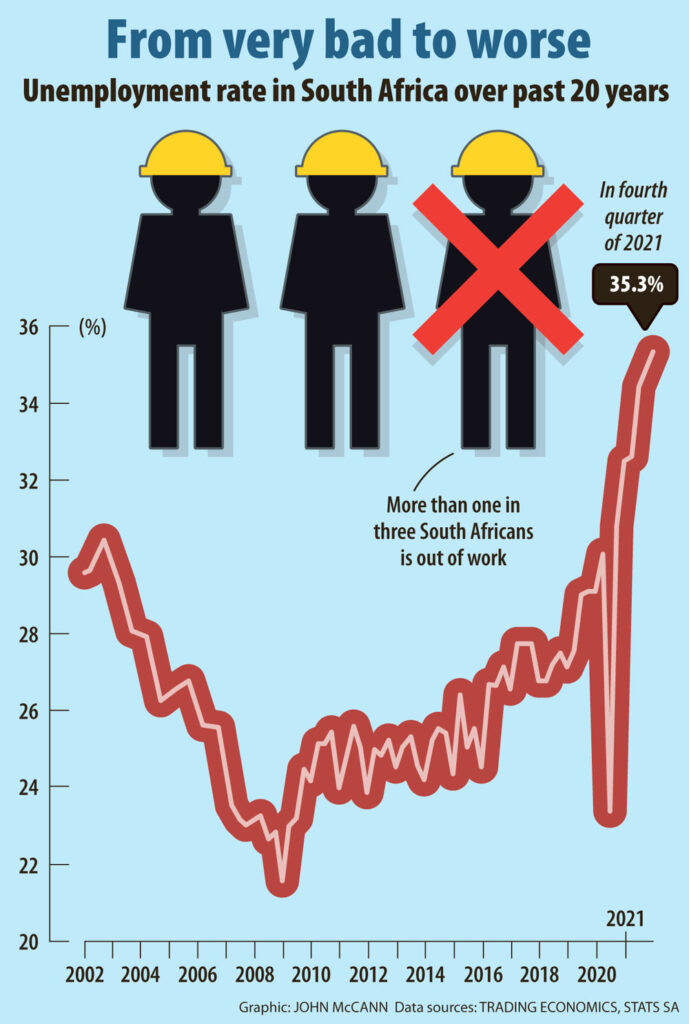 (John McCann/M&G)
Stagnant growth
GDP numbers for the fourth quarter of 2021 show that South Africa’s economy grew by 1.2%, but the economy is 1.8% smaller than it was in the first quarter of 2020, according to Stats SA.
In the national budget, tabled in February, the treasury said it expected the economy to reach its prepandemic GDP levels this year.
Gqubule noted that there is a relationship between GDP growth and employment. “The scale of the crisis we have demands us to get the economy growing. If the economy is not growing then employment will not grow … these things move together.”
Analysts previously told the M&G that the country’s economic growth was still far too low to stave off rising unemployment and possibly another bout of social upheaval. It is likely that, after enduring more than 10 years of anaemic economic growth, South Africa may be staring down the barrel of another lost decade.
Schoeman said South Africa was in a crisis, with growth stuck at 1.5% on average, adding that the economy was not creating jobs because there wasn’t the type of investment that created wages to hire people.
“If that is the problem we are facing, then you are going to get an upward pressure to spend more on things such as social grants,” she said.
South Africa currently spends most of its budget on social grants. While delivering his budget speech for 2022, Finance Minister Enoch Godongwane said the department of social development woulduld will receive the largest allocation — R58.6-billion — over the medium term.
Vulnerable laid bare
The unemployment rate is now 35.3% — or 46.2% if you count discouraged work seekers. That means 11.7-million people in South Africa are without work.
Black women are still the most vulnerable, with an unemployment rate of 42.4%.
There are about 10.2-million young people aged 15 to 24, of which 32.8% are not in employment, education or training. The graduate unemployment rate is 11.8%.
Schoeman said it was “quite concerning” that the unemployment rate for skilled individuals was so high.
Gqubule added: “I take offence at people saying people are unemployable because they are uneducated because it is not true. I like to look at the expanded definition and if you upack it, you will see that the unemployment rate for black women is 55.7% and for the youth it’s 77%. If we continue on this trajectory we will have 17-million people unemployed by 2030, based on the status quo.”
According to Schoeman, unemployment has a grave socioeconomic effect, because it not only provides upward pressure on the government to spend more on social welfare but on other crucial support structures such as the health system.
“If you don’t have any income you eat what you’’ve got and your health is compromised and you then put more pressure on the health system,” she said.
“It puts pressure on the outcome of the education system because kids get pulled out of school so they can contribute to the household income and what you end up with is a low skilled/unskilled base because everyone is hungry for income because we don’t have enough jobs.”
One of the solutions to South Africa’s unemployment crisis is public employment schemes, Gqubule suggested.
“The Expanded Public Works Programme gives half a million people jobs on a budget of about R3-billion a year. That has to be scaled up significantly and we should have a target of five-million public employment jobs. The project must provide full-time jobs as opposed to part-time jobs and the salaries need to be improved,” he said. “These are starvation wages that were paid to people on this programme. They must be fed at the minimum wage at least.”
The Expanded Public Works Programme is a government programme aimed at providing poverty and income relief through temporary work for the unemployed.
Gqubule said that another solution would be to restructure industrial policies: “Our industrial policies are not funded. Industrial policies steer the economy towards sectors that are high employment multipliers. You also have to create jobs that fit the education and skills profile of the workforce that we have, not the workforce we wish we had.”
An effective way to steer the economy would be to move people from agriculture to light manufacturing such as clothing, textiles so there is a national progression as the population is educated towards more complex activities, Gqubule added.
The largest decreases in employment were recorded in the manufacturing and construction sectors, which lost 85 000 and 25 000 jobs, respectively.
Schoeman attributed the jobs shed in these sectors to mechanisation which is happening globally.
“You just naturally have the labour shedding that comes with mechanisation. But at the same time, if you are not creating income in an economy you are not creating domestic demand and so you have no demand for your manufactured base from an internal domestic perspective and that affects employment in those sectors,” explained Schoeman.
Anathi Madubela is an Adamela Trust business reporter at the M&G.
[/membership]