Group of people working at a chicken factory doing quality control
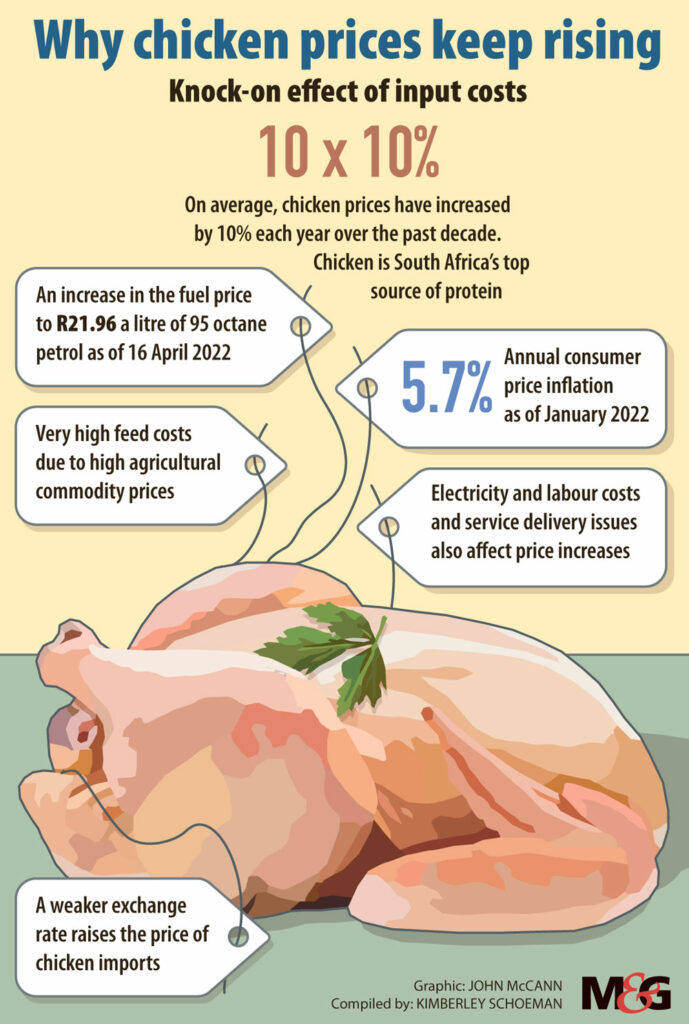
South Africa’s poorest households are again feeling the pinch as prices of chicken – considered a staple and affordable meat protein – increased because of inflation, the higher cost of feed, record-breaking fuel prices and Russia’s war in Ukraine.
The price of the white meat rose by R1.70 a kilogramme on Monday — from R42.19 to R43.89 — and is set to increase again in June, according to Donald MacKay, Trade Economist at XA International Trade Advisors, who spoke at a media briefing.
“We’re faced with a situation where chicken is rising in price more rapidly than other food products, and will rise more rapidly should tariffs in place continue,” said MacKay.
Tariffs means price increase
In 2020, the government raised the tariff on imported poultry products from 37% to 62% as a measure to protect the domestic poultry market.
“Chicken imports accounts for 14.9% of all chicken consumed in SA. Imports are a competition with an important impact to keep the price of chicken in check,” said Paul Matthew, chief executive of the Association of Meat Importers and Exporters (AMIE).
“The 62% duty is on boning chicken [wings, drumsticks, leg quarters] that is consumed most enthusiastically in South Africa.”
Consumers who depend on chicken as a protein source have already felt the weight of increased costs in transport and electricity. The country’s 35.3% unemployment rate has also led to significant belt tightening in poorer homes.
“At the end of the day, the biggest poultry consumers are the poorest. They’re the ones who are hit the hardest, and feeling the pinch of these tariffs,” said Matthew. “Despite saying they’re not upping the prices, the trends say otherwise. Consumers are going to face an increase in chicken prices.”
Brazil is the largest importer of chicken to South Africa, followed by Ukraine and Spain, said MacKay. But local producers are not exporting to places such as the European Union because of differing preferences in chicken portions and the unwillingness to change production methods.
“Local producers do not want to meet sanitary requirements to put poultry in the European market,” MacKay said.
Matthew added: “The willingness for local producers to export is low because of an investment to change their production methodology.”
Brining practices also contribute to the resistance to export chicken because international markets have stricter regulations against the practice of increasing weight by injecting salty water into the product.
“A brining judgment brought forward in 2016 against Rocklands Chicken that found they were ‘brining’ to a level of 60%,” said Matthew. “This creates a problem because of the focus on short term benefit. Now exporting has become a burden due to sanitary requirements, where other countries don’t have the luxury of brining.”
Solution: Cut VAT and tariffs
Matthew said there is an effective solution that the government can introduce to intervene in rising chicken prices. “Give consumers a three year relief on imported poultry. Remove VAT and the tariffs on chicken as long as supermarkets agree.”
AMIE executive board member Grant Hendricks said removing VAT and the import tariff would provide a great relief to those in lower-income households.
“Because of the price increases, it will cost between R80 to R100 a kilogramme. If you’re earning around R3 000 a month, it’s becoming more unaffordable. The trend is moving towards buying more processed meat,” he said. “Lower-income households don’t have the luxury of adjusting their diet to meet these price increases.”
[/membership]