Farmers and auction houses say the theft of cash from the president’s farm has unfairly stained the business of big game
Wildlife ranchers say the furore about the theft of cash from President Cyril Ramaphosa’s Phala Phala game farm in Limpopo has unfairly tainted a sector of the country’s economy.
It has triggered questions about how extensive the game trade is; how many dealers declare profits to the taxman and what the legal implications are of accepting cash payments.
But for many, this is an unfair characterisation.
“We are farmers, not politicians,” said a leading game farmer, who asked not to be named. “This is all just a lot of crap. Game farming is like other businesses; like property or the auto trade. People do private sales in cash.”
Car and property sales require registrations, which is not always so in the animal trade. Do all farmers keep an inventory of stock and who knows if cash deals are done on the side?
“Most people in the game industry are dead scared of cash,” another farmer said. “Cash puts a target on your head.”
How easy is it to trade in animals?
“Not at all: you need a whack of permits to move animals,” he added.
As with many businesses, a lot is unknown but there is some data that paints a useful picture.
Flippie Cloete is an agricultural economist and head of commercial agri-finance at the farming cooperative, Senwes. Previously in academia, he did research in 2017 when the turnover in the game industry from the sale of 40 000 live animals on auction was R2.2-billion. But this was only 20% of the total sales. The rest was done privately.
Animals are sold for consumption, hunting and tourism.
Cloete said last year’s auction turnover was R322-million for 31 200 animals. “The live trade segment is estimated to be close to R10-billion but if you include hunting, it is closer to R20-billion, excluding wildlife tourism.
“There are private sales between farmers and game reserves but nobody has ever put a figure on that and to do so is difficult. You only have indicators. Wildlife Ranching South Africa did a survey among its members but its members only represent a portion of the industry.
“As far as I know, different species are also not noted in the government’s agricultural census so it is difficult to know how many animals there are at any given time. Of course, there is scope for money laundering or under-declaration to the taxman but that is true of any industry.”
Cloete said authorities from agriculture to nature conservation regulated a vast and diverse industry but there was no central hub.
Wildswinkel, African Wildlife Auctions and Vleissentraal are among the companies that dominate the trade in game.
Wildswinkel chief executive Jaco Pretorius said his company facilitated about 20 stud game breeding auctions a year and trade was brisk.
“We do about 80% of the auction turnover in our market segment and in the last few years have generated annual live game sales of between R150-million and R200-million.”
All Wildswinkel auction sale results were publicly available.
“Current auction prices are a fair reflection of the value the farmer fetches from the end-user, off highs of the mid-2000s when game fetched crypto-currency type prices. Market supply and demand are aligned.
“The wildlife industry is healthy and lucrative,” Pretorius said.
The high prices of a few years ago showed breeders were prepared to invest in top stock, having done “an amazing job to take the industry forward with the focus on improving genetics to ensure sustainable usage of their natural resources. The tourism industry, of which wildlife plays an important role, contributes significantly to the economy.
“Ours is a completely transparent process from the point of sale to delivery of the animal, everything is audited. We don’t accept cash payments. We don’t handle foreign currency. We have a database of 20 000 farmers that we’ve dealt with over the years. On average about 300 buyers register per auction. It is supply and demand and free market trade on an open platform,” Pretorius added.
Peet van der Merwe, a professor at North West University’s School of Tourism Management, described the wildlife industry as “enormous”, employing more than 500 000 people.
He said game sales for hunting alone amounted to R14-billion a year, of which R12-billion was from South African hunters.
Van der Merwe described laws regulating the trade and movement of animals as “very good”, although policing was sometimes wanting.
“The movement of animals is policed differently in different provinces by nature conservation and agricultural authorities.”
As to how prevalent private cash sales were, or under-declarations to the taxman, he said: “I don’t think anyone knows. It is probably as vulnerable as any other sector. If I have a kudu and I sell it to my neighbour, who is going to know?”
Pieter Potgieter is a game farmer in Limpopo and the president of the Professional Hunters’ Association in South Africa, which has almost 4 000 members. He said hunting, tourism and its derivatives contributed R30-billion to the economy. Wildlife was the backbone of tourism.
“You come to South Africa for wildlife, to see it, photograph it or hunt it. We have commissioned research to get more exact numbers but our educated guess is that the contribution is upwards of R30-billion and this supports huge rural communities.”
 Big bucks: A spotter signals a bid during a Stud Game Breeders auction. Several times a year game farmers and breeders buy and sell wildlife animals for millions of rands. The wildlife industry in South Africa employs about 500 000 people. Photos: Stefan Heunis/AFP
Potgieter said the Ramaphosa case unfairly muddied the industry.
“In 22 years I don’t think I have ever bought live game and paid anyone in cash. This story has blown everything out of proportion. People buy game privately but it is mostly via EFT [electronic fund transfer]. These are legitimate business expenses so why would you hide them?
“International clients coming into South Africa are only allowed to bring in $10 000 in cash. Mostly they pay by EFT or by credit card. We have to show the Reserve Bank where the money is coming from. There is a definite record.
“Besides, guys are scared of their cell phone and binoculars being stolen. Why would they carry wads of cash beyond for shopping and tips?”
Potgieter said the game industry, like any business, had private deals that weren’t logged but these were few and far between.
The Ramaphosa story, he added, raised legitimate questions.
“These should be asked. There should be scrutiny by the taxman and the Reserve Bank. But at the end of the day, this shouldn’t taint the whole industry.”
Wildlife Ranching South Africa’s Rouan Nel said the sector was adequately regulated. “The sector firmly endorses free market principles” where business transactions were concluded legally.
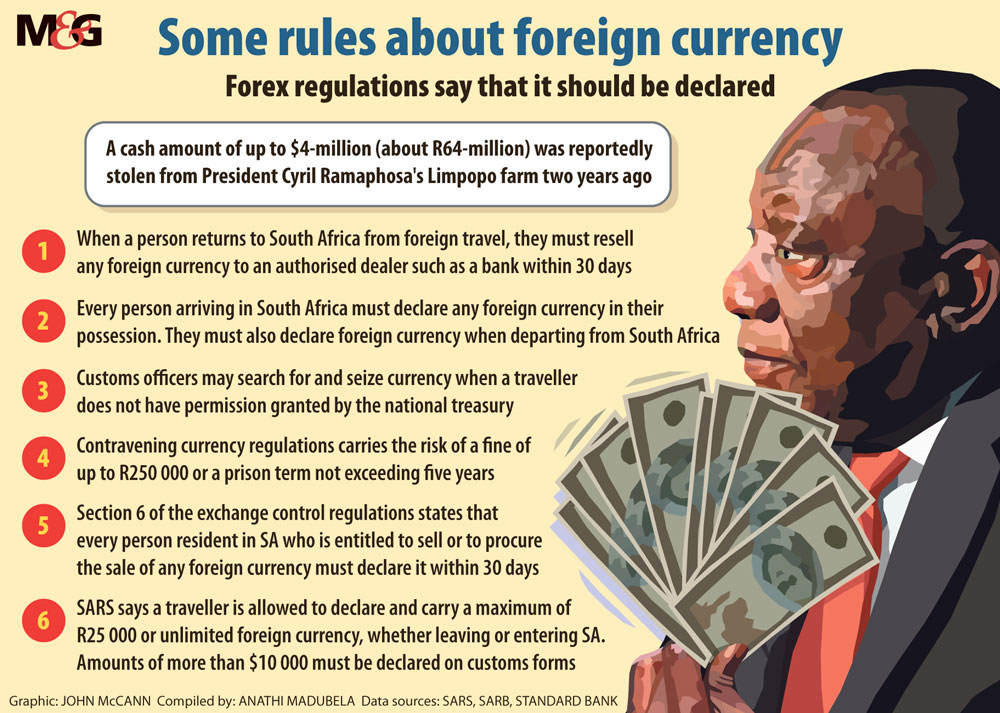
Former spy boss Arthur Fraser’s claims about the 2020 cash theft from Ramaphosa’s Phala Phala farm suggested R60-million cash in US dollars was stolen.
Anyone can receive payment in foreign exchange but this must be declared to the South African Reserve Bank or a commercial bank within 30 days and there is no limit on transactions. Banks accepting forex deposits act as “authorised dealers” and must query the source of the funds. Banks also have to declare deposits upwards of R25 000 to the Financial Intelligence Centre.The South African Revenue Service said social media claims of Sars commissioner Edward Kieswetter being a director of a Ramaphosa company were “incorrect … mischievous fake news”. Sars added that confidentiality about taxpayer information was written into law.
[/membership]