Seeing ‘red’: People attend a vigil in front of the US supreme court. (Brandon Bell/AFP)
For more than two centuries the United States supreme court has been a guiding star for constitutional democracies. In 1803 it established the principle of judicial review in Marbury v Madison. Henceforth courts could strike down laws which they found to violate the constitution.
New democracies wrote constitutional supremacy and judicial review into their constitutions. For Germany it was a way out of the rubble of World War II. The Canadian supreme court and South Africa’s constitutional court became contemporary role models.
During my first visit to America, in 1988 as a guest of their government, my day inside the supreme court was a highlight in my life. Over time my admiration has waned though.
I disagreed with the “originalist” approach of Justice Antonin Scalia, but recognised his intellect.
The appointment of Justice Clarence Thomas, in spite of serious accusations of sexual harassment by Professor Anita Hill, bothered me. Then teaching at Yale Law School, where both of them had graduated, I wondered whether this man might one day get back at those who humiliated him.
Recently his spouse, Virginia “Ginni” Thomas, participated in former president Donald Trump’s attempted coup d’etat after he had lost the 2020 election.
The lack of judicial temperament of Trump’s nominee, Justice Brett Kavanaugh, was shockingly evident during his confirmation hearing. In response to allegations of sexual assault, he angrily blamed an alleged conspiracy by “liberals” and “the Clintons”!
Two recent opinions all but destroyed my respect for the present court. One fears for what it may still do to America and the world.
In an article titled “Americans free to live under the gun. How’s that working out?” published in the Mail & Guardian on 3 June 2022, I argued that the citizens of that country did not seem to understand that gun control laws may limit their right to bear arms, without abolishing it.
A few days later it was pleasantly surprising to hear President Joe Biden, relying on a statement by Justice Scalia, stating clearly in his speech after the Uvalde school massacre that rights were not absolute and could be limited.
However, in moved Thomas and the majority he currently leads. New York Rifle and Pistol Association v Bruen, handed down by the supreme court on Tuesday 21 June, declared a more than a century-old New York state law requiring a licence to carry a concealed firearm in public invalid. To acquire the licence, one had to show a specific reason for the need to carry a firearm for self-defence.
This went too far, the court held. Things are now quite a bit easier for Mafia mobsters and Islamic State idolaters in Times Square and the New York City subway —some of the world’s busiest spaces.
The second amendment right to bear arms must not be treated as “a second-class right”, according to Thomas, referring to previous decisions, but as equal to the first amendment rights to freedom of speech and religion! This reasoning seems to result from a rather peculiar understanding of rights.
In countries like South Africa and Canada, we do not teach students about first, second, or further “classes” of rights. In determining the reasonableness of any limitation, the nature of the specific right is relevant. Expression and religion can cause serious psychological and societal damage, but not kill tens of toddlers in five minutes, like a semi-automatic gun in the hands of a maniac.
A newspaper, Bible, or Qur’an under your coat, on Broadway, is not the same as a Smith & Wesson.
After almost half a century and numerous appointments of “conservative” judges by Republican presidents, Bible Belters, Tea Party members and other “pro-lifers” succeeded on Friday 24 June in having the 1973 landmark ruling in Roe v Wade, that the constitution generally protected women’s liberty to choose an abortion, overturned.
In Dobbs v Jackson Women’s Health Organisation the majority upheld the Mississippi Gestational Age Act, which would not have passed constitutional muster under Roe. The majority repeatedly states —not in any nuanced way — that they overturn Roe. It “returned to the representatives of the people” in the states the power to legislate abortion; as it takes gun control away from the states in New York Rifle.
The many nuances of the emotional abortion debate cannot here be properly discussed. A few points are mentioned.
To shout “murder” — like some “pro-lifers” do — is a bloodthirsty war cry, not a legal argument. Abortion is not murder, because a foetus is not a person. Dobbs calls it “an unborn human being” though.
This does not mean that an abortion in the ninth month of pregnancy may never be prohibited. One question is for how long a foetus is part of a woman’s body and when it becomes separately viable; and how relevant this is.
Laws across the world differ as to dividing pregnancy into stages, with varying cut-off points for the free choice to abort. Roe worked with three trimesters. The Mississippi Act makes the provision of an abortion after 15 weeks a “felony”.
Many jurisdictions, internationally, allow abortion to save the mother’s life; to prevent serious harm to her body; or in cases of rape and incest. The Mississippi Act allows exceptions for “medical emergency or severe foetal abnormality”. Extremists — and some American states — believe that even pregnancy resulting from rape and incest is God’s will and may not be terminated.
These and other questions, in a federal system in which 50 Democratic and Republican states deal with abortion by way of varying state constitutions, laws and regulations, have caused legal chaos in the days following the delivery of Dobbs. Questions around the likely increase of dangerous backstreet abortions for poor women, abortion-driven travel across state boundaries and the availability of abortion-inducing pills remain unanswered.
About 10 “red” states have all but outlawed abortion; some “blue” states have left their laws untouched; and other states have imposed restrictions.
What could the two new judgments mean more widely? Four points come to mind.
First, the oversimplified relentless labelling of judges — like politicians, journalists, intellectuals and others — as “conservative” and “liberal” (effectively “Republicans” and “Democrats”) has resulted in, or reflects, the present dangerous division in American society.
The boring predictability of supreme court decisions is unhealthy. The judgments of an apex court as an independent arm of government should reflect the fair application of the law by way of rich, rational, nuanced reasoning, from diverse perspectives.
Independent judges are a nuisance in the way of blind predestined judicial loyalty to a brand or party. Politicians can just as well dispense “justice” themselves.
To this, the second is linked: Democracy can be its own worst enemy. A demagogue, like Hitler, elected on a tsunami of vulgar populism, can extinguish democracy. One who blatantly selects partisan judges (and calls them “my judges”, like Trump did) to serve for a lifetime, can suffocate the honest well-reasoned writing of judgements.
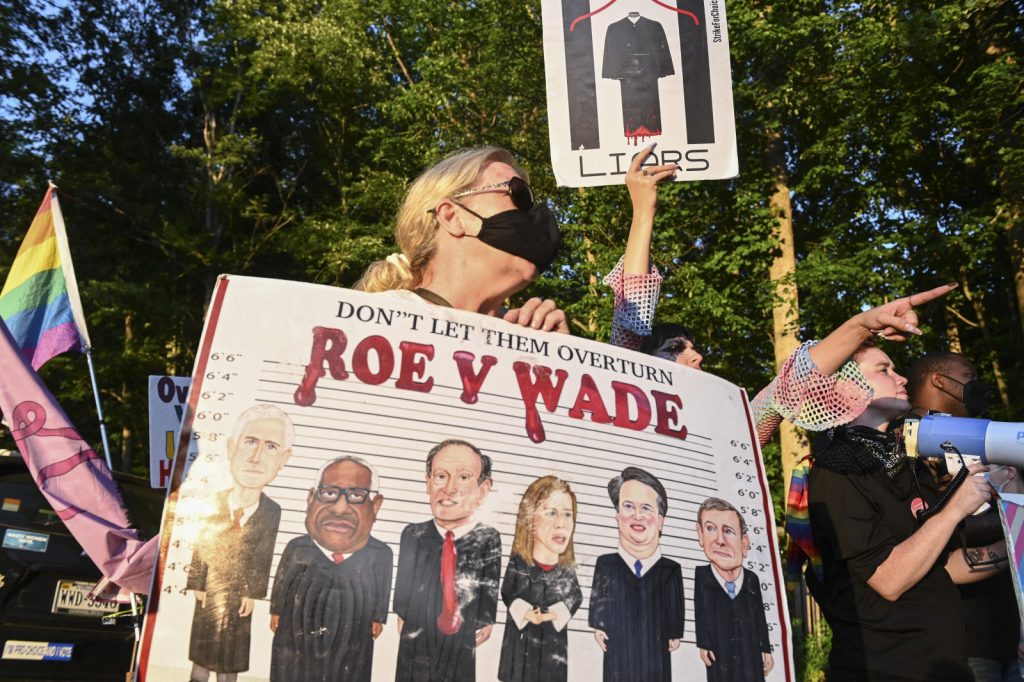 A protest outside the gated community where supreme court Justice Clarence Thomas lives. (Roberto Schmidt/AFP)
Could we be approaching the end of judicial review, on which our democracy so heavily relies?
Third, some commentators detect a global wave of conservatism. But, are conservatives not supposed to revere family life, including the protection of children? Is the desire to carry a gun in public based on conservatism, or on a personality type, exploited by moneymakers?
In the public discourse the New York Rifle opinion has been called many things, from “startling” and “a glorious victory”, to (by actress Whoopi Goldberg) “showing the middle finger to New York”. In view of the mass school and shopping mall killings just weeks before its delivery, descriptions like spiteful and sickening, rather than conservative, present themselves.
A “pro-life” preference is probably conservative, because of its link to religion, as opposed to the liberal or progressive “pro-choice” emphasis on women’s rights. What future may this conservatism bring?
In Dobbs justices Alito and Cavanaugh emphasise its narrow application to abortion. However, in his concurrence Thomas states that he hopes still to look at same-sex marriages and contraceptives! How far back into dark times does he intend to go?
Will his colleagues join his crusade? The minority opinion by justices Stephen Breyer (who has twice visited the South African constitutional court), Elena Kagan and Sonia Sotomayor mentions the “curtailment of women’s rights and their status as free and equal citizens and states that “no one should be confident that this majority is done with its work”.
Given the power behind Thomas’ statement, unnecessary for the judgement, it almost creates images of hate speech. One day after delivery of the judgment a shooting near a gay club in Oslo, Norway, hours before a Gay Pride parade, killed two people and injured several. The shooter might not have acted on Thomas’s threat, but we live in a broken world.
Lastly, generally a court may overturn its own binding previous judgement when it finds it to be clearly wrong. It is no small matter though. The Dobbs majority scathingly tears the reasoning in Roe apart and calls it “egregiously wrong”. What if our constitutional court one day regards its world famous Makwanyane judgment that abolished capital punishment as egregiously wrong?
[/membership]
The views expressed are those of the author and do not necessarily reflect the official policy or position of the Mail & Guardian.