Uneven application: Delegates at the ANC provincial conference in Limpopo, where there were calls for the party’s step-aside regulation to be scrapped. Photo: Felix Dlangamandla
ANC chairperson Gwede Mantashe has poured cold water on plans by provincial heavyweights to fight the party’s contentious step-aside rule at its policy conference this weekend.
In an interview with the Mail & Guardian, Mantashe said he was certain that when the sun set on Sunday, the step-aside rule would remain as is.
Mantashe, an ally of Cyril Ramaphosa, will be among those involved in a proxy battle against the president’s detractors, who are hoping to use the rule to advance their ambitions at the governing party’s national conference to be held in December.
“The mistake people commit — including many … journalists — is that a policy conference produces recommendations,” Mantashe said.
“The actual debate for any change of policy is in December. So there will be no change of policy in this conference … They go to the national conference, they get debated and [if] they win the day, [the] national conference [adopts them]. That’s how it works.”
Since July, regional leaders in Gauteng, KwaZulu-Natal, Eastern Cape, Mpumalanga and Limpopo have cried foul over the step-aside rule, which has mostly affected detractors of the Ramaphosa faction.
ANC leaders affected by the regulation, while unable to participate in the policy conference, will still exert their influence through delegates who support their attempt to have the step-aside rule amended, reviewed or scrapped.
In 2017, supporters of Nkosazana Dlamini-Zuma went into the policy conference at Nasrec with a package of resolutions on nationalisation, expropriation of land without compensation and white monopoly capital, which were aimed at weakening Ramaphosa’s chances of ascending to the party’s top job.
The step-aside rule will be used to serve the same purpose.
Another plan to expedite the scrapping of the regulation has been to call for a national general council (NGC), the ANC’s midterm review, which has the power to review and repeal decisions by the national executive committee (NEC).
The party has not held an NGC because of Covid-19 lockdowns.
ANC treasurer general Paul Mashatile has made it known that there would be no prospects of the policy conference being turned into an NGC.
Speaking to the media at the ANC KwaZulu-Natal provincial conference last weekend, Mashatile said only a state of the organisation report would be debated by delegates at the policy conference this weekend.
Thus far three provinces — Mpumalanga, KwaZulu-Natal and Limpopo — have indicated their intention to either have the step-aside rule reviewed and modified to deal with ambiguity and unevenness in implementation, or to have it scrapped.
They believe the regulation is being applied selectively against critics of Ramaphosa and that the modification to apply it only to those who are charged before court — as opposed to those facing corruption allegations — is a misinterpretation of what the delegates at the 54th national conference in 2017 intended when it was passed.
The implementation of the step-aside rule by the NEC, the ANC’s highest decision-making body between conferences, has sparked a backlash from supporters of former president Jacob Zuma and from provinces in which key leaders have been affected by the regulation.
The regulation has claimed a number of high-profile scalps, among them secretary general Ace Magashule, who has been charged in the R250-million Free State asbestos scandal, and former eThekwini mayor and ANC chairperson Zandile Gumede, who is standing trial over an allegedly corrupt R320-million solid waste tender.
 Accused: Supporters at Zandile Gumede’s pre-trial hearing into alleged tender corruption. The step-aside ruling stopped her from standing in the KwaZulu-Natal ANC elections. Photo: Darren Stewart/Gallo Images
Gumede was prevented from standing as KwaZulu-Natal ANC treasurer last weekend because of the regulation and also had to step aside as eThekwini chairperson after being elected to the post in April.
The eThekwini treasurer, Zoe Shabalala, who died last weekend, was also affected by the ruling because she was a co-accused in Gumede’s case.
Zuma is banned from attending NEC meetings because of the regulation because he is facing corruption charges relating to the arms deal of the 1990s.
At the 2017 policy conference, Mantashe, the ANC’s then secretary general, delivered a critique of the party’s standing in his diagnostic report.
“If we are comparable, then we must accept that corruption is therefore systemic in our movement, as was the case with the apartheid state,” he wrote.
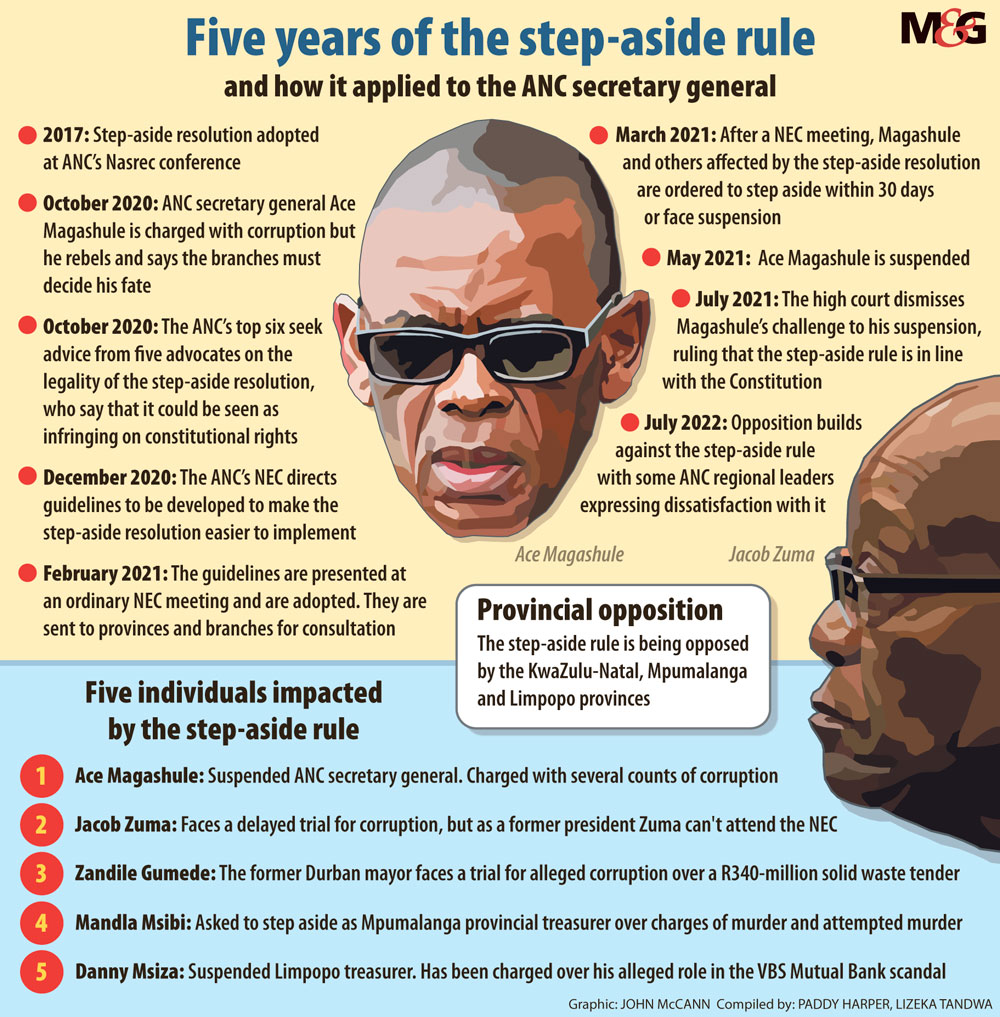
In December 2017, the national conference resolved that those charged with corruption must voluntarily step aside and those alleged, reported and accused of corruption face the party’s integrity committee.
In October 2020, Magashule was arrested and charged with 21 counts — later increased to 74 — of corruption, money laundering and fraud relating to the asbestos project during his time as Free State premier.
Magashule was expected to step aside but he rebelled and insisted that branches must decide his fate.
It was in that same month that the ANC’s top six sought legal advice from five advocates — among them former ANC treasurer general Mathews Phosa, Dali Mpofu and Gcina Malindi — on the legality of the resolution.
All decided that the step-aside rule could be seen as infringing on the constitutional rights of members and could be challenged in the courts.
In December 2020, the NEC moved the goalpost a little further. The party directed its top six to seek party elders — former president Kgalema Motlanthe and Phosa — to develop guidelines to make the regulation easier to implement for the faction-riven NEC. The two veterans had six weeks to produce and present the document.
The guidelines were presented in the February NEC meeting and allowed for:
l Stepping aside after indictment on criminal charges;
l Temporary suspension after indictment on criminal charges;
l Temporary suspension pending ANC disciplinary processes after indictment on criminal charges; and
l Dealing with allegations of corruption or serious crime.
They add that the decision to step aside must be reviewed periodically by the NEC, the national working committee, the provincial executive committee or the provincial working committee at least once a year, or from time to time at the request of the member, office-bearer or a public representative.
The guidelines were adopted and have been taken to provinces and branches for consultation.
 (John McCann/M&G)
On 30 March last year, after a chaotic NEC meeting, which was extended when members quarrelled over the step-aside rule, Magashule and others affected by the regulation were ordered to step aside within 30 days or face suspension.
Since then resentment has festered over the regulation and its implementation, with the regional and provincial structures pushing to scrap the rule at the national conference, although this might be too late to allow leaders such as Magashule and Gumede to stand for election in December.
Delegates at last weekend’s KwaZulu-Natal ANC conference noted “the urgency to review the implementation of the step-aside resolution in order to position the organisation on a trajectory for unity and renewal”.
The conference resolved that “the delegates to the national policy conference must forward a proposal that the step-aside resolution must not only be reviewed but must be scrapped”.
Provincial secretary Bheki Mtolo said the conference wanted to “holistically review” the step-aside rule, which was not a law of the country but rather a regulation that the ANC had decided to apply to its members.
“All the proponents of step-aside, they don’t implement step-aside in their own organisations but they celebrate the step-aside in the ANC because it constrains the ANC to discharge its responsibility and it makes the ANC to be in a continuous fight among itself,” Mtolo said.
In his closing remarks, newly elected ANC KwaZulu-Natal chairperson Siboniso Duma said the step-aside rule was being “weaponised’ against some ANC members but not being applied to others.
Mpumalanga held its provincial general council meeting on Monday and Tuesday, at which branches called for a review of the regulation and its implementation, but not for it to be scrapped.
The provincial treasurer, Mandla Msibi, who is facing murder charges, had to step aside earlier this year after being elected.
Addressing delegates, deputy secretary Lindiwe Ntshalintshali said branches should be given the space to discuss a review of the regulation but that once a decision was taken at the national conference in December, they would be bound by this.
“I must say that there were some serious reviews on the step-aside rule because [of] how the national conference resolved on the matter, and how it is implemented is not what the conference resolved on,” Ntshalintshali said.
“We are here to say that there is nobody who can amend a national decision of the conference, not even the NEC. These branches are the same ones that will go to the national conference to exercise their democratic rights regarding the step-aside rule. Let us allow branches that space.”
In Limpopo, where former provincial secretary Danny Msiza was prevented from standing for election over corruption charges, chairperson Stan Mathabatha called for the regulation to be “refined” and the province’s Vhembe region wants it scrapped.
Vhembe regional secretary Rudzani Ludere said the region had come out “strongly” and wanted the ruling “scrapped off” because it was not being evenly applied.
“We must scrap it. We must use the state and the police. If there are problems with corruption, people must be charged and convicted,” he said.
Ludere said ANC members should only be asked to step aside when they were convicted, to stop spurious charges being used to block people from standing.
“We seem to be making up the rules as we go”, with the result that “step-aside as it is now is not step-aside how it was resolved”.
“It is actually dividing the movement,” Ludere said. “It is very unfair, especially for a democratic movement like the ANC, to adopt these kinds of policies.”
[/membership]