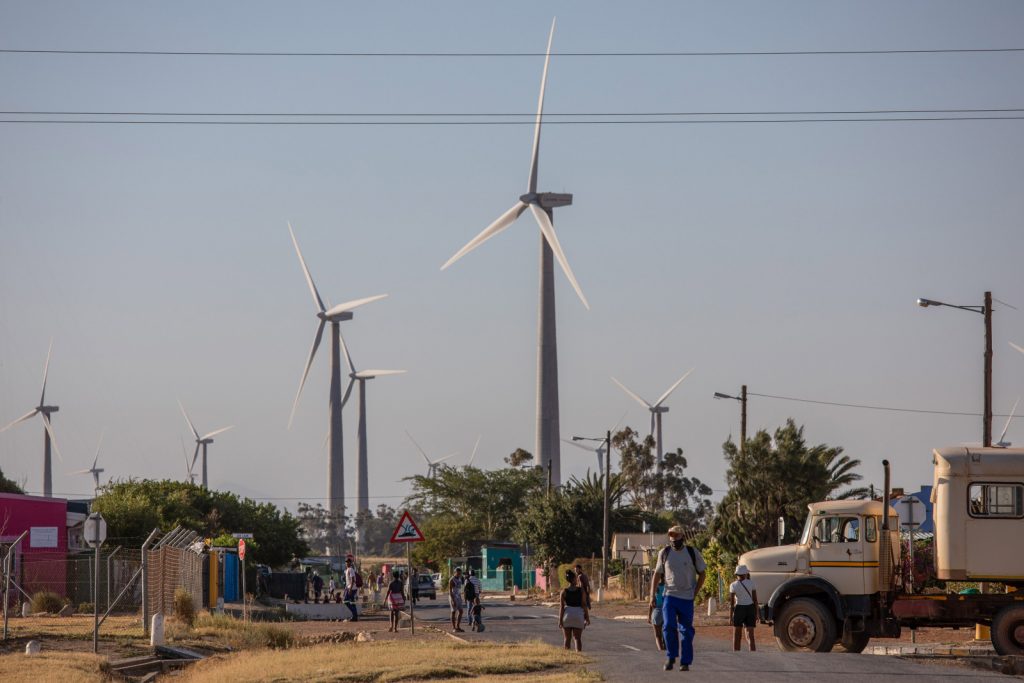
Photographer: Dean Hutton/Bloomberg via Getty Images
A just transition is perhaps one of the biggest topics in South Africa at the moment. Since COP26, the 2021 United Nations Climate Change Conference held in Glasgow, when wealthier countries pledged to help South Africa and other developing countries wean off coal and move to more clean energy, it has been two words regularly seen and heard. But what is it?
The International Trade Union Confederation defines it this way: “Just transition secures the future and livelihoods of workers and their communities in the transition to a low-carbon economy. It is based on social dialogue between workers and their unions, employers, government and communities. A plan for just transition provides and guarantees better and decent jobs, social protection, more training opportunities and greater job security for all workers affected by global warming and climate change policies.”
Mark Swilling, co-director of the Centre for Sustainability Transitions at University of Stellenbosch, says a transition normally happens when three shifts take place simultaneously: when there is a new energy system, a new mobility system and a new communication system. “When these three interact, you get major industrial transformation.”
But a just transition is much deeper and complicated than that.
An unjust transition
“What South Africa needs is a deep just transition,” said Charles Simane, a researcher and organiser at the Co-Operative and Policy Alternative Centre, a nonprofit for a grassroots driven transition.
“This is different from the ‘just transition’ popular in mainstream media. The just transition merely focuses on transitioning from fossil fuel-based energy systems toward renewable energy, thereby cutting down carbon emissions. However, as the Climate justice Charter says, South Africa needs a ‘deep just transition’.”
He says a “deep just transition” protests against the powers of global capitalism, rejecting privatised ownership of energy for socially owned renewable energy.
“South Africa already has deep structural and racial inequality and we cannot separate that with this green transition we are facing. So in addressing climate change in South Africa, we have to bring the same energy in addressing structural and racial inequality,” he said.
 “An unjust transition is a transition to a decarbonised world which leaves inequality and poverty more or less intact.” Photographer: Dwayne Senior/Bloomberg via Getty Images
In a previous article, Gaylor Montmasson-Clair, a senior economist at research institute Trade & Industrial Policy Strategies, a nonprofit economic research institution based in Pretoria, said South Africa and the world were on the path to “a very unjust transition”.
“It is effectively a very pro-rich transition that benefits rich countries, rich corporations and rich households. And if we don’t do anything, that is what is going to happen. Of course, there will be some benefits along the way for the broader society. But it is actually likely to deepen inequalities,” he said.
Swilling said that as the country moves towards a just transition, care should be taken not to create an unjust one. “An unjust transition is a transition to a decarbonised world which leaves inequality and poverty more or less intact. That would be an unfortunate outcome and a missed opportunity because the renewable energy revolution contains within it the potential for giving a certain directionality to the transition to the transformed world.”
It must be about people
Just transition is clearly about the people. Simane said “a truly deep and just transition is people-centred, it subjects the economy to the needs of the people”.
He said it is one in which “grassroots women, workers and the most vulnerable are the top priority, not the stock market or the interests of shareholders who have already benefited immensely from destroying the earth with fossil fuels”.
With the world inching towards greener and renewable energy, everyone needs to be cautiously taken on board. It shouldn’t be about the benefit of one rather than the other. More importantly, we should always remember why the world has collectively decided to move to greener energy — to save the planet for those who are still going to occupy it.
Swilling says he does not necessarily believe the direction the transition is moving towards is appropriate and that it could be steered into an “energy democratisation”.
Simane said: “A deep just transition is a socio-ecological transition that respects the boundaries of the Earth and understands that infinite growth is impossible on a finite planet.”
[/membership]