Ready-made solution: The Shackbuilder team constructs a house in Wesbank as an architecture student from Norway (left) documents the process. Photos: David Harrison
A circle of young men mix cement while others — including women — in rhythmic accord lay the foundation of a new home for a resident in Wesbank in Vogelvlei, an informal settlement outside Cape Town.
Against the familiar backdrop of poverty, unemployment and lack of opportunities, the building site managed by non-profit organisation The Shackbuilder is an unusual and uplifting sight.
The enthusiasm rings through in 23-year-old trainee Yonela James’s voice as she explains her varnishing method to Lucas Scheffer, 25. Scheffer, as well as three others on the site — Gabriel Alfnes, Thorvald Ness and Are Bergervd — are masters degree students studying architecture at the Norwegian University of Science and Technology, the largest university in that country.
For the next two months, the Norwegians will accompany the Shackbuilder team to several locations in the Western Cape and Northern Cape to gain and share architectural knowledge.
The Shackbuilder team consists of previously unemployed people as well as six trainees forming part of the organisation’s Backyard Varsity programme that was launched in 2021 and has seen several jobless young people gain valuable construction, business and management skills to help them get jobs.
The beneficiary of the house under construction is a woman known as “Druppels”, who lost three children and her husband when their backyard dwelling burnt down in July.
Equipped with notebooks and analogue cameras, the Norwegian students document how the houses are assembled. In their best English, the South African artisans explain their methods and building processes.
“We hope to learn a lot from them,” says Marvin Blauw, a 22-year-old Capetonian who is the project leader on one of the houses being built. This role is passed on to someone else in the team each time they start with a new house.
Working with the international team means a lot to Blauw, in that “people are really noticing the work we do for the community”.
“I’m proud of our team. I take my hat off to them. They never complain and work hard,” he tells Mail & Guardian.
In between taking pictures of the building process, Alfnes, 27, explains that the collaboration has both short- and long-term goals. First, it is “helping the Shackbuilders build new designs for their shacks — the architectural component — and [to] create methods to better understand how they can adapt their shacks within the urban fabric of the city”.
Secondly, they want to demonstrate the method of documenting the building process by way of taking pictures “to help build better structures”.
This includes workshops with communities to understand their perceptions of housing.
Alfnes commends the Shackbuilders’ Backyard Varsity programme, which teaches participants basic construction skills while also building much-needed homes. He says the Norwegians have learned a lot in the two weeks they have been in South Africa. This includes how materials are recycled and reused, which Alfnes says is a “wave hitting Europe”.
“These building models are something that is going to be a big part of European architecture in the years to come. Maybe not the biggest commercial projects, but many of the small ones. Especially temporary structures, moveable structures that you can disassemble and reassemble,” he says.
As he watches James varnishing a door, Scheffer says the construction methods are “different and not quite comparable” to the Norwegian ones, but he admires the sustainability of the Shackbuilders’ approach.
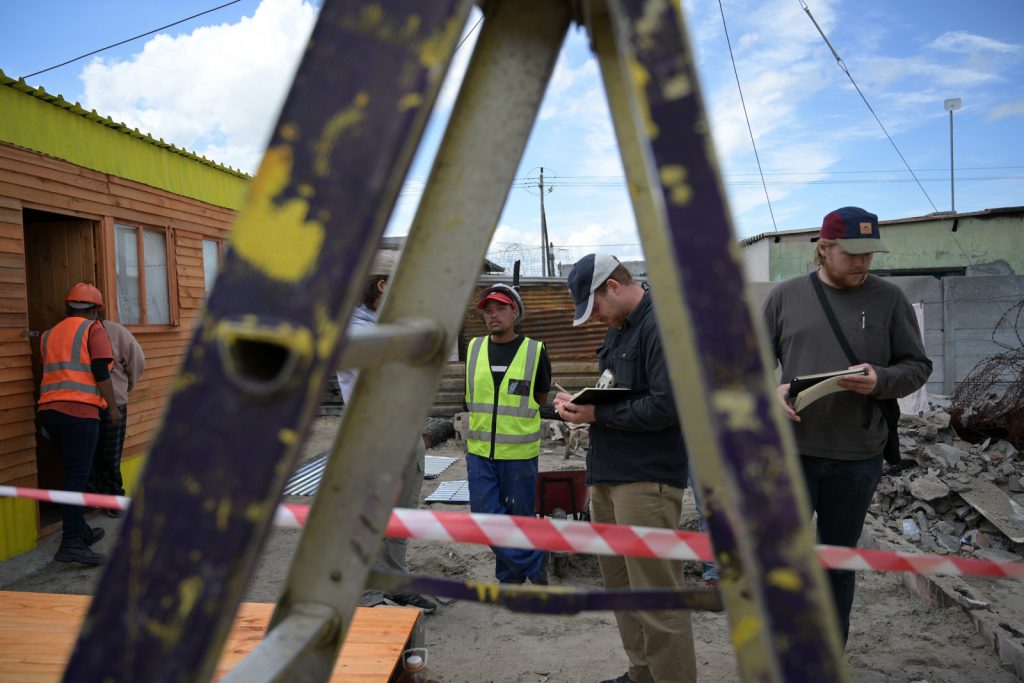 Work in progress: Norwegian students take note of the design and materials – mostly recycled – that Shackbuilders use to build houses in the Western Cape.
While the structures might be intermediate — and not as durable as a monument or church — the construction method is sustainable from a social, economic and environmental perspective.
When a housing project is completed, it means a number of unemployed youth have gained valuable training in construction work, someone has received a house and previously used materials are recycled and put to use again.
Ryan Jansen, a 28-year-old from Wesbank, left school in grade 11 when his mother became ill and he had to earn an income for his family. He never received further training or tertiary education and was making toys for children from recycled material when he was added to the Backyard Varsity team a month ago.
Jansen has big plans for when he finishes his construction training in November.
“When I am done, I can put my certificate on my CV,” says Jansen, pointing north to a local business that builds bungalows that will then “not think twice” about offering him a job.
[/membership]