Tricky: Chief Justice Raymond Zondo hands President Cyril Ramaphosa the State Capture Report, which contains 353 recommendations on criminal sanction. (Ntswe Mokoena)
There was always the fear that the government’s response to the painstaking, sometimes quixotic recommendations of Chief Justice Raymond Zondo on prosecuting and preventing state capture would be inadequate. Sunday evening’s address by President Cyril Ramaphosa on the subject proved it was well-founded.
The president’s undertaking on the findings came with a reminder that he holds three options with regard to every one of the recommendations — implement in full, in part or not at all.
There is no remedy if a proposal is ignored, no prospect of taking his decision on legal review, because by law the enjoinders of a commission of inquiry are not binding.
More than half of the 353 recommendations in Zondo’s six-volume report concern criminal sanction for those who committed or enabled state capture.
Here, Ramaphosa could appear firm. He mentioned the arrest of 165 accused, among them Brian Molefe and Anoj Singh, in 26 grand corruption cases and the initiation of 89 investigations by the Investigating Directorate (ID).
And he confirmed that the directorate set up to spearhead state capture prosecutions would be made a permanent entity.
To date, he added, the Asset Forfeiture Unit (AFU) and the South African Revenue Service have obtained freezing orders worth R12.9-billion and the AFU has returned R2.9-billion to whence it was stolen.
In Ramaphosa’s report to parliament, he said the AFU would, with the help of the ID and directors of public prosecution, develop a strategy specifically for state capture cases.
On Wednesday, the treasury undertook to grant the National Prosecuting Authority (NPA) more money in the 2023 budget.
Analyst and author Ebrahim Fakir said the president could rightly claim progress and success, but the public remained sceptical that the funds recovered would be put to proper use this time around.
“People don’t trust that that money is going to go into the right places, or that the return of public investment that will be made from it will be productive,” he said.
“Anywhere but the welfare system, the return on public investment is extremely low. So trust is low.”
Lawson Naidoo, the executive secretary of the Counsel for the Advancement of the South African Constitution, said if Ramaphosa’s response was “underwhelming”, the announcement on the ID was welcome, partly because permanency would help to resolve its recruitment problems.
Zondo lamented the historical weaknesses of the NPA and called for the creation of an independent anti-corruption agency.
It would, he remarked in an interview, require an “army of prosecutors” to bring before court all those he named in the report.
But the president’s approach to shoring up the state’s capacity to combat corruption seems more piecemeal, Naidoo said. The report to the legislature points to the ongoing review and redesign by the justice department of the country’s “anti-corruption architecture”, saying little more than that entities should be properly resourced and insulated from political interference.
Interestingly, Ramaphosa gave a cryptic undertaking to resolve concerns about the justice minister’s role vis-a-vis the prosecuting authorities: “Work will be undertaken to clarify the minister’s ‘final responsibility’ over the NPA as set out in section 33 of the NPA Act and settling aspects related to the NPA’s financial and administrative independence,” he said.
Naidoo said it was a welcome signal, even if we are not told whether Ramaphosa has concluded that the obvious solution is to scrap the constitutional requirement that the minister agree with prosecutorial policy and let the NPA account directly to parliament, so that it had full operational and financial independence.
Justice Minister Ronald Lamola at the weekend took issue with what he called the political cynicism of suggestions that either he or the president was telling the NPA “to arrest this one and not to arrest this one”.
It is inevitable that not all those named in the report will be prosecuted and that it will be speculated that some were spared for political reasons.
Ramaphosa was elliptical in his response to Zondo’s adverse findings against Minerals and Energy Minister Gwede Mantashe and deputy ministers Zizi Kodwa and David Mahlobo. “In this regard, I am attending to the commission’s recommendations,” he said.
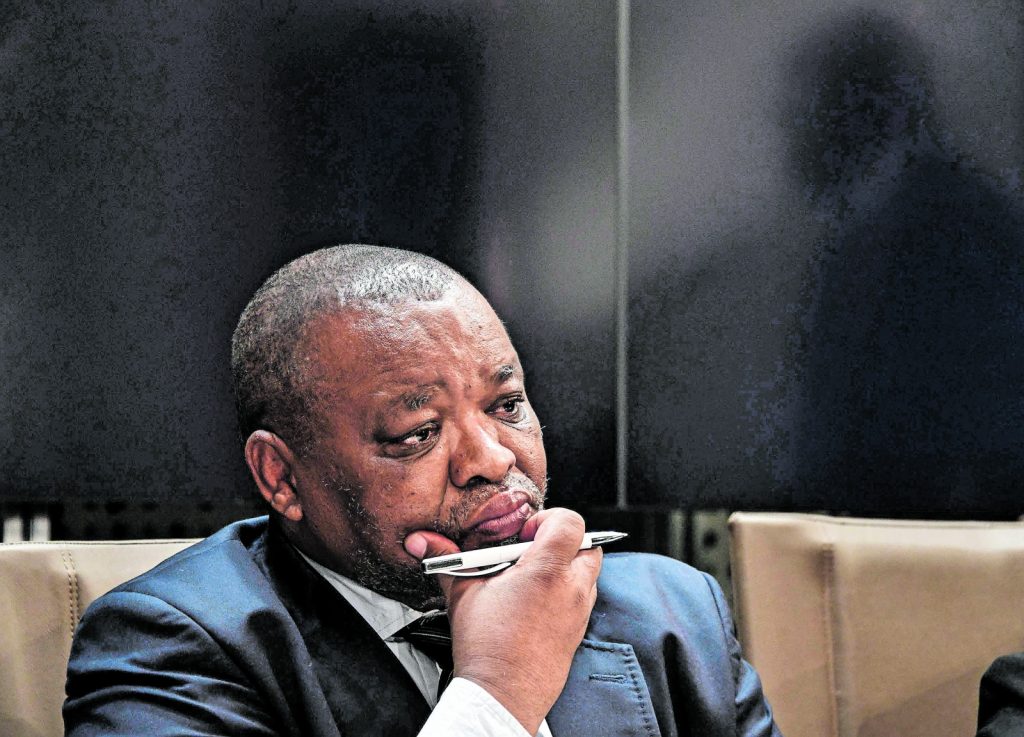 President Cyril Ramaphosa was ambiguous about the adverse findings concerning Minister Gwede Mantashe
Fakir said the president has always been constrained because of disagreements in the ANC on the report’s recommendations, including those for political reform.
“So as far as president of the republic goes, all the successes can be chalked up to that, but once he starts talking as president of the ANC and he says the ANC remains the strategic centre, to use the ANC’s outmoded language, that ANC is so divided on the findings of the Zondo commission report that it is inevitable he has to continue making the kind of compromises he has been making all along,” said Fakir.
Mantashe’s threat to take the report on review if he is investigated or charged for accepting free security installations from Bosasa illustrated the president’s predicament.
“[Mantashe] will no doubt likely be back in the NEC [national executive committee], so if an NEC member tells you he will take this thing on review, and he is implicated, then what of it?”
Former minister and Gauteng premier Nomvula Mokonyane appears on some pre-conference slates as a candidate for deputy secretary general of the ANC and may likewise rush to court to challenge the report, which recommended that she face prosecution for raking in inducements from Bosasa.
But weeks before a conference where Ramaphosa seeks another term as ANC president would be the worst time for him to sacrifice support for principle.
“He is just that vulnerable going into this conference. If he says anything that alienates any part of the party, it is a loss, because he has to court the support even of those people who he most likely would not want support from,” Fakir said.
“In this speech, I don’t think he could have done or said anything more. Frankly, it is political; he knows the ANC was at the centre of this thing, anything he says more means that he once again implicates his own party. So they will have to strike a whole range of compromises and in any case we know it is very easy to defund the NPA and the Hawks.”
The recent past and the report itself has shown how readily the criminal justice cluster can be stripped of capacity. “So literally the proof of the pudding is going to be in the eating. Molefe is on trial, Singh is on trial, how speedy, how soon those find resolution and whether there is the forensic audit and other capacity within the NPA to prosecute this kind of high-level, complicated, sophisticated crime is what everything is going to hinge on.”
Fakir predicted that the presidential dichotomy will continue past the conference.
Ramaphosa was silent on Zondo’s call to scrap cadre deployment and vague on his pleas for electoral reform as a way of sharpening political accountability.
Naidoo said the flawed Electoral Amendment bill passed last week will probably be the end of the matter and it will fall to civil society to fight for sensible reform and to save many, perhaps most, recommendations from oblivion.
Few will argue for Zondo’s more far-flung suggestions such as directly electing the president. But the chief justice is not so naive as to believe that what is politically inconvenient will be implemented, and knows his report will serve as a future reminder of what could have been done to mark a turning point.
[/membership]