Rwandan policemen guard The Total Mozambique LNG Project in Afungi in the Cabo Delgado province, Mozambique, on September 29, 2022. - Forces from Rwanda and other African countries, deployed in July 2021 after years of jihadist attacks, have helped Mozambique retake control of much of the province. (Photo by CAMILLE LAFFONT/AFP via Getty Images)
Insurgents in Cabo Delgado, in northern Mozambique have advanced southwards, with military forces meant to repel them hampered by logistical efforts, limited intelligence and understaffing.
The spread of the insurgents comes amid military efforts by the Southern African Development Community (SADC), Rwanda and Mozambique to combat it. The South African National Defence Force (SANDF) is the largest contributor to SADC’s operation in Mozambique, known as the Southern African Development Community Mission in Mozambique (SAMIM).
Since July, the insurgents have gained an estimated 134km of territory towards Nampula, south of Cabo Delgado, west towards Niassa, and north into neighbouring Tanzania.
Risk analyst Jasmine Opperman says the expansion must serve as a warning to all regional states. “The Islamic State is presenting itself in its most brutal form in Cabo Delgado, unknown to the region prior to Cabo Delgado and the insurgency.
“Once the Islamic State gets a footprint within a specific territorial area, it seldom gets pushed out of it,” she said, referencing Iraq and Syria.
But there was a greater concern about Alu-Sunnah wal Jama’ah — locally called al-Shabaab or Mashabab — than the Islamic State and violence “could easily spread to other parts of Mozambique and countries in Southern Africa”, according to an August study by the Institute for Security Studies and the Judicial Training Institute of Mozambique.
The study said the insurgency was the result of poor governance, valuable natural resources such as minerals, endemic corruption and political exclusion. It added: “It is observed that the escalation and sustenance of terrorism in Cabo Delgado are the result of intertwined foreign and domestic factors, which are evolving with the conflict.
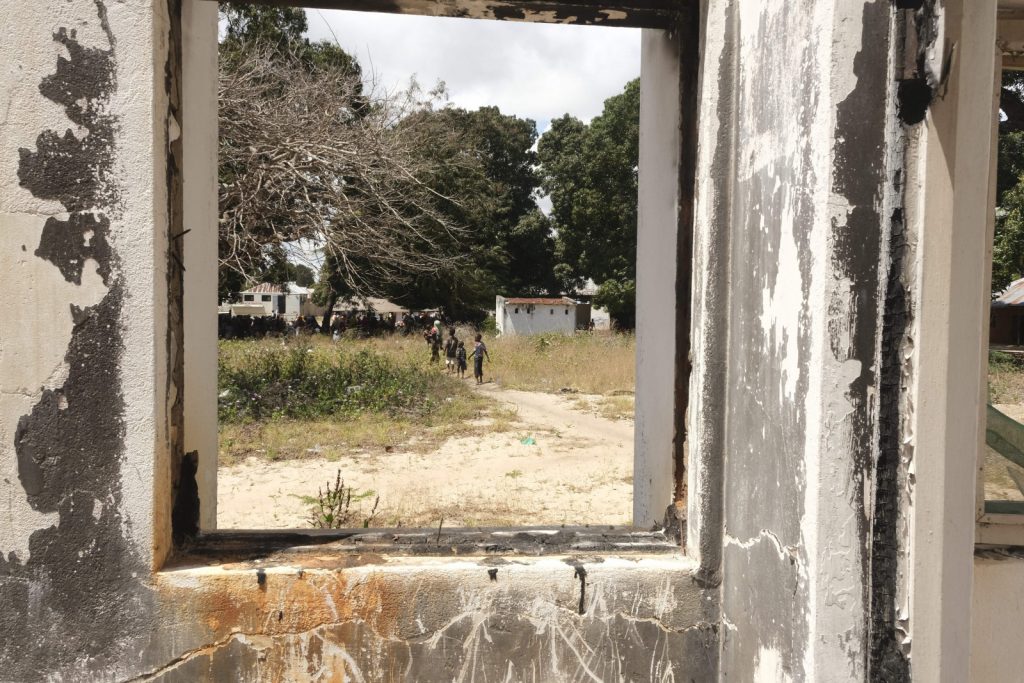 Children are seen through a broken window on September 30, 2022. – In March 2021, fighters affiliated to the Islamic State group attacked the port city of Palma — the jewel in the crown of a gas project that would supposedly shower Cabo Delgado province with good jobs and desperately-needed infrastructure. (Photo by Camille LAFFONT / AFP)
“Although the violence is committed primarily by Mozambicans, evidence suggests that without the foreign element, terrorism would probably not have escalated in October 2017. At least, it would have been far less intense,” reads the study.
Opperman’s comments come in the wake of a terror alert issued by the United States government this week about the possibility of an attack in Sandton, Johannesburg.
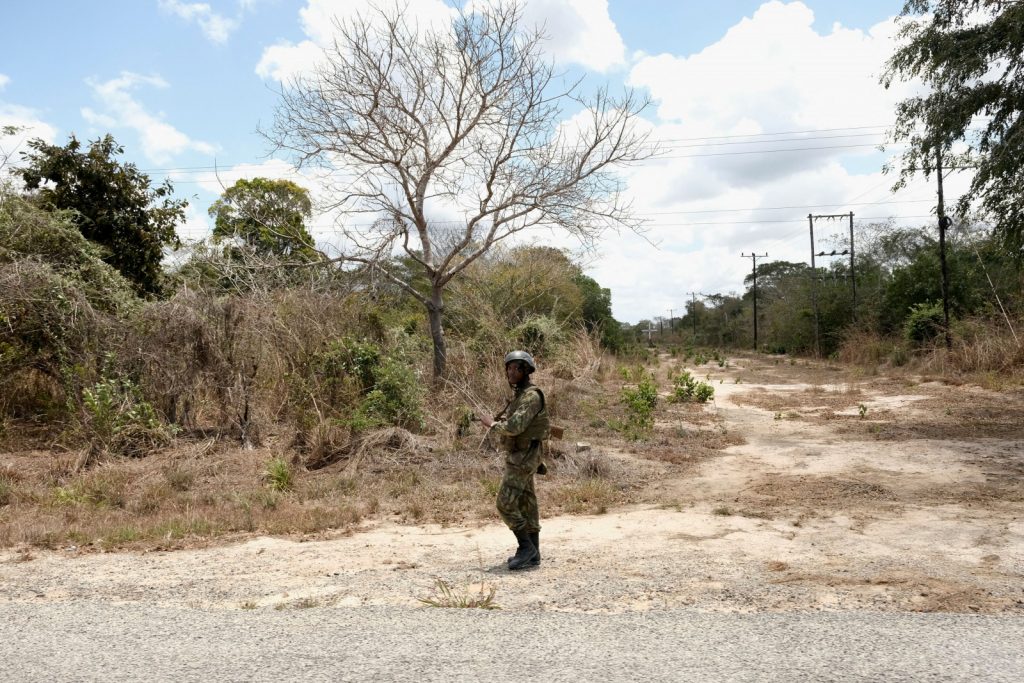 A mozambican soldier on patrol close to Mocímboa da Praia, a town in Cabo Delgado province liberated from jihadist insurgents, on September 27th 2022, in Mocímboa da Praia, Mozambique. (Photo by Camille LAFFONT / AFP)
In its alert, the US said it had received “information that terrorists may be planning an attack targeting large gatherings of people” in Sandton, but added that it had no further information “regarding the timing, method or target of the potential attack”.
News24 reported that attacks could be targeted at a gay pride march, a show by Jewish comedian Nik Rabinowitz or the peace talks taking place between factions involved in conflict in Ethiopia’s Tigray region.
When contacted by the Mail & Guardian for comment, David Feldmann, spokesperson for the US Embassy in Pretoria, said: “We don’t have anything to add to what’s already in the security alert.”
Opperman said: “Officials must be more clear to calm down the public hysteria, statements are too vague and too general.”
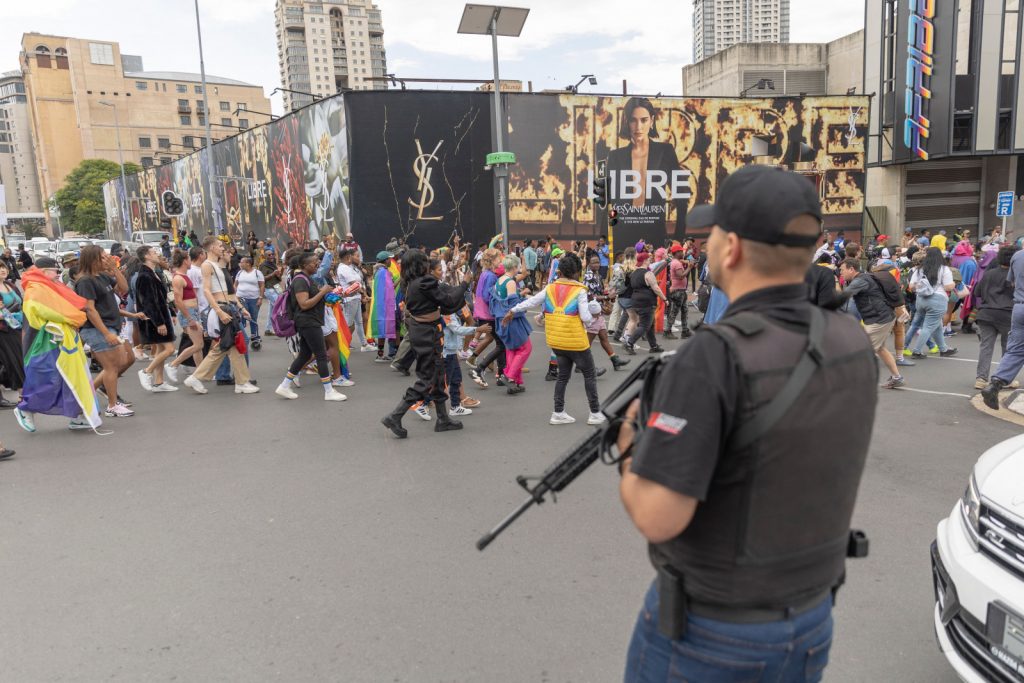 Members of SAPS (South African Police Services)on as people march in the streets during the Johannesburg Pride Parade on October 29, 2022 in Johannesburg. – The US embassy the day before posted an alert on its website and identified the potential target as Sandton. (Photo by GUILLEM SARTORIO/AFP via Getty Images)
After the US alert, the UK government released a foreign travel advisory saying terrorists were “very likely to carry out attacks in South Africa”, citing the US security alert.
“Attacks could be indiscriminate, including in places visited by foreigners such as shopping areas in major cities. The main threat is from extremists linked to Daesh (formerly referred to as ISIL). In February 2018, two South African-British nationals were kidnapped and killed,” said the UK government in its advisory.
The South African-British people being referred to were botanists and business owners Rachel and Rodney Saunders, who were allegedly kidnapped, robbed, killed and their bodies disposed of by Isis sympathisers Sayfydeen del Vecchio, Fatima Patel and Ahmad Mussa.
In its response, the South African government downplayed the warning with Deputy Minister of State Security Zizi Kodwa saying that “from the SSA – State Security Agency – point of view, there is no direct terror threat to South Africa”.
But the City of Johannesburg said it was taking the matter seriously and putting in place extra precautions for the weekend’s events.
President Cyril Ramaphosa said: “It was quite unfortunate that the US government issued that type of warning without having had a deep-dive type of discussion with us.”
As reported by the M&G on Friday, various experts and analysts have questioned the South African government’s preparedness for such an attack, heightened by the inadequate response to the July 2021 riots, which saw looters tear through KwaZulu-Natal and, to a lesser extent, Gauteng.
“South Africa’s position is most definitely not one of fortification against terrorism in the region,” said Opperman.
Although the country is not seeing an inclination towards terror attacks from Muslim extremists, the South African environment in terms of organised crime, illegal financial flows, easy border access for people with sentiments towards terror groups, “is a well known reality”.
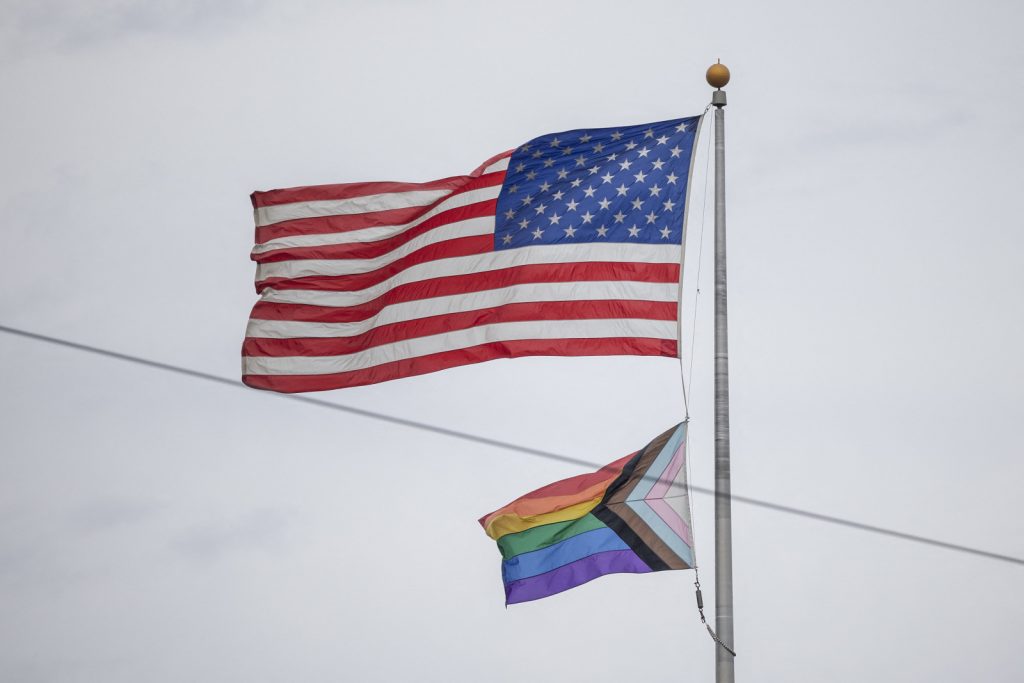 A United States of America flag and a rainbow flag are seen waving from the US consulate in the Sandton area of Johannesburg, on October 27, 2022. – The US government issued an alert of a possible terrorist attack during the weekend in the Sandton area of South Africa’s largest city Johannesburg. (Photo by MICHELE SPATARI/AFP via Getty Images)
On 20 and 23 October, two attacks took place in Mozambique. The first target was at a ruby mine, Gemrock, in Montepuez and the second at a military base in the Muidumbe district in Cabo Delgado.
The circumstances of the attacks have not been confirmed by authorities.
By the end of August, violent insurgent attacks had claimed more than 4 200 lives, according to data captured by the Armed Conflict Location & Event Data Project.
On Monday, data from humanitarian information portal ReliefWeb showed that more than 767 000 people were experiencing high levels of food insecurity, while about 945 000 were internally displaced in northern Mozambique.
The Cabo Delgado insurgency that escalated in 2017 is a complex composition of local insurgents, the Islamist group Ahlu-Sunnah wal Jama’ah — said to have no relation to the Somalia-based al-Qaedab affiliate — and foreign support from Isis.
Willem Els, a senior coordinator on transnational organised crime and terrorism for the ENACT programme at ISS, said insurgents “recently moved down in a southern direction into Nampula”.
He said the movement can partially be seen as the result of joint military efforts driving the terrorists into a corner. Consequently, they changed their tactics by breaking up in smaller cells and spreading towards other areas, resulting in stretched resources for counter military operations.
Simon Howell, a research associate at the Global Risk Governance Programme, believes Africa could become a breeding ground for terrorist groups to gather valuable resources.
He said the expansion of insurgents and Isis in Mozambique may escalate the ability and willingness of the terror group to begin recruitment of citizens. “But as a threat, in the traditional sense, I would not be too worried at the moment. Primarily their concern in Mozambique is resource-based.”
South Africa’s high crime levels rendered its daily threats “greater than what Isis can produce for the next 20 years”, he said.
This sentiment is far from unanimous.
A source close to the military mission, SAMIM, and its operations in Mozambique, said Isis was “piggybacking” on the failed state situation in Mozambique, that it had support in South Africa, and its attempts at infiltration here were a “known fact”.
The source, who spoke on condition of anonymity, said that according to intelligence “from the ground”, Isis would infiltrate KwaZulu-Natal and the Western Cape “within five years”.
Opperman said there was no basis to the time frame.
“Time is their greatest ally. They don’t work in Western time frames … They have time on their side” as they seek out opportunities for their expansion, she said.
“We should be concerned about the Islamic State but let’s be sound in our analysis.”
A source in a senior position in South Africa’s justice system, and who works closely with terrorism cases, expressed concern for the absence of urgency in the government to prioritise the gathering of intelligence and successfully prosecute incidents relating to terrorism.
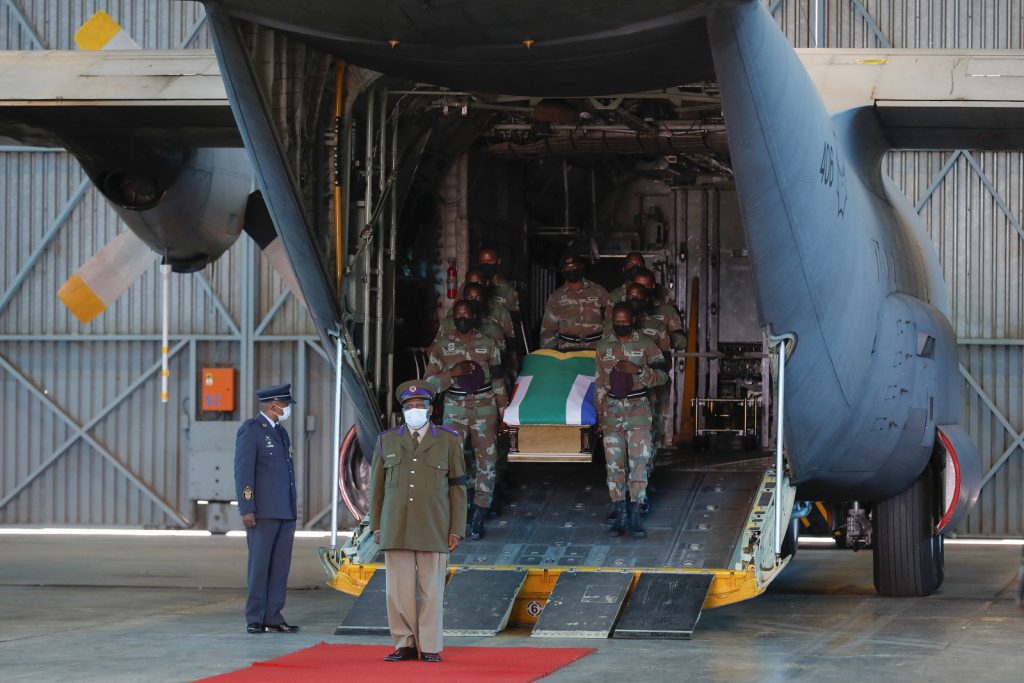 South African National Defence Force members carry a coffin containing the mortal remains of Corporal Tebogo Radebe at the Air Force Base Waterkloof in Pretoria on December 23, 2021. – Corporal Tebogo Radebe died on December 20, 2021 after succumbing to his injuries following an attack from insurgents during an ambush to the east of Chai Village during Operation VIKELA, the Southern African Development Community (SADC) Mission in Mozambique. (Photo by Phill Magakoe / AFP)
In March this year, the US sanctioned four South African-based alleged Isis and Isis-Mozambique financial facilitators, who allegedly play key roles in funnelling funds from the elite of the Isis hierarchy to branches across the African continent.
One of the accused, Farhad Hoomer, allegedly helped organise and start a Durban-based Isis cell between 2017 and 2018, which he now leads, according to the US.
Hoomer was arrested in 2018 in connection with a fatal mosque attack in Verulam, KwaZulu-Natal, and attempted bombings near commercial and retail buildings.
The prosecution against Hoomer was being delayed and there was uncertainty whether the case would resume, according to the source, who added that this contributes to how South Africa creates an environment conducive to illegal activities.
Speaking to the M&G this week, Hoomer said he was in Morocco after a two-month business visit to Russia.
Opperman believes countering the extremist narrative requires deep thinking, strategising counter measures, intelligence and governance.
But an intelligence report, seen by M&G, regarding the military intervention in Mozambique, sketches a grim picture of operations in that country at ground level.
“The force sent to deal with insurgent radical Islamists in Cabo Delgado province is struggling,” reads the report, titled Africa Intelligence and dated 12 October.
It is understood the intelligence report came after military and intelligence officials met in Pretoria early last month “to take stock of the many difficulties facing the SAMIM coalition”.
Of the eight SADC contributing countries, South Africa is the largest contributor to the SAMIM, with 900 to 1 000 troops, which includes logistical and maintenance crews.
To put it in perspective, of the nearly 1 000 SANDF troops, only 120 are combat forces forming part of one infantry company.
According to the intelligence, the SAMIM “has suffered a series of setbacks” ranging from fuel shortages and transport difficulties of troops to lack of intelligence gathering and coordination between the Rwandan and Mozambican forces.
Neither the SANDF or SADC responded to media inquiries.
Els, who recently visited Mozambique’s northern region, confirmed some of the difficulties the SANDF faces in its mission to stabilise the region. He gave as an example that there are no attack aircrafts, such as the Denel Rooivalk attack helicopters.
He said that of the SANDF’s three operational red falcons, one is in South Africa and two in the Democratic Republic of the Congo.
The sole aerial support is two unarmed Oryx utility helicopters.
He says troops cannot call on aerial support when they need it. “It’s unacceptable, you can’t fight a war like that.”
Opperman says the SAMIM “is the classical case of a political push and pull between politicians, it is a classical case of intelligence not being shared as it should or not being equipped with what is needed to execute effective and quick responses”.
For now, insurgents remain in the Cabo Delgado region, and according to Opperman, “not much” is preventing them from executing attacks in South Africa.
[/membership]