Nabbed: Alleged Israeli gangsters are arrested during a raid in cooperation with Interpol in Bryanston, Johannesburg, last week.
The blitz on Israeli gangsters in a high-profile bust in Johannesburg last week saw beleaguered South African police revel briefly in the limelight of a globally heralded arrest in co-operation with Interpol.
But fears abound that the country is fast turning into a gangster’s paradise.
On Thursday, Yaniv ben Simon, 46, the alleged right-hand man of jailed global mob commander Yitzhak Abergil, appeared in the Randburg magistrate’s court as part of Israeli extradition proceedings. The case against Ben Simon and his seven co-accused resumes next week after their arrest at a Bryanston house snagged international headlines.
The story, accompanied by pictures of the cable-tied gangsters lying face-down in a row, went global, along with details of the police seizure of a treasure trove of illicit material.
It was trumpeted as a coup for police and international law enforcement cooperation, but, for some, details of Ben Simon’s seven-year sojourn in South Africa prove the country is a place where organised crime thrives.
Institute for Security Studies organised crime expert Willem Els said Ben Simon’s presence in South Africa undetected for years was indicative of how weakened the security services are.
“The situation in South Africa is a perfect storm. Years of neglect, corruption, poor governance and weakening of the police, intelligence and justice systems means that organised crime prospers here, in spite of the very best efforts of police and intelligence, who are doing their best. The conditions for organised crime are wonderful. There is no fear of being detected and prosecuted.”
Els said while little was known about Ben Simon and his gang, their stay in South Africa had to have involved corruption or they would have been detected sooner.
“I can’t confirm this, but I heard that every time they went out in their sniper van they were escorted by cops. They must have had cover. The hitmen-for-hire theory seems plausible. Apart from the sniper van, look at the motorbikes, which are used in assassinations.”
In their swoop last Thursday, police seized six motorbikes; eight vehicles (some stolen); a sophisticated, soundproofed sniper van; cellphone-signal jammers; 19 firearms; $40 000; four drones fitted with cameras; money-counting machines; scales and 3kg of cocaine.
“I suspect this is only the tip of the iceberg. It is such a prominent case. These guys are professionals, really hardcore. South Africa has attracted Israeli gangsters and a host of underworld figures because billions of dollars’ worth of drugs come into the country, much of it shipped to Europe and the US. It is a highly lucrative business.”
Ben Simon’s lawyer, Ian Levitt, said he would be best equipped to comment after Thursday’s extradition proceedings, where the state would present details of its case.
He said the same applied to the criminal case against Ben Simon and his co-accused, set to be heard on Monday.
“We haven’t had any official documents from the state. Once we’ve received this and the charge sheet, we’ll be in a position to assess the situation. I can’t say whether we will be opposing extradition or our approach to the criminal case — it depends on what is given to us.”
The arrest of his clients has received wall-to-wall coverage in Israel. South Africa-linked Israeli journalist and political commentator Rolene Marks said: “It has been front-page news in all the papers. It is a huge story here.”
She described Ben Simon as one of the most wanted gangsters in Israel.
“This is a massive win for all involved. He is tied to the Abergil family and is wanted for all types of crimes. A lot of Israeli law enforcement agencies were involved [in the arrest]. Unfortunately, organised crime is also rife in Israel. A lot of violence related to it has been reported here.”
The Jerusalem Post carried a story quoting Israel Police’s Unit of International Crime Investigations commander Shmuel Sharvit saying Ben Simon’s capture followed covert intelligence and cooperation with Interpol. “We have strong evidence against him,” Sharvit added.
In 2019, Yitzhak Abergil, a 53-year-old mafia godfather and lifelong criminal, appeared in court in a cage made of fortified glass, under heavy security.
Writing for The Tablet, journalist Assaf Gur said Abergil’s murderous international crime syndicate “left behind a trail of mutilated bodies”. He described how Abergil grew “from a scrawny kid in a hard-hit neighbourhood” to a fearsome figure who did his first killing at school, was taken under the wing of crime bosses in jail and developed a taste for reading, favouring Ayn Rand’s Atlas Shrugged and The Fountainhead.
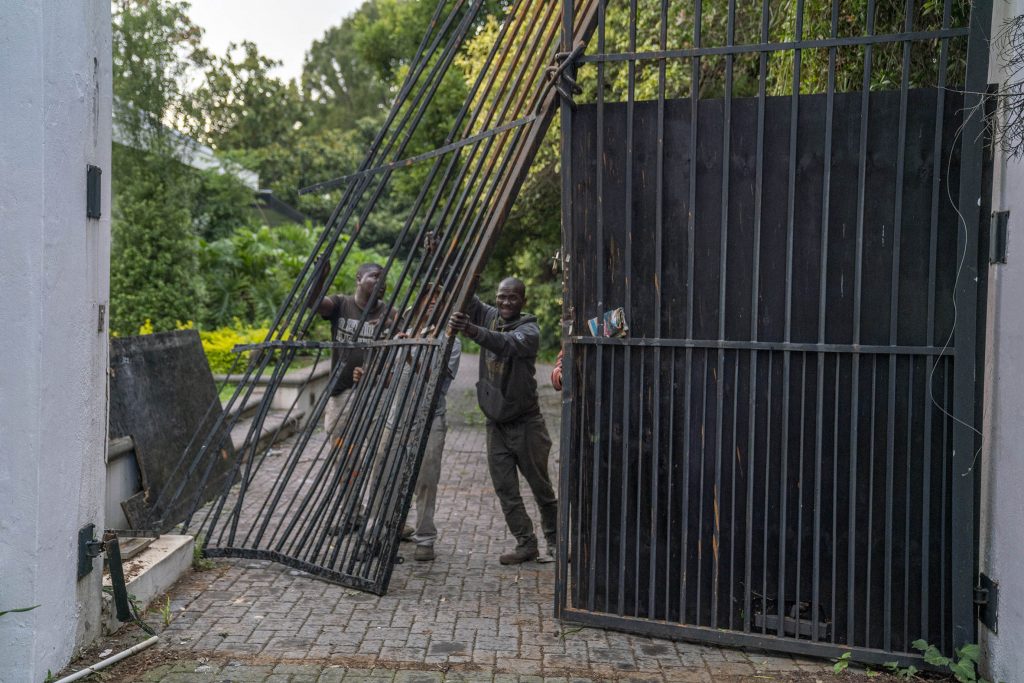 Gate crashers: Workers prop up the gate of the house in Bryanston, Johannesburg, after it was rammed by a police vehicle during the high-profile arrest of Yaniv ben Simon and other Israeli gangsters last week. Photo: AFP
Abergil’s ruthlessness saw him build a global drug empire and eliminate rivals.
“Israel, which loves calling itself the ‘start-up nation’ because of its impressive accomplishments in high tech, is also an exporter of highly organised and deadly crime,” Gur wrote, adding its crime families operated around the world.
Abergil is serving three life sentences for drug trafficking and murder and Ben Simon’s name was mentioned several times during his case.
One Israeli news outlet reported a recording was released “exposing a conversation between Abergil and Ben Simon, in which the two discuss plans to target infamous Israeli drug trafficker Zeev Rosenstein, after one of several failed attempts to take his life in 2003 killed three people and injured 18 others in Tel Aviv”.
According to another story, Abergil previously testified that Ben Simon “does not need permission from me or from anyone else. He doesn’t listen to anyone.”
How Ben Simon came to be in South Africa is a mystery for now.
Both the state and his defence successfully argued at his first court appearance for an in-camera ruling barring media coverage because of “sensitive” information related to the case, the National Prosecuting Authority said.
Pretoria University law professor Dr Llewelyn Curlewis said the court had carte blanche to make a determination barring open access even though the principle of justice being seen to be done was central to the Constitution.
“The ruling could be because of issues of state security or the safety of witnesses or because something needs to be protected from public scrutiny,” he said. However, the in-camera ruling was exceptional and unlikely to last for long in the proceedings, not least because it could be taken on appeal.
As to the circumstances sparking the arrest, little is known, although it has been suggested the Americans and the Israelis put pressure on South Africa because of its patchy success in dealing with terror cases.
Steven Gruzd, a political analyst from the SA Institute of International Affairs, downplayed these claims, saying that while Israeli-SA relations were often tense, this was unlikely.
“I don’t see any conspiracy, although theories may abound. This is a fugitive from justice and South Africa, acting on an Interpol notice, complied by making the arrest.”
The growth of organised crime in South Africa was described by the Global Initiative Against Transnational Organised Crime this year as an “existential threat” to democracy.
In the last 20 years, a number of high-profile underworld figures have made South Africa home, including Russian underworld kingpin Yuri Ulianitski, who was assassinated in Cape Town in 2007, and Czech crime boss Radovan Krejcir, who is serving 35 years in prison.
Last month, Israeli citizen Abdel Fattah Nassar was killed in a gun battle in Cape Town.
Global Initiative Against Transnational Organised Crime’s director of the organised crime observatory for east and southern Africa, Julian Rademeyer, said South Africa had a long history of harbouring international fugitives and Israeli criminal gangs have been active in the country since the 1980s and 1990s.
“The collapse of the Soviet Union and the end of apartheid political isolation saw South Africa integrate with globalisation, causing several criminal markets to expand rapidly and the country became an enticing new frontier for international organised crime networks, including groups like the Israeli Ramat Amidar gang, which was active in Norwood, Johannesburg.
“Exactly 19 years ago this month, Hazel Crane, a Johannesburg socialite and close friend of Winnie Madikizela-Mandela, was gunned down shortly before she was due to testify against Lior Saadt, a known Israeli crime figure accused of murdering Crane’s estranged husband and mob boss Shai Avissar.
“Two other witnesses had also been murdered and the case against Saadt collapsed.
“This week, Police Minister Bheki Cele hailed the arrest of Ben Simon as an indicator that ‘organised crime is also being dealt a blow’. But this belies the enormity of the challenge that we face, and the enormous scale of the organised crime threat that South Africa has to contend with, that reaches into virtually every facet of our society and lives,” Rademeyer said.
“Today, the majority of the criminal markets in South Africa in some way involve international connections. This manifests not only in the transnational nature of many illicit flows but also in the presence of various foreign actors within South Africa who bring a range of different means, motives and expertise to South African organised crime.”
Independent security analyst Jasmine Opperman said Ben Simon’s ability to operate undetected in South Africa for years was damning. “South Africa is a free-for-all for many foreign organised crime syndicates. These Israeli guys reportedly have links to Mozambique.
“There are few factors impeding organised crime businesses in South Africa. They are outwitting the authorities. This bust would not have happened without foreign intelligence.
“We lack capacity. But having said that, organised crime businesses at scale are global. They need external impetus and we need international co-operation to fight them. I worry about the capacity of our intelligence services, which is why we aren’t winning against terrorists [and] drug dealers and we are about to be greylisted.”
[/membership]