Misconduct: The JSC interviews have come under fire. (David Harrison/M&G)
Two reports released this week plead the case for amending the Constitution to reduce the number of politicians on the Judicial Service Commission (JSC) and the risk of bias dictating appointments to the bench.
Both Freedom Under Law (FUL) and the Helen Suzman Foundation cautioned that the independence of the judiciary was threatened by the commission’s recent history of arbitrary, at times inexplicable, appointments and the abuse of interviews with aspirant judges for political ends.
“Over the last 12 years the performance of the JSC in the execution of its two primary functions — of appointing judicial officers and holding them to account – has in many respects been dismal,” FUL said.
“Structurally, the JSC is cumbersomely large and beset by political interference. We accordingly suggest a reduction in the number of political appointees to the JSC,” it added, saying this would “go some way toward alleviating the problem of a single political party dominating the appointment of commissioners”.
It conceded that a change to section 178 of the Constitution, which sets out the composition of the JSC, was unlikely.
“This alone will in any event not address the problem of political interference completely, and there needs to be a shift in perspective to recognise the unique and non-party-political function of the JSC as a constitutional body expressly designed to ensure judicial independence.”
The period under review in the FUL report starts in 2009, when the Zuma administration took power and Jeff Radebe became justice minister. The authors recall that this was a watershed moment where the ruling party stamped its political dominance on the commission and the selection process in a manner that shaped the bench.
A round of interviews with aspirant constitutional court judges was postponed, at the last moment and at the minister’s request, giving then president Jacob Zuma time to replace the four sitting presidential representatives on the JSC. Those who were removed included advocate George Bizos.
The interviews that followed showed an aggressive focus on issues of transformation and race. It continued for years to come, prompting the resignation of advocate Izak Smuts in 2013 in protest at what he said was not simply hostility to white male candidates but a failure to appoint those possessed of intellectual excellence.
“The 2009 overhaul of the JSC’s composition marked the commencement of a period of greater political interference,” FUL said.
The meddling “manifests on a continuum from subtle (although no less insidious) to more overt” and includes the differential treatment of candidates on the basis of their political palatability”.
FUL notes that as the executive found its conduct declared unlawful by the courts, the interview process at the JSC was abused to ask candidates their views on those adverse findings.
In 2015, after the government flouted a high court order for the arrest of Sudanese president Omar al Bashir, then justice minister Michael Masutha memorably asked candidates interviewed for vacancies at the apex court whether in their view the courts could be “dangerously wrong”.
This subversion of process continues but continues in “a fraught political climate”, FUL said, with the only remedy in flagrant cases being legal review. Though the organisation has itself taken this route, it noted that it was hardly a perfect or preventative response.
Hugh Corder, professor emeritus of public law at the University of Cape Town and a director of FUL, on Tuesday recalled the persistent attempts, in interviews with candidates for the appellate court, by Economic Freedom Fighters leader Julius Malema to corner Gauteng high court Judge Elias Matojane on his order that Zuma’s return to prison to complete his sentence for contempt.
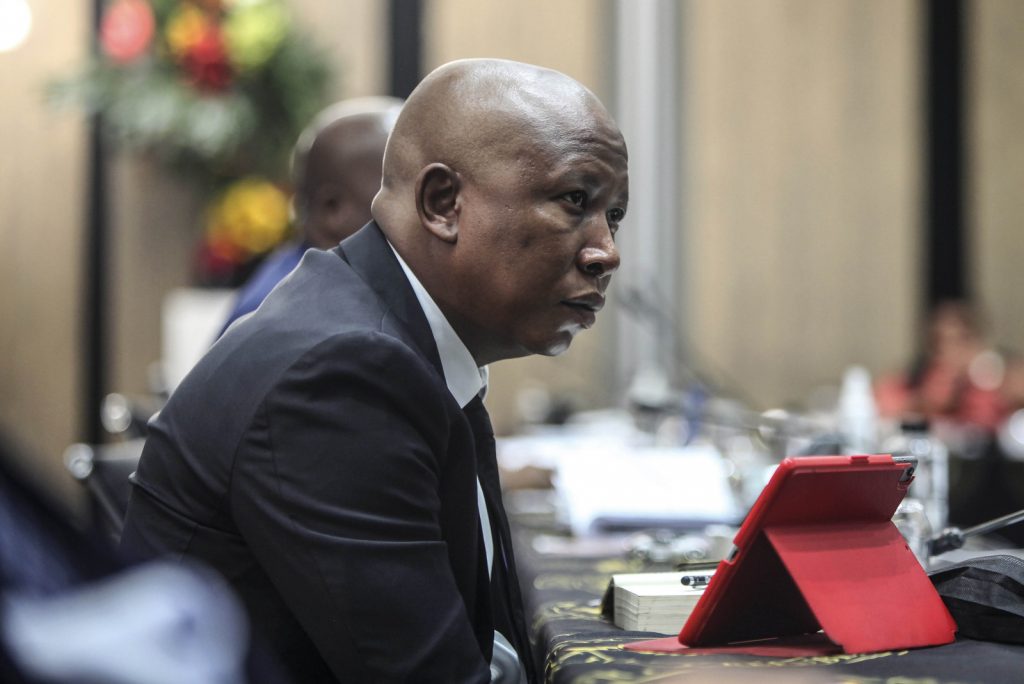 Freedom Under Law’s report says Julius Malema (left) has since 2014 opened the process to ridicule. (Oupa Nkosi/Judges Matter)
The HSF said Matojane’s plea in the course of his interview – that litigants could not be asked to respect rulings if the commissioners insulted candidates’ knowledge of the law – was a reminder that baseless attacks on the knowledge and integrity of judges “risks our system of law”.
“And the perversity of the process goes further: it gives incentive to judicial candidates who are ambitious and seek promotion to steer well clear of politically contentious cases lest they have to face hostile JSC commissioners,” HSF director Nicole Fritz said.
“It is entirely antithetical to the independent-mindedness that we want our judicial candidates to evidence.”
The foundation said the “political” component of the 23-member commission is outsized by international standards. It counts 11 members of parliament, among them the minister of justice, plus the four presidential nominees.
The introduction and make-up of the JSC was meant to bring legitimacy and inclusivity to the appointment of judges after the end of the apartheid era, where it was simply the secretive prerogative of the executive.
But FUL questions whether the structure achieves the aim, after noting the selection of candidates starts with a “sifting” process in a small seven-person committee.
Given the importance of this step, it said, one would have expected the members to be a microcosm of the wider JSC, but in fact it is weighted with presidential nominees and there is no published record of its deliberations.
“Of this group of seven, three are nominees designated by the president. Is it overly cynical to say that by stacking this initial screening body with presidential nominees, the resulting interviews (and possibly appointments) are no different from what they would be if South Africa had a smaller executive-dominated group nominating judges (as is often found in other Commonwealth countries) rather than its large JSC?” it asks.
But while calling for cutting the number of MPs on the commission by four, FUL acknowledges that “by no means all the cases of manifest political motivation have involved commissioners nominated by political parties”. Often unfair treatment is meted out by presidential nominees and representatives of the legal profession.
Last April, David Unterhalter SC came under concerted attack by Mvuzo Notyesi and Economic Freedom Fighters leader Julius Malema in his third interview for a vacancy at the apex court and was not appointed. In the interviews with the four candidates for chief justice in February, Malema and advocate Dali Mpofu ambushed Gauteng Judge President Dunstan Mlambo with rumoured allegations of sexual misconduct.
Professor Hugh Corder, who oversaw the writing of the FUL report, said if Malema had since 2014 repeatedly devalued the interview process and opened it to ridicule it was true not only MPS misbehaved. Hence, FUL suggested a senior retired judge train all new commissioners “wherever they are drawn from, as to the proper role of the JSC”, and that those who misconduct themselves face sanction. The HSF urged a code of conduct for commissioners.
“There have been some members of the practising legal profession who have behaved disgracefully as members of the JSC and I would only ask where is the Legal Practice Council or the bodies who have nominated those practitioners, where are they now in this? Or indeed the president in his nominees?” Corder said.
He welcomed President Cyril Ramaphosa’s recent replacement of nominees, among them Griffiths Madonsela, whose bias against Mlambo was blatant.
“Frankly some of the improved performance of the JSC in October interviews are due to those changes that have been made, positively,.”
The foundation agreed that optimism can be drawn from the outcome of the most recent interviews for appointment to the appellate and apex courts. In the latter, Justice Owen Rogers submitted that the JSC could afford to focus on skill over diversity as most of the judges at the court were black and many were women.
Rogers was appointed and the more detailed draft criteria for judicial appointment published by the JSC in October indicates a nuanced approach to the constitutional demand for demographic representivity.
“Diversity is a quality without which the court is unlikely to be able to do justice to all the citizens of this country, but it is not an independent requirement, superimposed upon the constitutional requirement of competence,” these read.
FUL said until now the JSC has appeared to conflate candidates’ commitment to transformation with their race and gender, and failed to understand that section 174(2) of the Constitution does not create a static obligation.
“The race and gender composition of the judiciary as a whole, and of each court specifically, changes with each new judicial appointment.”
Both FUL and HSF said the JSC had failed for years to table annual reports to parliament and only recently remedied the situation. And both were withering about its record in holding judges accountable.
The JSC’s track record during the period under review has shown that the current system of dealing with judicial complaints – at least in respect of gross misconduct – is broken, FUL said.
It said the handling of these complaints was marked by delay, inconsistency and constitutionally unsound conduct and decision-making, while it was hard to assess its record on lesser complaints for lack of information.
“Section 10 of the Act requires reports on its activities from the Judicial Conduct Committee (JCC) to the JSC, but these appear not to be in the public domain, if they exist at all.”
It called for a radical overhaul of the disciplinary system, saying it seemed sound on paper but was undermined by the JSC’s apparent lack of understanding of the bar for judicial conduct.
FUL recommended that the JSC adopt a default policy of promptly recommending the suspension of judges pending the resolution of complaints of judicial misconduct. It has routinely taken this approach, with the glaring exception of Western Cape Judge President John Hlophe.
The JSC finally did so in July, 11 months after calling for his impeachment, but the president has yet to heed the advice.
The commission’s own delay has undermined public trust in the JSC’s ability to fulfil its constitutional role of disciplining judges to protect the integrity of the judiciary.
“It is difficult not to infer that Judge Hlophe has been doggedly protected in his position by some underlying political motive,” FUL ventured, but added that it was hard to say whether the overall weakness in disciplinary matters was due to a lack of administrative capacity or rather appetite to pursue complaints with alacrity.
Whatever the answer, delays were not limited to the high-profile cases of judges Hlophe, Nkola Motata – who escaped impeachment after a drunk-driving incident – and Mushtak Parker.
Complaints lodged in 2008 and 2009 against four Pretoria High Court judges relating to delays in handing down judgments – ranging from 12 months to six years – were finally resolved recently only when the JSC decided to reprimand those in question and order them to apologise to litigants.
“There is a tragic irony in the fact that it took the JSC almost 14 years ultimately to rap a group of judges over the knuckles for not handing down judgments timeously,” FUL said.
It plans to send its report to Chief Justice Raymond Zondo and Justice Minister Ronald Lamola.
[/membership]