Dirty coal: Nomsa Zulu (left) wants clean energy for health reasons. (Delwyn Verasamy/M&G)
There’s no money to buy coal and Nomsa Zulu’s daughter is cooking the family’s supper on an open fire in their dusty backyard of eMpumelelweni, a township of eMalahleni.
It’s a cold, grey day and the bedridden Zulu lies huddled beneath a thick layer of blankets. An old coal stove stands hulking alongside her.
“Coal is very important to us,” said the mother of five children, who survives on social grants. “We depend on it. We use it to keep the house warm and to cook. Sometimes it makes us cough but we don’t have any other choice.”
A 50kg bag of coal lasts the family a few days.
Like many residents of eMpumelelweni, Zulu has not heard about the just energy transition to shift South Africa, and the coal belt of Mpumalanga in particular, away from coal to a low-carbon, climate-resilient economy.
“If this cleaner energy can make our lives easier and give us cheaper energy, I will be happy to use it,” she said.
Some people in eMalahleni still use coal in their homes, even if they have electricity, said Vusi Mabaso, the project coordinator at Vukani Environmental Justice Movement in Action. “It’s cheaper than electricity but is expensive in your life,” he said, referring to the harmful effects on people’s health of burning coal in houses.
But, said Promise Mabilo, the coordinator of the Vukani NGO, Mpumalanga’s people are being excluded from the plans to shift from coal-fired power to cleaner energy.
“We feel that people here don’t even know what it means for a just transition,” she said. “We need people to [understand] these are the reasons we need to shift from coal. They feel like their bread and butter is being taken away, they’ve grown up with coal and they depend on coal, but they don’t know what the effect of coal is.”
In March, Vukani and groundWork, an environmental justice nonprofit, were victorious in their Deadly Air court case when a high court judgment found that toxic air pollution in Mpumalanga’s Highveld is a violation of constitutional rights.
For Mabilo, the transition seems “like this huge elephant where one or two legs are missing” and is being dominated by Eskom and large industries.
“As communities, we have to wait for them to finish up their business, before we get the leftovers.”
They don’t want that; they want a fair, just energy transition. “We are seeing the bigger picture in terms of people who are affected by coal mining in this area. Our health is suffering. We are losing a lot of rivers and streams we rely on because they’re polluted. We are losing our means of having food gardens or space where we can farm our own food.”
The transition must be “community-led, whereby we can do things on our own”, she said, expanding on her hopes for local-scale mini-grids, solar farms and the rehabilitation of denuded mining landscapes, which will create jobs.
Michelle Cruywagen, a senior just transition and coal campaign manager at GroundWork, said: “I think what may be confusing is that we have the Presidential Climate Commission’s [PCC’s] Just Transition Framework, which is quite well defined in terms of what the just transition is meant to be. Then we also have processes rolling out ahead of the implementation process that is meant to follow the framework.”
The decommissioning of Eskom’s Komati coal-fired power station and various energy summits in Mpumalanga “are running ahead of the process. So what we have is a transition that is not being managed fully.”
There has been a degree of consultation, especially with the PCC and with community organisations, but “has not necessarily filtered through to communities on the ground”.
“I think some of the dialogues have been superficial, which is why you’ve reached one tier of communities and organisations, but not necessarily communities in themselves,” Cruywagen said.
Neither has there been a comprehensive worker communication programme, which is probably the most essential of all, she added.
Eva Mokwena lives in the nearby township of Vosman, which is encircled by open-cast coal mines.
“When the mines blast, our houses shake. It’s terrible to live like this.”
She shows the damage — cracks that run like veins through her home and broken windows sealed with tape.
She is in favour of the just energy transition because the mines damage homes and make people sick. “When I blow my nose, blood is coming out. Our houses are filled with black with dust every day and we breathe it in.”
It’s the same for the residents of Lakeview informal settlement in Vosman.
“Our homes are damaged by these mines yet we don’t benefit from them and get jobs,” said Albert Tshabalala, pointing to plumes of black smoke.
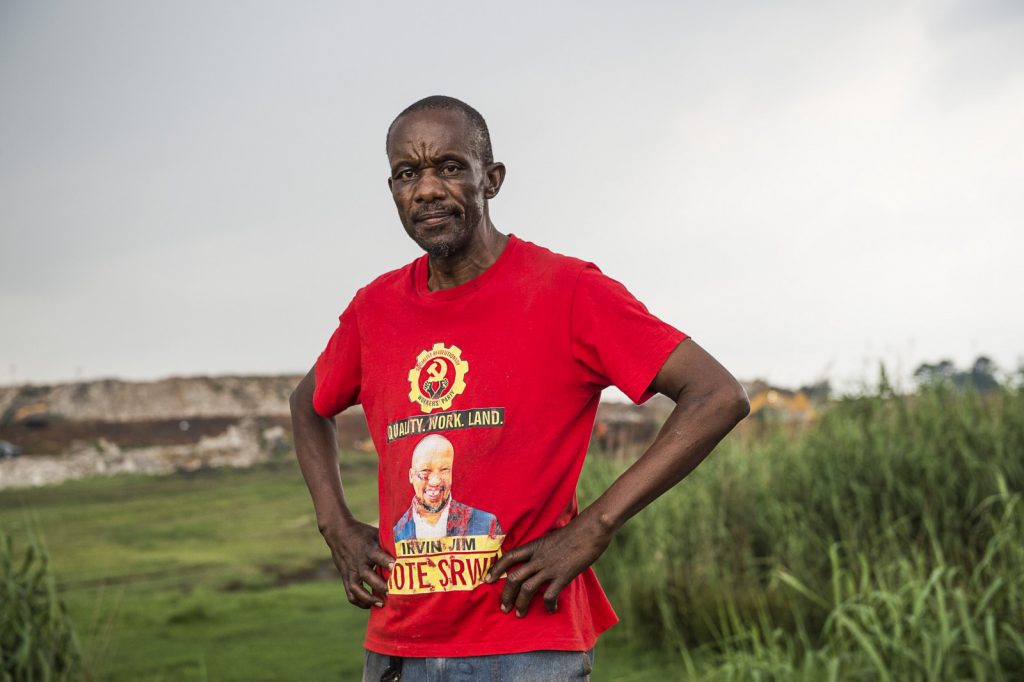 Albert Tshabalala wants clean energy too but worries about job losses. (Delwyn Verasamy/M&G)
He also knows little about the energy transition. “We just heard from the news that they are going to change this coal. But what about people’s jobs if these mines close?”
A recent Human Rights Watch report on South Africa’s unrehabilitated coal mines found that of the 445 mine closure certificates issued countrywide by the government from 2011 to 2016, only six were in Mpumalanga. “Potentially toxic tailings, essentially waste rock from mining, are often found near the abandoned mines.”
None of the six were for coal mines, despite Mpumalanga having about 800 abandoned mines, as of 2019, and 235 active coal mines. The report said the central government has done little to ensure sites are secured, let alone cleaned up.
It said the costs of the cleanup are borne by the mining company. “By also ensuring that companies have to pay the real cost of coal extraction, rather than communities de facto subsidising the cost, coal will become less appealing as an energy source versus cleaner and lower emitting sources of energy.”
Little to no attention is given to the mine sites and their toxic legacy and this “should be included in any just transition discussions or government strategies”.
Vukani’s Mabaso said people are left with these “man-made mountains. The mines say they’ve got no money to rehabilitate. The government says, ‘go to the department of mineral resources and energy’, yet they will tell you the owners are gone.”
He attended the PCC’s consultations and advocated for a community-led energy transition “but when they come back they don’t talk about those things. That means they will go and decide for us.”
Blessing Manale, the head of communications and outreach for the PCC, said when it had started its consultations, it found a “vacuum of outreach and community engagement”, which had built a lack of trust.
“Only few people understand [the just energy transition]. You have got to have the best of the best of our environmental NGOs and activists building the charge. So, the woman that does pap and steak does not know tomorrow the [coal] worker might not come because the environmental NGO is fighting high-level issues about fossil fuels.”
The PCC had found that there “is quite a lot of social distance” between people at local level and the national discourse on the transition.
“When President Cyril Ramaphosa said we’ll do a social compact, we said the PCC will contribute to that by mobilising communities around issues — the just transition, jobs, the future of coal, community empowerment,” Manale said, describing this as a new model for managing the climate crisis at local level.
[/membership]