Members from the Carnarvon Riel dance group perform during the unveiling of SKAO Mid near Carnarvon. (Photos: Denvor de Wee)
The MeerKAT array telescope is a thing of magnificence in the Karoo. Higher than a six storey building, one can’t help but marvel at the workmanship of South Africans.
The telescope has 64 antennas and was designed by engineers at the South Africa Radio Astronomy Observatory (SARAO). Several discoveries have already been made.
They include two giant radio galaxies, said to be 64 times bigger than the Milky Way. In January last year, the SARAO announced that the galaxies were among the largest single objects in the universe and were thought to be quite rare.
Six months later, it announced that the MeerKAT radio telescope had produced a striking image showing a combination of cosmic features never before seen, revealing unexpected details of the inner workings of enormous radio galaxies.
And in September, the telescope enabled astronomers from all over the world to measure the neutral hydrogen gas around galaxies as they were four billion years ago.
But it is now time to take another leap into a part of our universe that we know little about.
In the course of the next two years 133 Square Kilometre Array or SKA dishes will be added to the existing 64 of the SKA-precursor telescope MeerKAT to form a mid-frequency instrument.
According to the SARAO, the first two antenna stations are to be completed by May 2023, while the first dish is to be installed in April 2024, followed by three to four dishes each month.
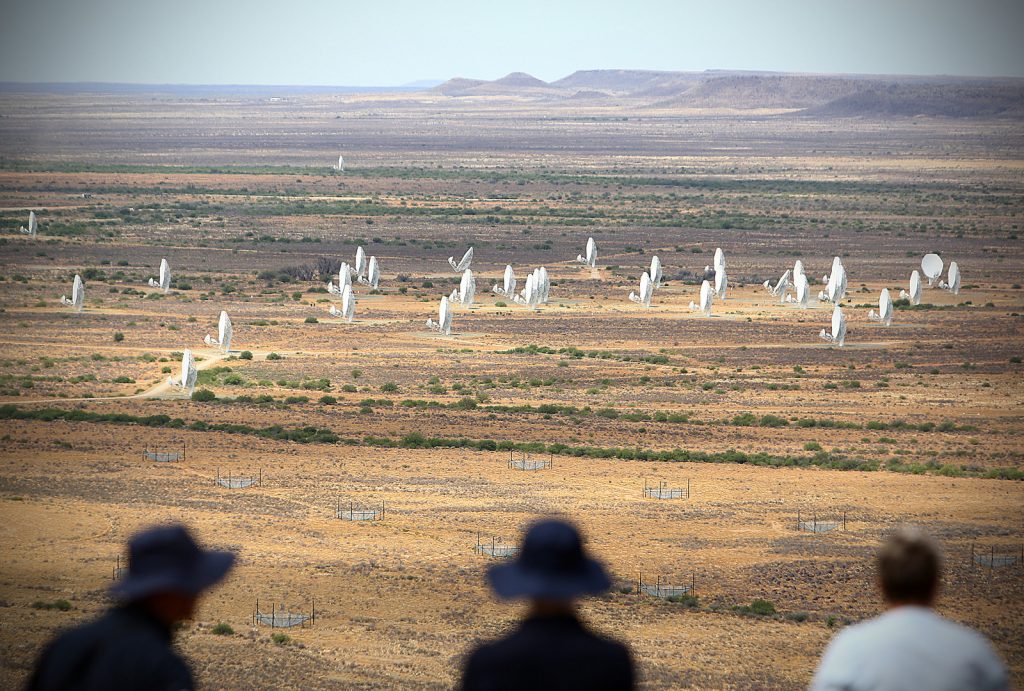
In the end, the SKA-Mid will comprise an array of 197 dishes including the MeerKAT telescope. The largest concentration of dishes will be in the core while others will span along three spiral arms, stretching 150km — the equivalent of the landmass of Wales.
This is all happening in the most rural parts of the country. The closest town to this magnificence is Carnarvon, which was established by the Rhenish Mission in 1853, on a route between Cape Town and Botswana that was followed by early explorers and traders.
These telescopes are to assist in research piecing together what the world looked like more than 100 million years ago, according to Tracy Cheetham, SKA-Mid Construction director.
“The science that the SKAO [SKA Observatory] are looking at for the next 50 years is really transformational, as we know the big bang is 13.8 million years ago. SKAO hopes to go 100 million years back trying to understand the information of stars and galaxies and the evolution of the universe. On-site construction of 133 dishes will start early next year until 2028.”
The MeerKAT array telescope was completed in 2018 at a cost of R3.2 billion, with 75% local content boosting the industry in terms of manufacturing various components for the telescope, according to the higher education, science and innovation minister, Blade Nzimande.
During his address, Nzimande said that over the past five years South Africa’s investment in the development of astronomy, specifically the MeerKAT, not only positioned the country as a premier hub for scientific research and innovation, but also realised socioeconomic spin-offs, including the installation of 110km of overhead power lines, the resurfacing of 80km of road and the construction of complex foundations for the 64 dishes.
The government has pledged to invest R40 billion in the project over 10 years. This means there will be more room for upskilling of local people. The SKA has already created 1400 jobs.
Started in the early 2000s with a bid to host the SKA with Australia, a deal was struck in 2012 for South Africa to host the mid-frequency and Australia the low-frequency.
[/membership]