Shocking state: President Cyril Ramaphosa delivers his State of the Nation address at City Hall in Cape Town, where he announced the electricity crisis as a national state of disaster. Photo: Dwayne Senior/Bloomberg
Within days, two national state of disasters were declared but South Africans still need “some convincing” by the government’s track record on disaster management, a governance expert says.
Kedibone Phago, a professor of public administration at North-West University, was responding to the disaster declarations that have been announced to deal with the country’s crippling electricity crisis and widespread flooding in seven provinces.
Last Thursday, during his State of the Nation address, President Cyril Rampahosa announced a national state of disaster to respond to the energy crisis and its effects.
On Monday, the presidency announced that in terms of the Disaster Management Act, it had declared a national state of disaster to enable an “intensive, coordinated response” to the floods affecting Mpumalanga, Eastern Cape, Gauteng, KwaZulu-Natal, Limpopo, Northern Cape and North West.
Phago noted how it must be made clear what the guidelines and plans are for the energy crisis for a state of disaster to have any merit.
People will need transparency so a mapped way forward can be seen. It is crucial that the government is transparent on plans and regular, clear updates are given.
Flood disaster qualifies
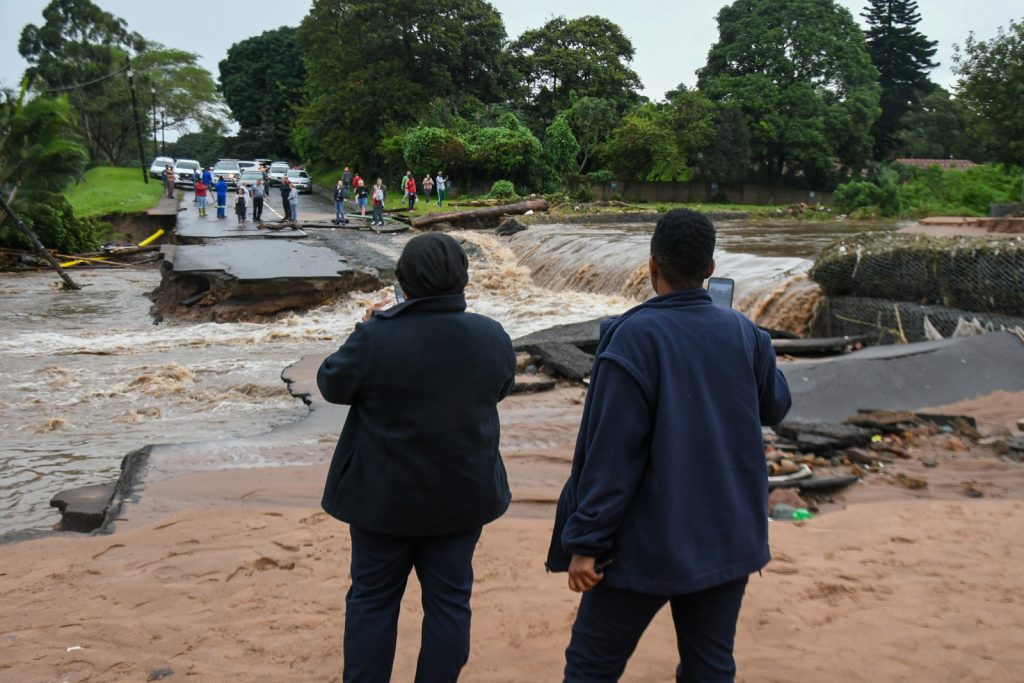 Emergency: Persistent heavy rain in KwaZulu-Natal resulting in widespread flooding (left) constitutes a disaster. How the energy crisis happened cannot be categorised as a disaster; for example, emergency preparedness and other aspects of the Disaster Act would be difficult to explain, says an expert. Photos: Darren Stewart/ Gallo Images and Dwayne Senior/Bloomberg
Phago said he had two considerations, the first being the definition of disaster according to the Act and the second, the purpose of the Act itself.
“First, in the definition of the Act, it is clear that the disaster situation needs to be considered based on extraordinary and significant impact on the people and the environment exceeding the public administration systems in place to cope. Both situations — the floods and energy crisis — could be catered for somewhat by this definition and understanding.”
Second, there are clear provisions of the Act, as per its 2015 amendment.
These include that: “The Act is also amended to provide for the South African National Defence Force, South African Police Service and any other organ of state to assist the disaster management structures; to provide for an extended reporting system by organs of state on information regarding occurrences leading to the declarations of disasters, expenditure on response and recovery, actions pertaining to risk reduction and particular problems experienced in dealing with disasters.”
He said that the provision to have an “integrated and coordinated disaster management policy that focuses on preventing or reducing the risk of disasters mitigating the severity of disasters, emergency preparedness, rapid and effective response to disasters and post-disaster recovery” means that the flood disaster would fit into this context and understanding.
‘Energy crisis hardly categorised as a disaster’
“This means the president needs to help us understand his justification in believing that the energy [situation] is relevant in the context of the Act. This is necessary because categorising and declaring a state of disaster should not only consider the definition of the Act alone but also its provisions,” Phago said.
It should be clear that the manner in which the energy crisis happened “could hardly be categorised as a disaster”, because, for example, emergency preparedness and other aspects of the Act would be difficult to explain in this context.
“It is indeed a square peg in a round hole,” Phago said.
As was seen during Covid-19 lockdowns, there is a need to provide clear guidelines and plans.
“The Act has a section that makes provision for management strategies and plans, which allows for operational issues to be outlined. For me this is the crux of the matter. That is exactly what gives meaning to this kind of intervention.
“So, declaring a state of disaster means little if this component is missing or weakened.”
Ramaphosa needs to provide detailed plans and targets that would demonstrate actions that are to be taken during this state of disaster.
“Plans should demonstrate capability across the board to manage the disaster to give meaning to the declaration.”
In a constitutional democracy such as South Africa’s, the principles of transparency and accountability cannot be compromised.
“But we need to keep the president accountable regarding his earlier declarations of the state of disasters. He needs to provide progress made and lessons, if any, on what’s going to be different this time around.”
A clear example is for Ramaphosa to take the country into his confidence on the KwaZulu-Natal floods last year, he said.
“But we know that South Africans still need some convincing by the government’s track record on disaster management in the country.”
Flooded homes, vehicles swept away
In Monday’s announcement, the presidency said the National Disaster Management Centre (NDMC) had received reports ranging from flooded homes, vehicles swept away and overflowing dams and sewage facilities to the loss of basic infrastructure and damage to roads, bridges and a Limpopo hospital.
“In agriculture, farmers have suffered crop and livestock losses, and anticipate further losses as the South African Weather Service predicts that heavy rains will persist.”
These conditions have been brought on by La Niña, which has brought above-normal rainfall.
“With the continued strengthening of the La Niña event, the country can expect above-normal rainfall and below-normal temperatures over the summer rainfall areas,” the presidency said.
“Taken together, these conditions demand the provision of temporary shelters, food and blankets to homeless families and individuals and the large-scale, costly rehabilitation of infrastructure.
“National entities, including the South African Police Service and the South African National Defence Force, may be required to play a role in the response to the disaster.”
NDMC capable
Dewald van Niekerk, the head of the African Centre for Disaster Studies at North-West University, said the NDMC was not running the electricity crisis response.
“The president created the national emergency crisis committee and they’re running that show, but when it comes to the floods, they’re quite capable,” Van Niekerk said.
“There’s lots of resources within the government that they can draw on — skills and expertise. So, what the national centre would be doing is working closely with the provinces, metro, district and local municipalities to understand where there are resource constraints, what they do need, and how they can assist from a national perspective,” he said, adding that the NDMC is well-equipped in terms of knowledge and capabilities.
“There’s quite a lot of skilled people there but what can they reasonably do? They must see what they can draw on throughout the government and if there’s not enough resources, then they must look at accessing the contingency reserve … or then call for help from the international community. I’m sure they’ve done that already — when it comes to these kinds of magnitudes of disasters, they’re immediately there anyway.”
[/membership]