Rumour: ActionSA leader Michael Beaumont has shot down the idea of a fund to back the moonshot pact. Photo: Papi Morake/Gallo Images
Opposition parties were set to meet on Thursday night to discuss the “moonshot pact”, proposed by the Democratic Alliance (DA), against a backdrop of claims that the initiative is being driven by the donor community, and not the parties themselves.
Sources in several opposition parties have claimed that lobbyists acting on behalf of donors have been offering a share in a R500 million fund — in money and resources — to parties willing to back a pre-election agreement to prevent a governing coalition between the ANC and the Economic Freedom Fighters (EFF) after next year’s poll.
According to the sources, who have asked not to be named, the donors, including long-term DA funder Martin Moshal, now also a regular donor to ActionSA, want the splintered opposition to form a united front going into the elections.
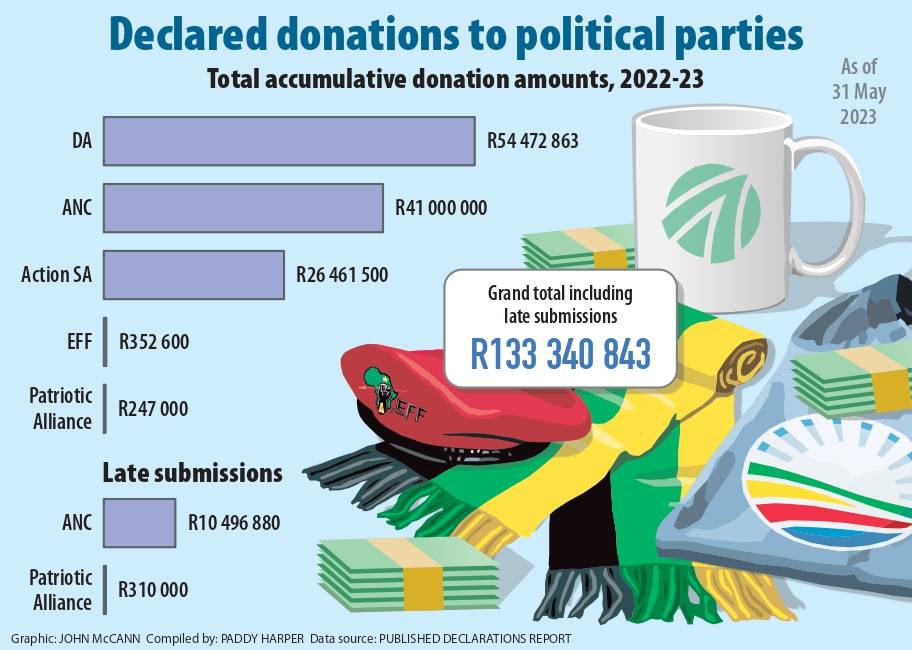
Moshal gave the DA R15 million in the 2021/2022 financial year and gifted R5 million to the newly created ActionSA during the same period, increasing his investment in Herman Mashaba’s party to R11 million during the course of 2022-23.
A senior official of one of the smaller parties said there had been “conversations” taking place with a number of people “in the funding space” who had “indicated the availability of monetary support and resources” to parties backing DA leader John Steenhuisen’s idea.
The Mail & Guardian has seen a WhatsApp message, purported to be from one lobbyist, in which one of the smaller parties is offered polling facilities and other assistance should it decide to join in the moonshot initiative.
Both the DA and ActionSA have denied the existence of a R500 million fund to assist parties who buy into the moonshot idea in fighting the 2024 elections. They also deny that any of their funders would place preconditions of participation in the moonshot initiative on donations they made.
Steenhuisen introduced the idea of a moonshot pact among opposition parties to oust the ANC at the beginning of April after being re-elected as party leader, arguing that a pre-election agreement was essential if they were to keep the “doomsday coalition” out of office.
The party has since written to 15 other parties, inviting them to join the moonshot agreement — excluding the Patriotic Alliance (PA) and “those who are aligned to the ANC and EFF” — with varying results.
They were set to meet on Thursday night to hammer out which parties would participate, a point of contention between the DA — which wants to dictate who can or cannot be involved — and parties such as ActionSA, the United Democratic Movement and the African Christian Democratic Party.
DA federal chairperson Helen Zille told the M&G that there was no insistence from funders that parties participate in the initiative.
“I can assure you that there has been no pressure at all from any DA donors to do the moonshot pact,” Zille said.
Steenhuisen said through a spokesperson that “we are not aware of it”.
ActionSA national chairperson Michael Beaumont told the M&G that he was aware of the rumours but that they were baseless.
Beaumont said while the party’s funders, including Moshal, had not placed conditions on funding, they understood — and supported — the need for a working coalition after the 2024 poll.
“Our donors, including Martin, would never condition his support to ActionSA by saying do this or don’t do that. As a party, we walk away from donors who place conditions like that on their support,” Beaumont said.
 (John McCann/M&G)
He said parties, donors and South African voters understood that “this is going to be a coalition environment post 2024 but they are concerned about the collapse of coalitions at local government level”.
A “sound” agreement between parties would have to be reached going into the elections, based on a collective process in which they acted as equals and treated each other as such.
“Supporters of ActionSA, Martin included, would like to see that working out but it would be wrong to say that one is dependent on the other,” Beaumont said.
Rumours that a R500 million fund to back the moonshot pact had been put together by donors were “not true”, he added.
“There was a fairly pernicious rumour at one stage, that was going around, in which a specific amount of money had been attached to public funding of the so-called pact. It’s not true.”
“The irony is, right now, a meeting for looking at modalities among the parties can’t even agree about who is going to be in it,” Beaumont said.
A number of lobbyists had been talking up the fundraising potential of a pre-election coalition pact but that the matter had no substance.
“There were a few people running around talking about the potential behind such a pact … people who were making those kinds of claims, but there was no serious discussion in any way,” he said.
Beaumont said the focus was on “trying to make this thing walk” and reach some kind of agreement among the parties about how to approach the elections.
Should the parties be able to “form a strong public bond based on an alternative vision for South Africa, I have no doubt many donors would be animated by that idea”, he said.
However, the DA’s approach of wanting to dominate the process had sparked a “very hard push back” from a number of opposition parties who backed the idea of a pre-election coalition but did not believe it was “owned” by the DA.
“At the end of the day, it would require a collectively owned process,” he said.
“The proportionality that would come in would be determined by the 2024 results. Until then, we are all equals,” Beaumont said.
“Thanks to the DA for getting the ball rolling — but it’s not your ball.”
There were inconsistencies in the DA allowing the National Freedom Party and the Abantu Batho Congress, both of which were in coalitions with the ANC and EFF, to participate, while stopping the PA from participating on the same grounds.
“This is a huge contradiction,” Beaumont said.
RISE Mzansi’s Songezo Zibi said potential donors that the party had met — and voters — were “concerned about the fragmentation of the opposition ahead of next year’s elections”.
Zibi said they believed that there was a need to unite South Africans behind a common vision and political objectives, rather than “merely pulling together opposition parties who disagree on many things”.
“This is what South Africans are looking for, especially in light of the destructive squabbling we see in the metros,” he said.
“To narrow the conversation around just removing the ANC, without setting out a common vision, values and principles to guide such a coalition, will only further alienate voters who are looking for an empowering message of hope and change.
“Consensus is built in substantive, private conversations first, not through the podium and media conferences and then only reaching out to people later.”
Moshal, a tech entrepreneur who is based in Australia and runs the Moshal Programme, which funds student exchanges between South Africa and Israel, did not respond to repeated emails from the M&G.
Moshal has donated widely to opposition parties, including generously to the DA and, of late, ActionSA, which received R3.5 million from him during the first four months of this year, according to the Electoral Commission of South Africa.
However, some sources in the opposition who have relationships with Moshal said they had no knowledge of him being the brains — and the money — behind the moonshot pact.
One source said, when asked, Moshal had categorically denied it.
There is some scepticism developing in opposition circles as to whether the pact, mooted by the DA’s leaders at the close of its elective conference, is a sincere overture to voters.
“It goes against received political wisdom to speak of coalitions before votes are cast and counted,” said one opposition source.
“That the DA is doing so here may mean that it is attempting to show voters that it tried all other options before eventually entering into a working arrangement with the ANC, which has become an unpalatable move for its core voters.”