Warning: People on the Greek island of Rhodes left fruit on scorched land to help animals survive after wildfires swept through the area this month. (Angelos Tzortzinis/Getty Images)
By last Sunday, Phoenix, Arizona, had sweltered for 24 blistering days in a row at temperatures above 43°C. In El Paso, Texas, there were 38 consecutive days where temperatures rose above 38°C.
These long heatwaves are of an intensity and a duration that have never occurred before, said Francois Engelbrecht, a climatology professor and the director of the Global Change Institute at the University of the Witwatersrand.
This past June was the warmest ever recorded, with July likely to be the warmest July recorded, he said.
“The records go back until the mid-1800s or so but from our paleoclimatic records, for example by studying the ice cores and the concentrations of different gases in the ice cores, drilled into Antarctica and also in the Arctic, we can deduce that this is probably the warmest Northern Hemisphere summer, specifically now June and July, of about 100 000 years.”
Modern humans are “in uncharted territory” in terms of global warming and associated climate change.
The heatwaves have stretched from Asia to the United States and Europe, particularly the Mediterranean.
“There have been seven days above 39°C, which is quite exceptional for Greece,” Engelbrecht said.
Wildfires have scorched Greece and the islands of Corfu, Evia and Rhodes, as well as Sicily, Croatia, Italy, Portugal, Algeria, Syria, Montenegro and Turkey in the past month.
Engelbrecht said wildfires and heatwaves go hand in hand. “When the air is very dry, then of course there’s this additional risk of wildfires. And we’ve seen in the last few years how prone the Mediterranean and also Europe has become — and Australia … in terms of these terrible bushfires they’ve been having.”
This week, a rapid study from climate scientists at the World Weather Attribution network found that the extreme heat in North America, Europe and China this month were made much more likely by climate change.
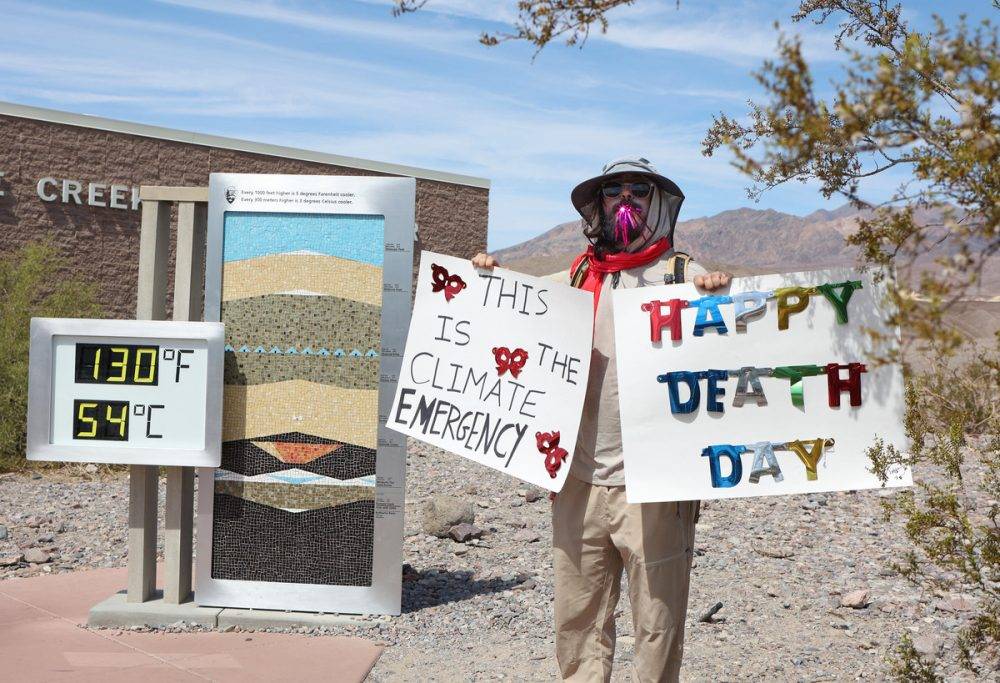 A protester stands next to a digital display of an unofficial heat reading at Furnace Creek Visitor Center during a heat wave in Death Valley National Park in California, US, on 16 July. Wildfires have, this summer, hit the Northern Hemisphere. El Niño will form in the Southern Hemisphere this summer. (Ronda Churchill/Getty Images)
“Without human-induced climate change, these heat events would however have been extremely rare,” they said. “In China it would have been about a one-in-250-years event while maximum heat like in July 2023 would have been virtually impossible to occur in the US/Mexico region and Southern Europe if humans had not warmed the planet by burning fossil fuels.”
In all the regions, a heatwave of the same likelihood as the one observed in today’s world would have been significantly cooler in a world without climate change. “Similar to previous studies we found that the heatwaves … are 2.5°C warmer in southern Europe, 2°C warmer in North America and about 1°C in China in today’s climate than they would have been if it was not for human-induced climate change.”
The climate scientists said that unless the world rapidly stops burning fossil fuels, these events will become even more common and the world will experience heatwaves that are even hotter and longer-lasting. “A heatwave like the recent ones would occur every two to five years in a world that is 2°C warmer than the pre-industrial climate,” the study noted.
The science is clear, Engelbrecht said.
“It is us humans, through the burning of fossil fuels, the increasing greenhouse gas concentrations in the atmosphere, thereby warming the planet, [who are] changing the climate system, [who are] also changing the circulation systems to the extent that these high pressure systems are causing the heatwaves and are forming more frequently.”
On Tuesday, the World Meteorological Organisation (WMO) said that intense heat is gripping large parts of the Northern Hemisphere in a “summer of extremes”. It cited how China set a new national daily temperature record — 52.2°C —and how many new station temperature records have been broken.
“Wildfires have caused devastation and dozens of casualties and forced evacuations of thousands of people in parts of the Mediterranean, including Algeria, Greece, Italy and Spain,” the WMO said. “Canada has seen its worst wildfire season on record, harming air quality for millions of people in North America.”
Sea surface temperatures have hit new records, with severe marine heatwaves in the Mediterranean and off the coast of Florida.
“The extreme weather — an increasingly frequent occurrence in our warming climate — is having a major impact on human health, ecosystems, economies, agriculture, energy and water supplies,” said WMO secretary general Petteri Taalas. “This underlines the increasing urgency of cutting greenhouse gas emissions as quickly and as deeply as possible. In addition, we have to step up efforts to help society adapt to what is unfortunately becoming the new normal.”
Engelbrecht said a contributing factor to the current warm weather in the Northern Hemisphere is the formation of El Niño in the Pacific Ocean. “El Niño does contribute to the generally warmer conditions across the world and in the Northern Hemisphere right now but it’s not the most important reason for the heat.”
He said the cause is “systematic global warming” and the strengthening of the high pressure systems that are unleashing heatwaves. El Niño is not as prominent because it is winter in the Southern Hemisphere.
“El Niño, right now, is still of weak to moderate strength but this is going to change,” Engelbrecht said. “El Niño is always weak in winter and then as the Southern Hemisphere oceans begin to warm, specifically the Pacific Ocean, south of the equator, that’s when the El Niño starts to gather its strength.”
The predictions are that El Niño will be of moderate to strong intensity. “The last strong El Niño was the El Niño of 2015-16 and that summer turned out to be the hottest summer in the history of South Africa. The chances are about 50% that the El Niño will be strong once again.”
Engelbrecht said that if El Niño is strong, southern Africa should be preparing for one of the hottest summers ever “because, on top of the El Niño we have this systematic global warming”.
Although this is a possibility the country must prepare for, it’s not a certainty.
“But it’s likely it will be a warm summer and it’s also likely that it will be a summer of below normal rainfall because El Niño usually suppresses rainfall over southern Africa,” Engelbrecht said.
“When the El Niño forms the end result is the more frequent formation of high pressure systems over southern Africa in summer. And those high pressure systems cause the heatwaves, but at the same time, they suppress cloud formation.”
If it’s going to be a dry summer in South Africa with many heatwaves “that may possibly be of an intensity we haven’t seen before, it’s a major risk for us”.
South Africa needs to prepare for drought, in terms of the effects on agriculture. The maize crop is highly vulnerable to heatwaves, combined with below normal rainfall, as is the cattle industry. In 2015-16, tens of thousands of cattle died in the North West, Limpopo and northern KwaZulu-Natal. Botswana lost about 20% of its cattle in 2015 and a further 20% in 2016.
But Engelbrecht pointed out an important difference.
“The El Niño of 2015-16 was strong, but it followed on three previous years that were also dry. The El Niño of 2023-24 — that’s summer — may be strong but it follows three very wet years, three consecutive La Niña years. So, we’re in a much better position in terms of our dam levels, and in terms of grazing, at the beginning of this El Niño event, compared to where we’ve been at the onset of the 2015-16 event. That’s a bit of good news.”
Tafadzwa Mabhaudhi, a professor at the school of agricultural, earth and environmental sciences at the University of KwaZulu-Natal, said El Niño will be fully developed and more pronounced in the Southern Hemisphere summer.
“If we get a similar cycle, we can expect also to get those extremes [as in the Northern Hemisphere].
He said the World Weather Attribution study shows that climate change is not only making extreme weather events happen more frequently but also with more intensity.
“We’ve got time to start preparing ourselves in the event that we face similar scenarios of heatwaves and wildfires,” said Mabhaudhi.
“We should be prepared, we should have anticipated and then be able to mitigate the risks and the loss of lives and property.”