Business Unity South Africa chief executive Cas Coovadia
South Africa’s business lobby has batted away concerns that, by collaborating with the government to arrest South Africa’s economic decline, it risks being co-opted into the ANC’s election bid.
This was after business organisations announced that 115 of the country’s top chief executives had signed a pledge to urgently address the country’s economic problems. As part of their partnership with the government, members of South Africa’s business lobby met various government departments on Tuesday.
During a media briefing on Wednesday, business leaders — including Business for South Africa’s Martin Kingston, Business Unity South Africa chief executive Cas Coovadia and Business Leadership South Africa chief executive Busi Mavuso — provided an update on Tuesday’s meeting. They also addressed concerns that business’s intervention will do little more than give the ANC an unearned boost ahead of the election.
Responding to this point, which was raised in an analysis by the Brenthurst Foundation’s Ray Hartley and Greg Mills, Standard Bank South Africa chief executive Lungisa Fuzile said he would “unashamedly” work with the government if it means improving the country’s prospects.
“Because I want a South Africa that works, a South Africa that delivers prosperity for everyone,” he said. “I am not doing it for the governing party. I am doing it for South Africa.
“South Africa does not belong to the government. And, by the way, we are going into an election next year. If it were to happen that a different government were to emerge, I would unashamedly work with that government, because it would be the will of the South African people to have a different government. As a chief executive officer of a company that operates in South Africa, I will work with a legitimate government that exists at any given point in time.”
There is always a risk that whatever governing party is in power will spin business’s efforts to its benefit, Fuzile said.
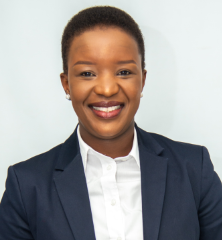 Busisiwe Mavuso, CEO of Business Leadership South Africa
“But that’s the reality of life, isn’t it? Similarly, when they mess up things, it counts against them as the government in power.”
The business leaders also responded to questions about their influence over the government, given the nature of their partnership — which has them providing capacity and resources to the current administration in their joint effort to reverse the country’s energy, logistics and corruption crises.
Mavuso said: “It would be negligent for business not to come to the party because we are worried about the narrative that we are taking on government responsibility …. The true north, and the most important thing, is that we need to be able to fix our trading environment so that we can ensure that we get investment into the country.”
Earlier during Wednesday’s briefing, Kingston suggested real progress was made in the meeting with the government the day prior.
 Stop gap: Martin Kingston of Business for South Africa. (Paul Botes/M&G)
A joint statement, released ahead of the briefing, noted that business and government agreed to focus on, among other things, finally establishing Eskom’s National Transmission Company, finalising the Freight Logistics Roadmap, as well as the National Prosecuting Amendment Bill. The latter piece of legislation will establish the Investigating Directorate as a permanent entity.
Coovadia was similarly optimistic about Tuesday’s meeting, saying that he was struck by how different the meeting was to a previous get-together. “If you look at the previous meeting, there was very little helpful input from the government’s side, particularly from the ministers,” he said.
“And at yesterday’s meeting there was substantial input and most of it — in fact, all of it — positive.”
The business leaders cited research by PwC and Sanlam showing that, if progress is made in the three identified areas — energy, logistics and corruption — the country’s GDP could get a more than 3% bump.
“If we address those three areas, we think that we can certainly create a platform for sustainable, inclusive economic growth,” Kingston said.
“Without doing it, we can’t …. Without consistent growth of over 3% per annum, we’re actually going to see increasing unemployment.”