This week’s G20 summit in Johannesburg will bring Indian Prime Minister Narendra Modi to our shores.(Delwyn Verasamy/M&G)
With India expected to host the G20 summit in the coming weeks, Prime Minister Narendra Modi said he has made Africa his “priority” during the country’s presidency of the grouping.
In an exclusive interview with the Mail & Guardian this week, Modi said the voice of Africa would be crucial in the developmental journey of the world. He said he had a strong emotional connection with the countries of the global south, especially those in Africa.
The Indian prime minister said he had personally taken the initiative to give the African Union full membership of the G20 and that he remained confident that the same would be realised during the forthcoming summit.
“As I said before, since India assumed the presidency of G20, we have worked with the motto of ‘One Earth, One Family, One Future’. It has been our priority to bring concerns, priorities and aspirations of the global south, including the countries of Africa, to the forefront of the G20 agenda,” he said.
Modi said India believed that the global political order needed to hear the voice of those affected the most by the decisions taken in the G20.
“We started our presidency with the Voice of Global South Summit in January 2023. Forty-seven African countries participated and shared their thoughts. It helped us to frame the agenda of our presidency,” he said.
“I must say that we have made a lot of progress in the past nine months. We have been able to impress upon our partners within G20 the importance of taking into consideration the priorities of the developing world.
 M&G Editor-in-chief Ron Derby interviews India Prime Minister Narendra Modi. (Delwyn Verasamy/M&G)
“We have strongly advocated for the permanent membership for the African Union in G20. This stems from our belief that Africa should be given its due. And, I am confident that we will achieve this during our presidency.”
The Indian prime minister was in South Africa this week attending the Brics annual summit, which brought together the leaders of member states Brazil, Russia, India, China and South Africa and agreed to admit six new countries to the bloc.
India’s influence in Brics has grown in parallel with its growing stature as a geopolitical superpower. In 2022, India surpassed the United Kingdom to become the fifth-largest economy in the world. Expectations are that its economy will shoot up to the third spot by 2029.
With India now considered as having the largest population in the world, Modi said the South Asian country was also young in terms of demography.
“The world over, India is seen as a global bright spot, a nation which can enhance global prosperity. And, I assure you we are not content with these great jumps … our people are powering India towards becoming the third-largest economy in a few years.
“So, we are a unique combination of being the fastest-growing emerging economy with a very young population. This will remain our great strength in the coming times.”
Modi’s government has committed to greater cooperation with Africa in trade, investment, defence, energy and health. India’s trade with the continent stands at about $100 billion, while investment is at $80 billion.
“The true test of our enduring partnership is that we have stood with each other in the times of need. During the challenging Covid times, we worked together to supply vaccines and essential medicines for the people of Africa. We have partnered in establishing pan-Africa networks for tele-education and tele-medicine,” Modi said.
“This year, in April, we set up the offshore campus of the National Forensic Science University in Uganda. Last month, we set up the offshore campus of the premier Indian Institute of Technology at Zanzibar in Tanzania. These will serve the educational needs, especially in the areas of science, technology, engineering and innovation, of the entire region.”
Modi dedicated the success of India’s Chandrayaan mission to the moon to all developing countries around the world.
India began exploring the moon’s surface with a rover on Thursday, a day after it became the first nation to land a craft near the largely unexplored lunar south pole.
The successful touchdown of the Chandrayaan mission comes four years after the previous Indian lunar mission failed during final descent, in what was seen at the time as a huge setback for its space programme.
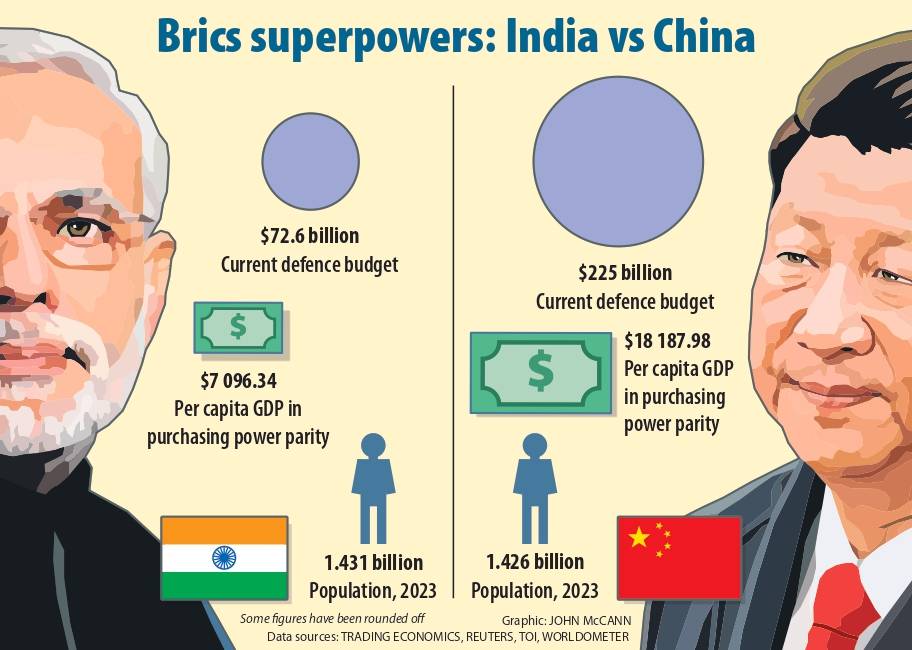 (Graphic:John McCann/M&G)
“I believe that its [success] will act as a source of inspiration that if India can realise its dreams, the rest of the developing world can also achieve their dreams. I know many countries in Africa have their aspirations for developing a space programme as part of the AU’s Agenda 2063. I assure them that India stands ready to share its experience and help in various ways,” he said.
“Africa is an aspirational continent. We welcome its vision to modernise and industrialise through the ambitious Agenda 2063 and the African Continental Free Trade Agreement. India is ready for the partnership and will share its capacities with the countries of Africa so that they can realise the potential to be a global economic and technological powerhouse.”
India is fast matching the achievements of established spacefaring nations.
The country is moving ahead on its ambitious programme for 500 gigawatts of renewable energy by 2030, Modi said, and is working towards increasing solar, wind, biofuels, nuclear, hydrogen and other sources in its energy mix.
With India and Africa’s shared nature of challenges and the development journey, Modi said he believed the innovations and solutions developed in India could be easily replicated in African countries.
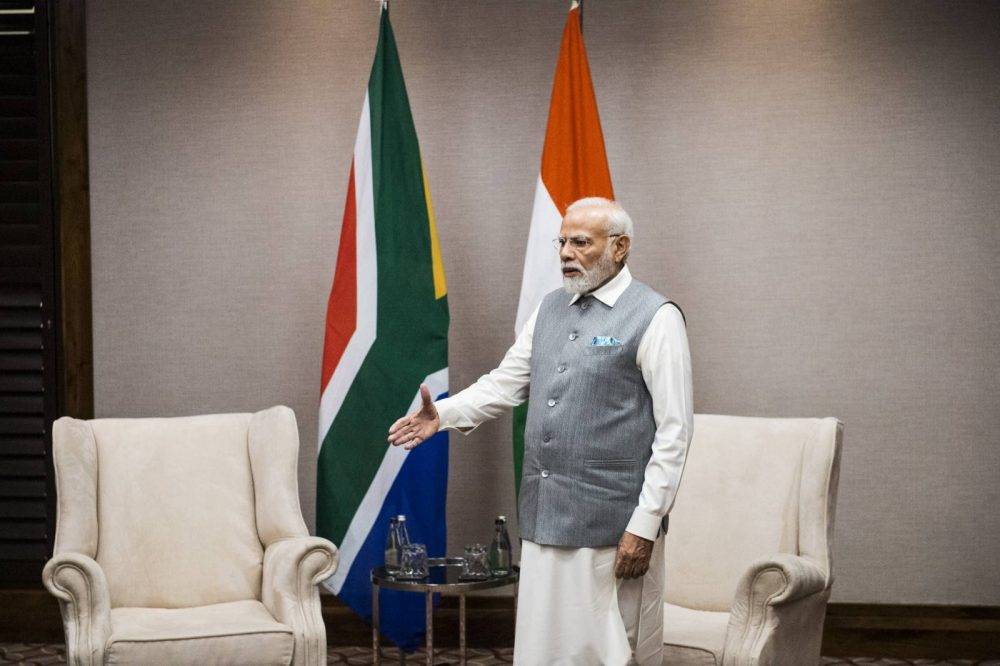 Moving forward: India’s Prime Minister Narendra Modi says that the country moving ahead on its ambitious programme for 500 gigawatts of renewable energy by 2030. (Delwyn Verasamy/M&G)
“India is ready to work on challenges that affect the planet. The initiatives for strengthening food security are a priority for all of us. Africa has significant land for production of various products. Both sides can build partnerships between the public and private sectors to invest in agriculture production and agro-industry. It will not only promote food security, but also generate large-scale employment,” he said.
“It will bring prosperity to the people and enable the African economies to move up the value chain through creation of agro-processing facilities. The 3.5 million Indian diaspora in the African countries constitute a strong bond of friendship between India and the region.
“I am sure, the youth of India would be excited to work with the youth of Africa to forge a partnership that will be a force for the global good. I would like to reiterate that India shall remain an enduring partner for Africa in its development journey of realising its aspirations.”
South African foreign policy analyst Sanusha Naidu said India’s foreign policy of strategic economy had seen it growing in international stature and influence, with its population and skills growth allowing its workforce to outstrip that of China.
India’s rivalry with China, with whom it has a 60-year border dispute, was one of the unspoken issues at the Brics summit, at which the two leaders interacted for the first time since 2020.
Modi’s comments on Africa make it clear that India, which has since the inception of Brics been overshadowed by China in terms of influence on the continent, intends to close that gap with its growing economic power. Regional rivalries between the two countries date back to the 1960s, with both countries now competing over “who is the voice of agency in representing the global south, for fighting for the marginalised nations and acting on behalf of the developing world”, Naidu said.
India had gained international stature, with Modi, who was once on the United States banned list, now “a darling of Washington”, with whom India secured significant defence contracts without becoming a militarily aligned partner.
”Right now, India is there. Suddenly this is a country that everybody wants to do business with,” Naidu said. “In his addresses to Brics, Modi has made it clear that India has arrived, that we are ready and that everybody wants to do business with us.”
Naidu said Brics had provided a significant opportunity for Modi and his Chinese counterpart, Xi Jinping, who had not met since the flare-up of the border dispute between the countries in May 2020.
The fact that the two had been involved in securing a consensus agreement on the addition of six new member states to Brics was significant.
Naidu said it was also significant that India and China, which both have internal conflicts with their Muslim populations, had coalesced to allow for the admission of a number of Muslim states to Brics.