South Africa, the world’s seventh-largest coal producer, faces a climate challenge that has largely flown under the radar: methane emissions from coal mines. (Delwyn Verasamy/M&G)
It perhaps comes as no surprise that in a world where multilateralism is no longer in vogue, and political suicide in many of the democracies in the West, that there aren’t too many capitals raising their hands to host expensive summits, such as the recently ended COP28, that seek to bind nations to programmes not shaped by domestic politics. In their absence, there were “audible gasps” when the summit was awarded to a cash-flush and oil-rich Dubai, said Roland Ngam, and for him, “what played out confirmed most people’s fears at every turn.”
“Dubai tried to overwhelm the negotiators by packing the event with its lobbyist friends and then it did everything to water down the clauses on fossil phase-out in the final declaration,” said Ngam, the programme manager for climate justice and socio-ecological transformation at the nonprofit Rosa Luxemburg Foundation Southern Africa.
From an African perspective, his biggest disappointment is in its leaders who are helping countries such as Dubai and Kuwait “lock coal into the hegemonic colonial capitalist paradigm” by offering them vast hectares of land for carbon offset schemes.
Countries such as Tanzania, Kenya, Liberia and Zimbabwe are selling millions of hectares to Arab nations, with “zero consultation with local and indigenous communities”.
He had “zero confidence” going into COP28 and left with zero confidence in what is supposed to be the biggest win of COP28 — the loss and damage fund. This “fund that so far has been filled only with pledges is another waste of time, just like the $100 billion that was promised to developing countries in Paris”.
At COP27 in Egypt last year, the announcement of the loss and damage fund was seen as groundbreaking. Countries that face the worst effects of climate change have long called for a fund to deal with the devastating effects of these extreme weather events.
This year, the loss and damage fund was launched on the first day of the conference. With it came pledges exceeding $420 million from countries in the European Union, America, the United Kingdom and the United Arab Emirates. It is one of the success stories of this year’s event, even though more funding will ultimately be needed.
Brandon Abdinor, a climate advocacy lawyer at the Centre for Environmental Rights, said although it’s great that the loss and damage fund has been established “it’s not going to mean anything without money in it. And we don’t even have a billion dollars in there and the needs are $300 billion a year, so that’s not even scratching the surface.”
Ngam said: “The many problems that we face shall not be resolved in Azerbaijan [where COP29 will be held] or in any UNFCCC [United Nations Framework Convention on Climate Change] structure. We urgently need an alternative.”
On Tuesday, negotiations overran a deadline set by Dubai after a backlash over a draft text that omitted the phase-out of fossil fuels took negotiators back to the drawing board.
South Africa’s chief negotiator, Maesela Kekana, said on Tuesday: “From our perspective, we are doing our best to come up with an ambitious outcome on the global stocktake and on the Global Goal on Adaptation.”
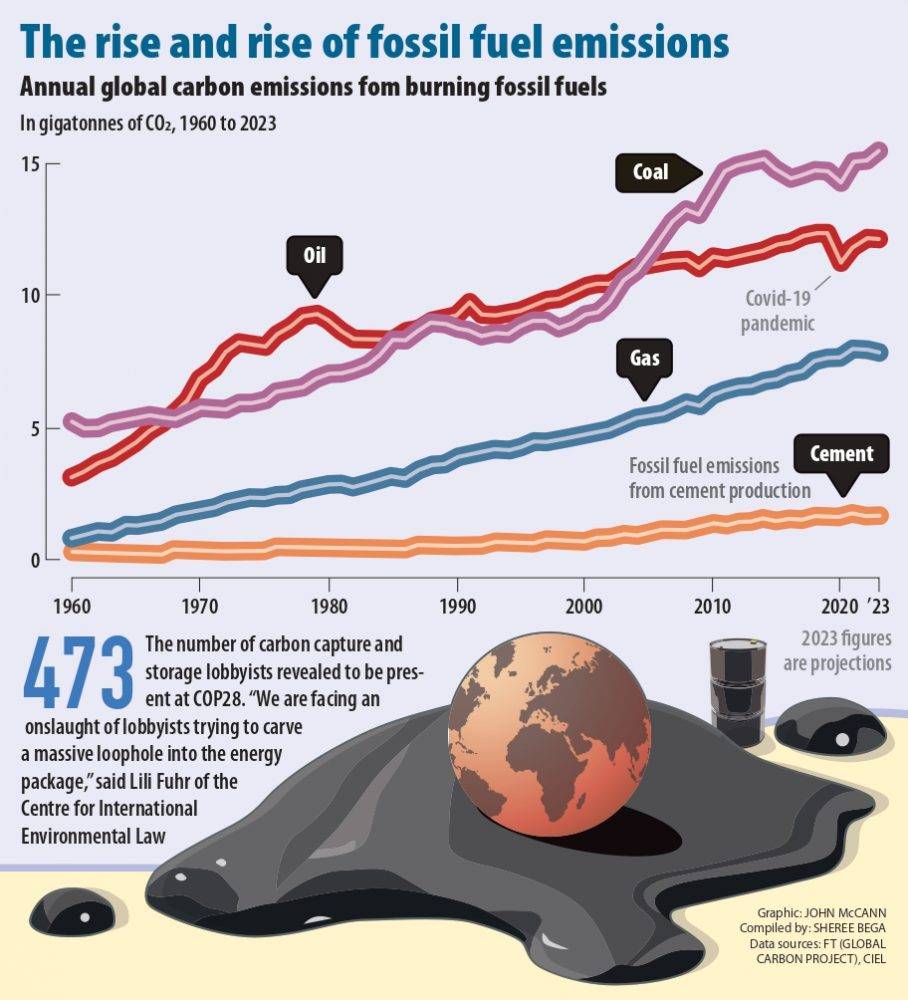 (Graphic: John McCann/M&G)
He cited the delivery of the loss and damage fund at the start of COP28 and “the many pledges made to that particular fund” as a win.
“We concluded the work on the just transition with outcomes on the way forward so everything so far worked out well. We are just trying to finalise these two outstanding issues on the global stocktake and the Global Goal on Adaptation.”
Despite reservations about the summit’s outcomes, Forestry, Fisheries and the Environment Minister Barbara Creecy welcomed decisions on the global goal for adaptation, the language for the global stocktake and the loss and damage fund. “For the first time we have language which calls for transitioning away from fossil fuels in energy systems in a just, orderly and equitable manner so as to achieve net zero by 2050 in keeping with the science.”
By Wednesday morning, the parties had agreed to the UAE Consensus, with no discussions or objections. It “sets out an ambitious climate agenda to keep 1.5°C within reach”, COP28 president Sultan Ahmen al-Jaber said in his closing speech. “The UAE Consensus calls on parties to transition away from fossil fuels to reach net zero, encourages them to submit economy-wide nationally determined contributions, includes a new specific target to triple renewables and double energy efficiency by 2030, and builds momentum towards a new architecture for climate finance.”
The world needed to find a new way. “We have worked very hard to secure a better future for our people and our planet. We should be proud of our historic achievement.”
Alex Scott, the programme lead at climate think-tank E3G, said: “Countries have agreed a path to address the gaps in global climate action: transition away from fossil fuels, deliver on global targets on adaptation, and take new steps to scale up finance for climate action, critically setting up a new loss and damage fund.
“There are gaps — especially on finance for adaptation — and loopholes, but the ultimate direction of travel is clear: the fossil fuel era is ending.
“The proof will be in the delivery — in countries’ next climate plans due by 2025, and in the transformation of the wider finance system to deliver the economic shifts needed.”
On fossil fuels, Mohamed Adow, the director of Kenya-based think-tank Power Shift Africa, said: “For the first time in three decades of climate negotiations, the words fossil fuels have ever made it into a COP outcome. We are finally naming the elephant in the room. The genie is never going back into the bottle and future COPs will only turn the screws even more on dirty energy.
“Although we’re sending a strong signal with one hand, there are still too many loopholes on unproven and expensive technologies like carbon capture and storage, which fossil fuel interests will try to use to keep dirty energy on life support.”
The text calls for a transition away from fossil fuels but “the transition is not funded or fair”, Adow said.
“We’re still missing enough finance to help developing countries decarbonise and there needs to be greater expectation on rich fossil fuel producers to phase out first.”
He said some people may have expected more from this summit, but this result would have been “unheard of two years ago, especially at a COP meeting in a petrostate. It shows that even oil and gas producers can see we’re heading for a fossil free world.”
“We’re still missing enough finance to help developing countries decarbonise and there needs to be greater expectation on rich fossil fuel producers to phase out first.”
He said some people may have had their expectations for this summit “raised too high”, but this result would have been “unheard of two years ago, especially at a COP meeting in a petrostate. It shows that even oil and gas producers can see we’re heading for a fossil free world.”