Former president Jacob Zuma Photo: Tebogo Letsie/Getty Images
As former president Jacob Zuma’s uMkhonto weSizwe party begins to gain momentum in KwaZulu-Natal, the ANC’s head of elections Mdumiseni Ntuli believes that what effect the MK party will have is yet to be understood.
The MK party — which rose to prominence in December when Zuma announced its founding, saying he would campaign for it ahead of the coming elections instead of the ANC — has proved to be a thorn in the side of the governing party.
The new party has shocked many detractors in recent by-elections in KwaZulu-Natal by snatching away votes from the Inkatha Freedom Party (IFP) and the ANC. This week, it again showed its strength in uPhongolo in rural KwaZulu-Natal, where its candidate received 28% of the vote.
While acknowledging Zuma’s party had been a cause for concern for the ANC given the recent by-election results, Ntuli said its effect would be equally felt by the IFP.
“I think that the perception at the moment is that the people who voted for MK were from the ANC, which is not necessarily scientific. I think the situation in KZN might be slightly different in a sense that the Zuma factor is also going to be a major challenge in the IFP which has modelled itself as a traditional Zulu organisation,” Ntuli said.
Ntuli, who was previously the ANC secretary in KwaZulu-Natal, said that the only time the IFP’s back was broken in the province was when the ANC elected Zuma. He said that with Zuma as ANC president, the IFP was unable to sustain a narrative that the ANC was for non-Zulus, which undercut its attractiveness.
“So I understand perfectly well as someone who comes from KZN that the JZ factor is going to be a threat to ANC to a certain extent, but it’s most likely to be a serious threat to the IFP.”
IFP spokesperson Mkhuleko Hlengwa said it was treating the MK party like any other party, adding that the IFP will treat the Zuma-led party in the election as an opponent.
“If you simply look at the numbers they tell a significant story. Over the past by-elections the IFP has grown in support despite MK party contesting these wards. Therefore, we don’t think of the MK [party] as a factor. We concentrate on growing our support and delivering on our mandate to the people where we govern,” he said.
Hlengwa said the IFP was the most diverse in terms of representation.
“If you have a closer look at our public representatives, you will find that there is a racially diverse and committed group of public representatives which espouse our values as a party. Peddling this narrative [are] nay-sayers who feel threatened by the IFP’s diversity and growth, thus they revert to old narratives about the party,” he added.
The governing party was the biggest victim of the IFP’s growth in support in the province in recent years. While many critics of its founder, Prince Mangosuthu Buthelezi, have over the years predicted that the IFP would not outlive him, the party has in recent years turned around the electoral decline it suffered from 1994 to 2014.
It has increased its share of the vote in every national and provincial and local government poll since 2016 and has also dealt with the succession crisis that forced it to postpone elective conferences for a decade.
The party took 41 of 80 legislature seats in 1994, but this dropped to a low of nine in 2014, with its current share sitting at 13. But its growth in 2021 has given the party hope that it can take back control of the province through a coalition with the Democratic Alliance (DA).
Ntuli said the IFP was in a more difficult position without Buthelezi, whose stature in the province was equal to that of Zuma.
“So yes, of course, the JZ factor will have some impact, because they are ANC members who have left, definitely those members vote for the ANC. They’ve left to go and occupy responsibilities as coordinator for one form or another. But whether or not those members will have the ability to attract along with them more support from the ANC, we are yet to see,” he said.
For decades, the question of who would replace Buthelezi as president of the IFP was taboo in the party, with an alternative centre of power to its founder being tolerated by him and his loyalists.
But, in 2019, Buthelezi handed over the IFP leadership to Velenkosini Hlabisa, who was elected unanimously at the party’s 35th national conference, having been nominated unanimously by its national council to take over the role two years earlier.
Buthelezi was awarded the title of president emeritus and remained the face of the party’s 2021 local government election campaign, as will be the case when South Africa goes to the polls next year.
Zuma’s relationship with the ANC leadership soured during the state capture inquiry, leading to his incarceration after he failed to comply with the constitutional court’s order to appear before the Zondo commission.
He is also said to have been disgruntled by the decision of some ANC leaders not to support him during his corruption trial.
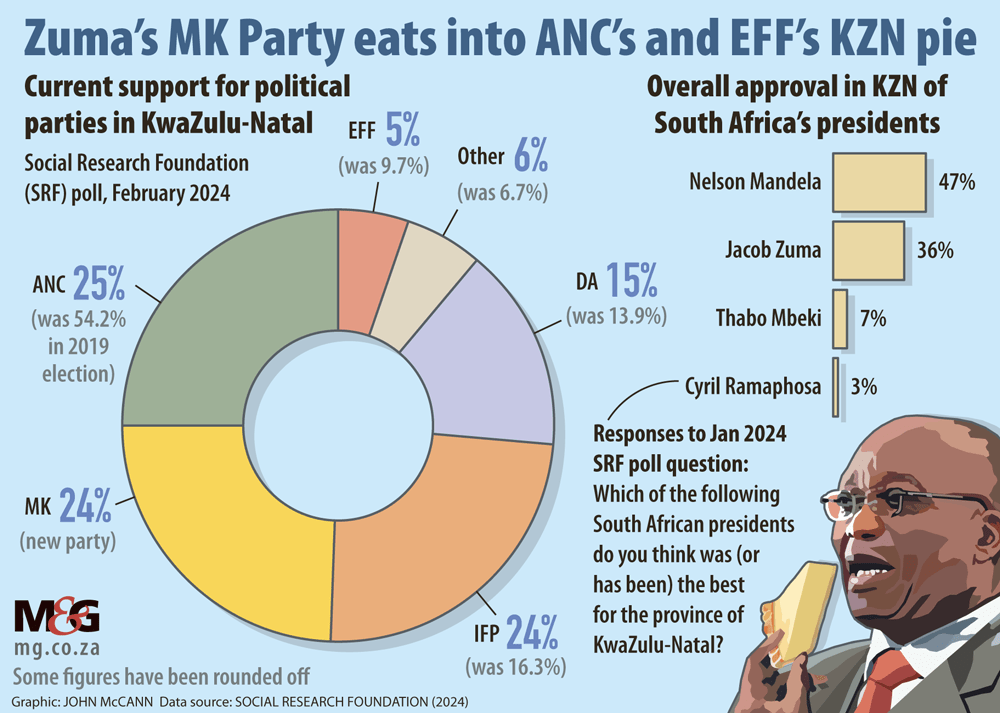 (Graphic: John McCann/M&G)
Ntuli said Zuma’s posture against ANC leaders was first identified during the Nasrec 2022 conference when the former party president opted to sit with KwaZulu-Natal delegates instead of joining national executive committee members at the podium.
“So I I’m still very convinced that while it may be difficult to persuade him to come back to the ANC because he has positioned himself as the face of the new formation. But I think the ANC must never get tired, at least to persuade all other ANC members, who may have taken a decision to go and join him,” Ntuli said.
“I think it’s our responsibility to persuade those members and maybe if we succeed in persuading them, that may force him to abandon this thing, and just stay home for his retirement or to return to the ANC.”
He said the ANC had lost members in branch executive committees and regional executive committees who had defected to the MK Party.
“It’s important that we properly gain an understanding of the conditions that have led those members to take a decision to leave the ANC. I don’t think they’ve just left the ANC because Zuma has left the ANC. I think there are compelling reasons for them in their localities, which have made them come to the conclusion that they are better off,” Ntuli said.
“And the ANC has to be worried about that. Because to lose a member and to lose as many as were lost, who are in the leadership structures of the ANC. Even if they are 10, or they are 20. It must be concerning.”
The ANC announced Zuma’s suspension from the party after intense discussions between party leaders on whether it should act against him before the elections.
In January, ANC secretary general Fikile Mbalula said the ANC’s rule 25.60 enabled the party to suspend members if justifiable exceptional circumstances warranted an immediate decision of temporary suspension without eliciting the comment or response of the members in question
Ntuli — who also holds a position in the national working committee — said the decision to suspend Zuma was necessitated by the exodus of the ANC’s ground members who were leaving to join the MK party in support of Zuma but still assuming positions in lower structures of the ANC.
“So the approach on JZ was so that you can communicate this message, clearly and it must apply universally, that you can’t be this way and still call yourself an ANC member.”
In October the Social Research Foundation conducted a poll that demonstrated Zuma’s popularity in KwaZulu-Natal. The poll sampled 2 434 registered voters in the province.
According to the poll, Zuma was favoured at 80% in the party while Ramaphosa was favoured at 54%. The poll also found that Zuma was still popular among all races, polling at 63.1%, while Ramaphosa’s popularity stood at 31.6%.
Zuma was, at 75%, more popular among black people, than Ramaphosa at 31.6%. The president was better favoured by white people (33%), Indians (20%) and coloureds (29%). The poll suggested that 46% of all races felt Zuma was treated unfairly by the ANC, the majority of those being black people (53%). But 31.7% of those polled from all races believed that Zuma had been treated fairly by the governing party.
This article was updated to include IFP spokesperson Mkhuleko Hlengwa’s comments.