The decriminalisation of adult use in private was a relief to users who allege arrests are low-hanging fruit for police. (Delwyn Verasamy/M&G)
‘It feels good to smoke in the comfort of my home — without the worry of the police harassing me,” said Tebogo Seele, puffing a thick and pungent cloud into the air.
Seele, speaking from his home in the Gauteng township of Katlehong, was reacting to the National Council of Provinces passing the Cannabis for Private Purposes Bill — also known as the dagga bill — in February. It has been sent to President Cyril Ramaphosa to sign into law.
The informal trader said the bill would have the added advantage of expunging the criminal record of his cousin, who asked to be identified by his township nickname, Spanner, for possession of dagga.
But cultivating the product for financial gain, known as dealing, will still be illegal, when the law is passed.
The bill does not specify what quantity of cannabis in a person’s possession is deemed to be stock for selling, rather than for personal use.
The proposed legislation leaves it to police officers’ discretion to determine what amount of dagga constitutes intention to sell.
This week, Katlehong residents who spoke to the Mail & Guardian said law enforcement officers had “weaponised” the policing of dagga-use by adults in their private spaces, accusing them of harassing people in order to boost their arrest numbers as part of their key performance indicators.
The residents’ contention is supported by an August 2020 report by Fields of Green for All, an NGO, which was founded by the late Julian Stobbs and his partner Myrtle Clarke, known as “the Dagga Couple”.
In September 2018, the constitutional court ruled that sections of the Drugs Trafficking Act of 1992 were unconstitutional, after a legal challenge that involved Stobbs and Clarke. The sections included cannabis — or dagga — among prohibited drugs, making it a criminal offence to be found in possession of the product.
In his report for Fields of Green for All, Suresh Patel said arrests for dagga possession counted favourably towards police officers’ performance indicators and this had to be factored in when “understanding cannabis arrests in South Africa”.
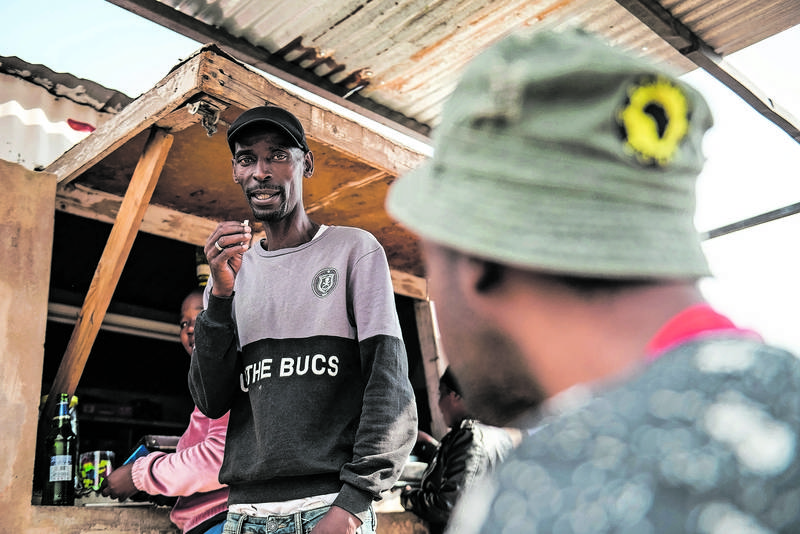 Up in smoke: Tebogo Seele and his cousin Spanner (above) outside his shop (above and left) in Katlehong, Gauteng. Spanner says he was tricked by the police into signing an admission of guilt after he was arrested for possession of cannabis. (Delwyn Verasamy/M&G)
“Arresting a cannabis user or grower is low-hanging fruit for South African police officers because they meet their targets without having to expose themselves in dangerous and stressful situations where violent crime is involved,” Patel said.
“South Africa is one of the most violent and socially unequal countries in the world, with organised crime and gang elements proliferating in high-density, low-income areas.”
Patel’s views are supported by crime statistics for the 2017-18 financial year, which showed that 65% of the 323 547 people who were arrested for drug-related crimes were on possession of dagga charges.
The statistics include Spanner’s payment of an admission of guilt fine in January 2018 at the Katlehong South police station, when police arrested him, he said, on false accusations of being a cannabis dealer.
A plastic bag containing the dried plant was found in his home, which he shares with his cousin, Seele. There, the two men grow and smoke what they refer to as their “feel-good medicine”.
Should Ramaphosa pass the dagga bill, the criminal records of people who signed an admission of guilt, or were convicted for the possession of cannabis, will fall away.
Spanner said he had been “tricked” by officers at the local police station into admitting his guilt, saying he had paid the R500 fine because he did not want to sleep in the cells and appear in a magistrate’s court the following day.
“I had to go to work, so I could not risk my employer finding out that I was arrested, especially on drug possession charges.
“What I did not know was that paying the fine would result in a criminal record,” said Spanner, who works as a mechanic at a garage in Alberton.
“Five years later, my bosses have no idea that I have a criminal record, so I am very happy that parliament passed the bill. I hope the president signs it into law as soon as he can, so the dark cloud hanging over my head is removed,” Spanner added.
Despite the 2018 judgment stating that dagga arrests should be stayed until parliament rectified the unconstitutional laws, police have continued to arrest people found with cannabis in their homes, according to a Fields of Green for All report from February last year.
In the report, the organisation accuses the police of violating court orders in order to continue their “abuse” of cannabis smokers.
“It is once again clear that the SAPS [South African Police Service] do not respect the constitution or the government, they do not follow the law, let alone their own directives or circulars, and they don’t respect any South African citizen’s human rights,” it said.
Those arrested included 21-year-old Dwayne Welgemoed from Lambert’s Bay in Western Cape, who was caught with 130 cannabis plants in various stages of growth and four buds in the flower. He was held in December 2022.
“We do not sell nor support any unlawful use of cannabis in any way. We use cannabis solely for recreational use,” the report quoted Welgemoed as saying.
“The police confiscated all of our plants without showing a warrant or giving a reason why they were there.
“The police said they needed someone to go to the police station so I went with them without resisting. They charged me for cultivating cannabis,” he added.
In September last year, national police commissioner Fannie Masemola, realising that police could face legal action for unlawful arrests for dagga possession, issued a directive to all officers to stop the practice.
“Since there is no definition or quantification of the concept of ‘personal consumption’ [in the 2018 judgment], the South African Police Services is at risk if they arrest a person for possession, use or cultivation and such matter is not enrolled, struck off the roll, or otherwise does not result in prosecution. This exposes the SAPS to civil claims for unlawful arrest and detention,” Masemola said.
He added that arrests should be the last resort when officers suspect someone of dealing and that the suspects should be “treated with dignity and in compliance of the prescripts laid down by the law”.
“Before arresting alleged cannabis offenders and the seizure of their property proceeds, members of the SAPS should liaise with the prosecuting authority, where possible, to determine whether the matter will be enrolled and prosecuted. It is also advisable to obtain a search and seizure warrant beforehand [and] before such operations are conducted,” the police commissioner said.
Taking another long drag on his joint, Seele said Masemola’s directive meant he could relax and enjoy dagga without risking an unwanted visit from police officers.
“I once burnt my leather couch trying to put out my joint after my cousin imitated the rough voice of a cop when coming towards the kitchen door, saying I am under arrest,” he reminisced with a laugh.
“The paranoia got me there. Now I can be paranoid in peace.”