Shell’s recent announcement that it is leaving the country is likely to set off mergers and acquisitions (M&A) activity as the oil and gas company sells its refinery and service stations during the divestiture. (photo by Mike Kemp/In Pictures via Getty Images)
Shell’s recent announcement that it is leaving the country is likely to set off mergers and acquisitions (M&A) activity as the oil and gas company sells its refinery and service stations during the divestiture.
Shell’s 2024 energy transition strategy — under which it plans to reduce carbon emissions and focus on its more profitable upstream businesses — is one of the reasons it is leaving South Africa.
The announcement also came after media reports of a dispute between Shell and its black economic empowerment partner, Thebe Investment Corporation.
Reacting to the pending move, Mineral Resources and Energy Minister Gwede Mantashe sounded a defiant note last week, saying that other companies would be waiting in the wings to take over Shell’s operations. “Engen left, Vitol took that over. Caltex left and that is why Caltex garages are written Astron now. Shell is going to leave and I can tell you with my eyes closed, there will be a company or a consortium that will take over that business.”
Another corporate story that has recently made headlines is a second unsolicited bid from Australian mining giant BHP for the operations of South African industry peer Anglo American. The first unsolicited bid was last month. BHP thought that if it teamed up with Anglo, the combined entity could generate more value.
The conditions for the transaction from BHP were that Anglo had to let go of its subsidiaries Anglo American Platinum and Kumba Iron Ore.
But Anglo rejected the offer, saying the proposal significantly undervalued the company and its future prospects, and that it would deliver significant value for its shareholders on its own.
Why do companies merge? And why do potential mergers sometimes fall through?
Ian Hayes, the head of corporate and commercial practice at Cliffe Dekker Hofmeyr, singled out four primary reasons for corporate mergers and acquisitions: synergies, economies of scale, diversification and strategic alignment.
“One of the reasons companies merge is because of synergies and this is where they think that the combined entity can generate more value than the two entities can generate separately,” Hayes said.
Another is economies of scale, where entities see an opportunity to reduce costs per unit and improve efficiencies in production or distribution. The third is diversification, where companies look to vary their revenue streams, products and reduce reliance on a single product or market by merging with a company that has coverage in other areas.
In the miners’ case, BHP said it was after Anglo American’s copper assets, which it could not obtain without acquiring the company.
On Tuesday, Canal+ announced it has now acquired 45.2% of MultiChoice’s equity through both on-market and off-market transactions. The French-based media giant, which already has investments in Swedish player Viaplay and Hong Kong-based streamer Viu, wants to penetrate new markets.
 (Graphic: John McCann/M&G)
The fourth reason companies merge is for strategic alignment, said Hayes. This is when the merger makes sense based on the strategic goals and the challenges for the two corporations to merge.
Last year, Impala Platinum obtained a controlling stake of Royal Bafokeng Platinum. Analysts said Impala wanted Royal Bafokeng, which has mechanised and shallower mines, adjacent to its own ageing, costly and deep-level shafts in the Rustenburg platinum belt.
“Corporations can expand and grow themselves organically, but sometimes it’s a lot quicker and makes more sense to merge with a company or acquire a company or an asset to get into those strategic areas rather than starting from scratch,” Hayes said.
There are a number of aspects to a successful merger, including careful planning and due diligence, he noted, adding that many mergers have failed because of poor integration, cultural differences or policies.
In 2021, for example, the Competition Commission blocked the acquisition of Burger King South Africa by private equity fund Emerging Capital Partners Africa. The commission found the merger would lead to a significant reduction in the shareholding of historically disadvantaged people in the target firm, from more than 68% to zero.
A few months later, the Competition Tribunal gave the green light to the acquisition after Emerging Capital Partners Africa agreed to meet several requirements.
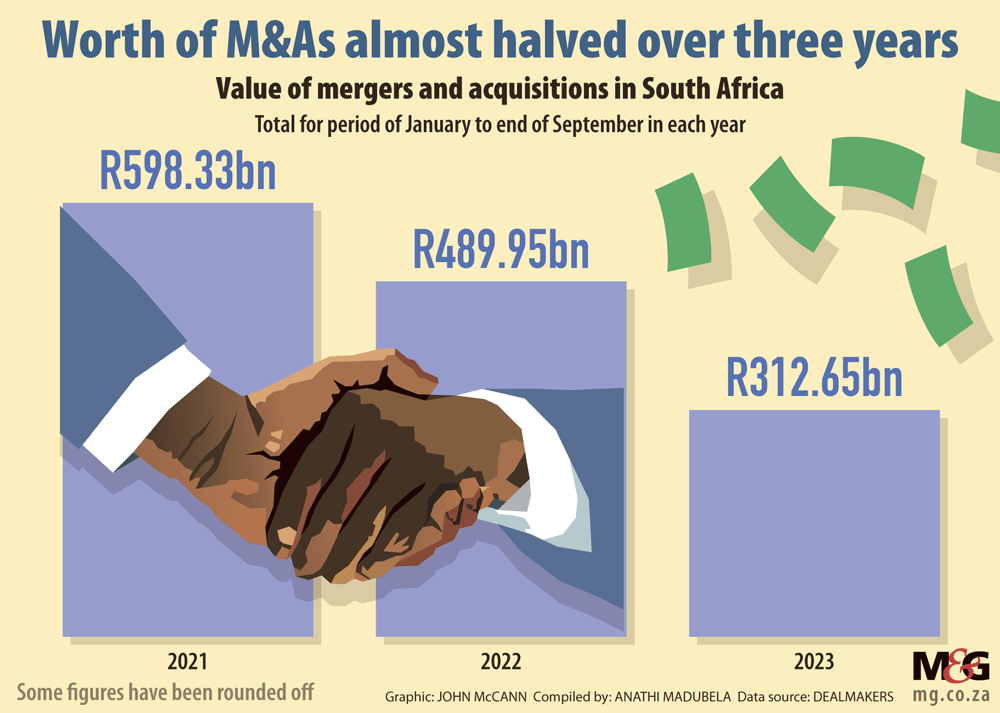
Mergers and acquisitions activity in Africa experienced a sharp decline in 2023 compared with 2022. In South Africa, completed M&A deals collapsed almost 90% to $1.9 billion (R34 billion) in 2023 from the previous 12 months, according to data compiled by Bloomberg.
While 2023 was one of the worst years for M&A activity, this year is not expected to be any different, especially with the uncertainty linked to elections, law firm Norton Rose Fulbright said in a report.
Hayes agreed, saying: “People are sitting back and waiting to see what will happen with the elections. There are some signs of recovery in the M&A space this year but I don’t think we’ll really know until after the elections.”