After conducting damage assessments, the weather service has now confirmed that the tornado in Tongaat had estimated wind speeds in the order of 225km/h to 265km/h
The deadly tornado that tore through Tongaat in KwaZulu-Natal last week has been rated EF3 on the Enhanced Fujita (EF) Scale, a report by the the South African Weather Service (SAWS) has concluded.
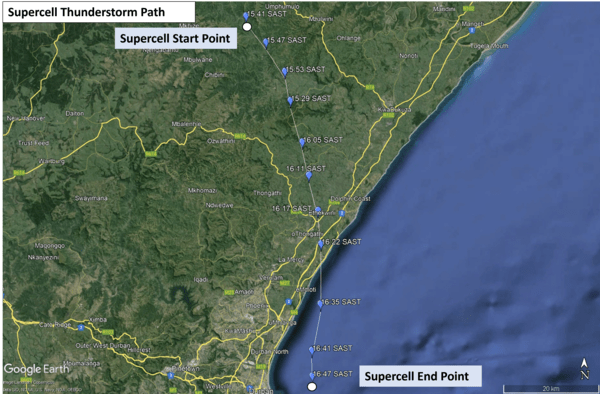
On 3 June, a severe thunderstorm called a “supercell” developed at 3.10pm over the interior of KwaZulu-Natal, according to forecaster Wayne Venter. It then moved towards the oThongathi area just before 4pm where a tornado was observed.
Most tornadoes develop from these strong and violent thunderstorms.
After conducting damage assessments, the weather service has now confirmed that the tornado had estimated wind speeds in the order of 225km/h to 265km/h, which occurred within the tornado’s path, Venter said.
The EF scale is used to assess the intensity of tornadoes by assigning a rating to a tornado based on estimated wind speeds inferred from observed damage by using various damage indicators, the weather service said. This rating system enables the classification of tornadic events.
The tornado left 12 people dead, damaged more than 7 000 homes and affected 17 000 people. On Wednesday, Cooperative Governance and Traditional Affairs Minister Thembi Nkadimeng classified the areas devastated by the tornado as a national disaster.
A line of thunderstorms developed along the border of the Free State and KwaZulu-Natal on 3 June ahead of a well-developed cut-off low-pressure system situated over the western interior of the country, the weather service said.
“Cold and dry air swept in from the western parts of the country to the central interior, while the eastern parts, particularly KwaZulu-Natal, experienced warm and moist atmospheric conditions, aiding in the development of severe thunderstorms where these cold and warm air masses met,” it said.
Strong low-level wind shear — the change in wind speed and direction with height — was present over the coast and interior of KwaZulu-Natal ahead of the line of severe thunderstorms.
“This process of shifting/changing winds in the lower levels of the atmosphere, as the line of severe storms moved across parts of the province, was one of the primary contributing factors in the development of the supercell thunderstorms and tornadoes,” the weather service said.
At least two tornadoes were confirmed in the province on 3 June. One of them, called a wedge tornado because it is wider and larger than it is tall, resulted in severe damage in the oThongathi area.
“An analysis of the Durban radar data revealed several features indicative of a ‘supercell’ thunderstorm,” the weather service said.
It said meteorologists rely on specific radar features to identify severe thunderstorms like supercells. “At least two thunderstorms could be classified as supercell thunderstorms, while another, despite exhibiting supercell characteristics, did not persist long enough to meet the required time criterion.”
A supercell is a severe type of thunderstorm that contains a rotating updraft and can be identified using a weather radar with characteristic features such as the hook echo on the reflectivity field and a rotational signature on the Doppler velocity field.
Such thunderstorms are also known to sometimes produce tornadoes.
“The thunderstorm that passed over Tongaat and produced a tornado was confirmed to be a supercell, with a hook echo, although it did lack the typical rotational signature on the Doppler velocity field due to various limitations of the radar data,” the weather service said.
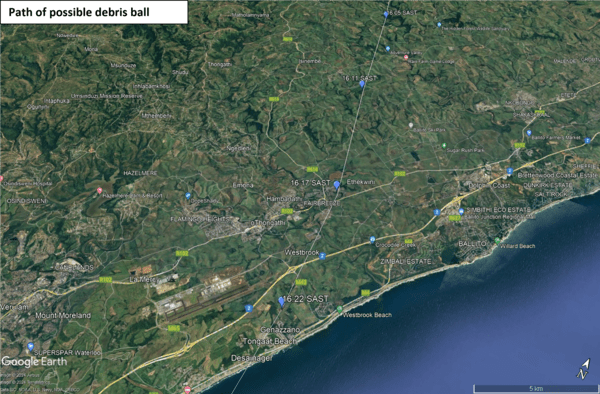
“A tornado signature on the Doppler velocity field may at times be detected, although limitations exist including the proximity of the storm to the radar. No significant Doppler velocity signature was noted in this case despite its close proximity to the radar, however on the reflectivity field a possible tornadic signature known as a debris ball was noted.”
Such signatures occur because of the debris that is picked up aloft by the tornado and results in a “ball-shaped” echo. Debris balls are often associated with stronger tornadoes — EF3 or greater on the Enhanced Fujita Scale, it said.
Tornadoes are the most formidable windstorms on Earth and “unleash devastating destruction” along their trajectories.
“Tornadoes typically form in environments where certain atmospheric conditions come together. Some factors include wind shear … and atmospheric instability, where warm, moist air near the ground is overlaid by cooler, drier air aloft,” said the weather service.
Systems like cold fronts or cut-off lows help the warm, moist air to rise. Sufficient moisture in the lower atmosphere is also necessary to fuel the thunderstorms that can produce tornadoes.
Tornadoes are more common in South Africa than people think, although the probability of them occurring is still low.
Most tornadoes in the previous century occurred over the eastern provinces, especially Gauteng and KwaZulu-Natal. And most tornadoes in South Africa are weak, with a low EF rating of 0 to 2. “The stronger and more destructive tornadoes (EF3 and EF4) occur every decade or so.”
One of the highest-rated tornadoes in the country’s recorded history was the Welkom tornado of 20 March 1990, which was rated as an F4 on the Fujita scale. It damaged 4000 homes, and was one of the costliest in history.
In 1999, an F4 tornado struck Mount Ayliff in the Eastern Cape. This tornado threw cars and trucks into the air and left 95% of the population in the area homeless.