South Africa’s landfill sites are in a terrible state and if drastic measures are not taken, the country will soon drown in its own waste. (Andy Mkosi)
The City of Johannesburg’s landfills collectively have about three years of capacity, and some are expected to reach the maximum sooner because non-municipal solid waste such as rubble take up volume.
Leon Grobbelaar, the past president of the Institute for Waste Management Southern Africa (IWMSA), said that last year it was estimated that the Robinson Deep landfill, the oldest and largest landfill of 25 hectares, had about 18 months of airspace left.
“Those facilities should be used for municipal solid waste [MSW] or domestic waste, but because there is so much building rubble and garden greens coming into this facility, they are actually taking up the space of the MSW and that actually declined or decreased the space available on these facilities,” he said.
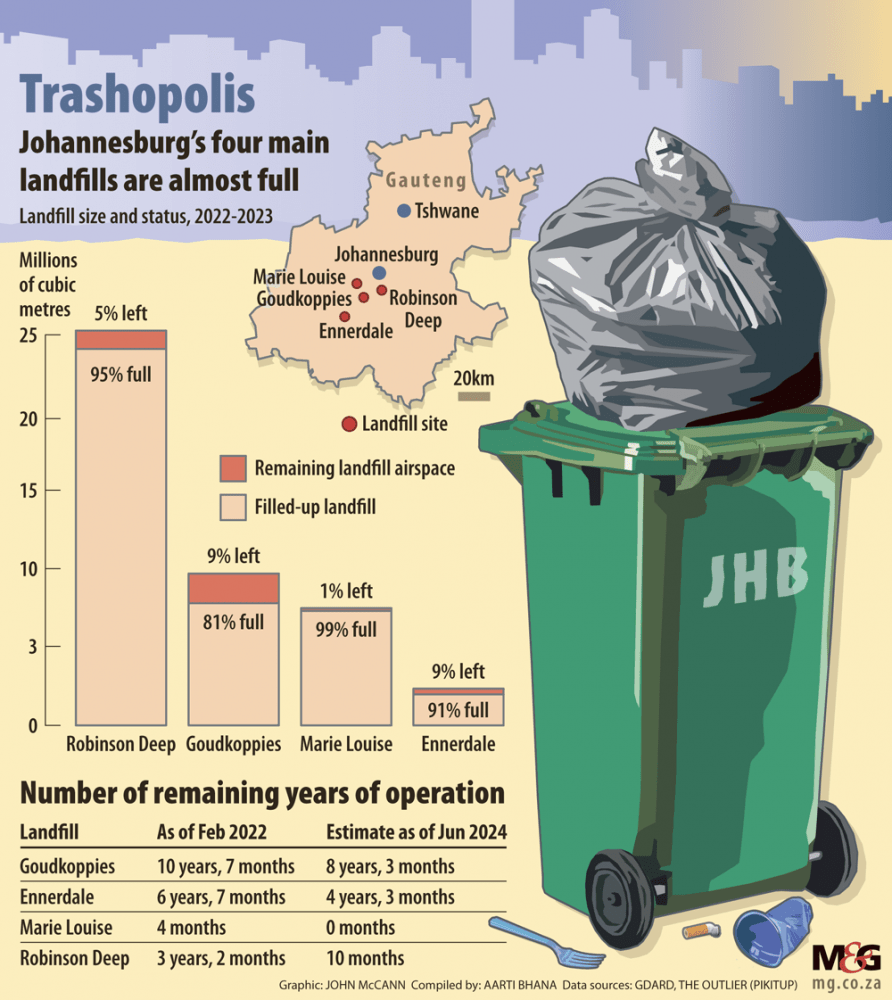
The city has four landfills, and according to Johannesburg waste management company Pikitup’s 2022-23 annual report, Robinson Deep has 5% of capacity left, while the other three landfills are also nearing the end of their lifespans.
The Goudkoppies landfill, the second largest, has about 19% of remaining capacity, while the Marie Louise and Ennerdale landfills have about 1% and 9% space left, respectively.
In terms of time, these landfills will be filled in about three to five years, said Pikitup spokesperson Muzi Mkhwanazi, citing the increasing population in the city for the dwindling capacity.
“[The high population] is also evidenced by the high number of mushrooming informal settlements and the densely populated central business districts such as Johannesburg, Roodepoort, Randburg, Lenasia and Midrand,” he said. “It is projected that plus-minus six million people reside in the City of Johannesburg.”
The problem of landfills reaching capacity has been flagged on numerous occasions.
In 2022, the Gauteng department for agriculture and rural development reported that Robinson Deep had three years and two months left, while Marie Louise had four months, Goudkoppies had 10 years and seven months and the smallest of them all, Ennerdale, had six years and seven months.
An earlier report on the status of landfill airspace in Gauteng — published by waste management consultants Kobus Otto and the IWMSA in 2020 — estimated that the four landfills have up to five years of air space left.
The bottom line is that landfill capacity in Gauteng is scarce, and the solution is for the city to divert the non-municipal solid waste away from landfills, Grobbelaar said.
“The city has signed contracts with different contractors to divert waste away from landfill like building rubble, garden greens, but I don’t think they are serious about the diversion,” he said.
“If the city is not taking the diversion of building rubble and garden greens away from the landfills, they will sit with a serious crisis and we will be drowning in our own waste.”
In 2023, the city appointed a service provider to collect and process green waste — biological waste like food leftovers that can be used as compost, Mkhwanazi said. As a result, Pikitup has managed to divert more than 5 000 tonnes away from the landfill sites.
The city has plans to buy land in Ennerdale to develop a new landfill and expand current sites.
 (Graphic: John McCann/M&G)
“Pikitup is awaiting the finalisation of the transfer of land to Pikitup and this additional land is expected to add an additional 10 years of airspace to the Ennerdale landfill site,” Mkhwanazi said.
“[The] Robinson site has been extended. Construction of stormwater drainage is taking place and the site is expected to have an additional lifespan of over 20 years. Assessments are afoot in the other landfills to assess their extensions or lack thereof.”
But Grobbelaar noted that these processes take time, because it requires land and a licence, and “a new landfill can only be up and running within seven years from now, technically speaking”.
There is no quick-fix to the problem and the landfills need to be rehabilitated, he added.
The issue is prevalent in other metros in the province: the landfills in the City of Tshwane have on average three years left, although those in the City of Ekurhuleni have more — about 20 years — the Gauteng department’s 2022 report said.
In its 2025 forecast for landfill capacity in the province, the report says there will be no landfill site in Johannesburg. Tshwane’s Soshanguve landfill will have one year remaining, the Garankuwa landfill will have two years left and the Bronkhorstspruit landfill will have three years. Only Ekurhuleni will still have capacity left.
Mkhwanazi said the City of Johannesburg will continue strengthening measures to deal with the problem. This includes the “Separation at Source” programme, in which Pikitup is assisting with the collection of recyclable materials from depots, diverting them from landfill sites, and registering more waste pickers to help prevent waste entering landfills.
The city has registered more than 2 000 waste pickers and the process is still continuing, Mkhwanazi said. But, he added, residents must also play a role by recycling. Pikitup has integrated waste management facilities in the city for this purpose.
“Pikitup is appealing to all the residents of the city to embrace a culture of recycling
to not only preserve its landfill sites but also to preserve the environment. Landfill should be a last resort if all of us recycle only residual waste which will be in small quantities will end up in landfill sites.”