Operations: Water trucks supply residents (above) while maintenance is carried out in Johannesburg. (Photo by Gallo Images/Sharon Seretlo
While residents bear the brunt of severe water shortages, Johannesburg Water’s board is alleged to be preparing to appoint a R2.6 million-a-year executive position in an act of apparent nepotism.
Gugulethu Phakathi — Johannesburg Water’s former board chairperson who currently sits on the structure as a non-executive director — is primed to be the entity’s chief operations officer following alleged shenanigans to favour her candidacy.
Phakathi has been shortlisted with two other people for the post. The Mail & Guardian has tracked the recruitment process since early May before applications were submitted, following a reliable tip-off about the City of Johannesburg-owned entity’s appointment plans.
In what highly placed sources in the city and its company called “blatant nepotism”, Phakathi resigned as Johannesburg Water’s board chairperson on 23 October last year eight days before the fixed five-year term of the previous incumbent, Derrick Kgwale, ended.
Phakathi’s resignation is detailed in the water company’s annual report for the 2022-23 financial year, which did not state reasons for the change, adding only that Sipho Mthembu assumed the chairperson position on 27 October.
The report was signed off in November by, among others, Mthembu and Jack Sekwaila, the mayoral committee member responsible for environment and infrastructure.
In December, Johannesburg Water advertised its executive position, stating that prospective candidates required a minimum of a three-year engineering degree at the National Qualification Framework (NQF) level seven, as well as “a postgraduate degree in business management or engineering at NQF level eight”.
Phakathi did not fully meet the requirements, having a University of Johannesburg bachelor of technology (BTech) in mechanical engineering, which is an NQF level seven qualification.
A source close to the water entity said this created a problem for the board, which was allegedly driving her appointment.
“She was the chairperson of the board and anticipated that the chief operations officer position would be advertised. Before that was done, she then resigned,” the insider said.
“But she was not truthful to the board and executives she is working with about her qualifications, which created problems for them.
“As a result, they had to withdraw the advert and issue a new one, which then required an NQF level seven. And now she is shortlisted.”
A new advert posted in May for the chief operations officer job backed up what the source said. The requirements were altered to state that the minimum qualification was a three-year engineering degree at NQF level seven. The previous requirement of a postgraduate degree was now “an added advantage” rather than a necessity.
According to sources in the City of Johannesburg and its water entity, the board and executive management’s alleged actions in favour of Phakathi have fostered a culture of fear in Johannesburg Water for anyone challenging their plans.
“They [the board] were warned many times not to go ahead with their plans to appoint Gugu as the COO in the way they have gone about it. It has got to the point where I don’t ask any questions anymore after being threatened with the loss of my job,” one insider said.
Another source said the company’s managing director, Ntshavheni Mukwevho, “was not happy with the blatant nepotism”.
“But there is nothing she [Mukwevho] can do because the wheels are already in motion,” the source added.
Johannesburg Water spokesperson Nombuso Shabalala insisted this week that there was nothing nefarious about the lowering of the qualification requirements from NQF eight to seven, saying this was not done to favour any candidate but to “align Johannesburg Water’s positions with those of the City of Johannesburg and its entities”.
 Gugulethu Phakathi is shortlisted for a job at Johannesburg Water.
She added that the city’s group chief operations officer, as well as the managing directors of the Joburg Property Company, Pikitup, and City Power, among others, had an NQF level seven as a requirement for the positions.
“So, the decision by Johannesburg Water to make the position to be an NQF level seven is not in favour nor disadvantaging any candidate. It implies all candidates who have an NQF seven or higher can qualify for the position,” Shabalala said. “The recruitment process has been conducted in compliance with Johannesburg Water policy and no section of the policy has been compromised.”
But contrary to Shabalala’s claims, the chief operations officer and managing director posts at the aforementioned companies all required an NQF level eight minimum qualification, not seven, with a master’s degree cited as an “added advantage” for City Power.
An insider in the city said the board’s handling of the matter had overshadowed the fact that Phakathi, who was appointed as a Johannesburg Water non-executive director in March last year, was “fit and proper” to handle the high-ranking post. They added that she was experienced in the engineering and project management field.
“Unfortunately, the way the board has gone about this chief operations officer post has been blatant nepotism and arrogance.
“It is unfortunate because this will unnecessarily taint Gugu and she does not deserve the bad press,” the source said.
In her LinkedIn profile, Phakathi said she was an “accomplished professional” with 12 years of experience in the built environment, project management, and water engineering and infrastructure development.
The controversy over the chief operations officer job comes as the city has been grappling with a water crisis since March, when Johannesburg Water said lightning struck a pump station in Eikenhof, resulting in about half of the six million residents going without water.
The utility has also implemented “water-shedding” in Johannesburg, asking residents to reduce consumption by 10%, which has been compounded by the month-long maintenance programme by Rand Water that began on 22 June.
 (Graphic: John McCann/M&G)
In an interview with broadcaster Newzroom Afrika on Tuesday, Ravin Singh, of the civic group Joburg Water Crisis Committee, said residents in parts of the city such as Emmarentia and Kensington had faced a perennial water problem long before 22 June.
“The problem in Emmarentia [and] the problem in Kensington have been there long before this maintenance programme, and we’ve been living with it for over a year now,” Singh said, adding that Rand Water’s maintenance of the system was “very important”.
He said the crisis committee had resolved to ramp up its protest action over the shortage of water in an area that has a population of about 25 000 residents, according to the 2023 Census.
“We are very clear that this problem that we face will not disappear overnight. But, when you have a city that does not communicate properly with its citizens, when they don’t fix leaks on time, you are not going to get citizens that are cooperating with the city to address the issue of over-consumption,” Singh said.
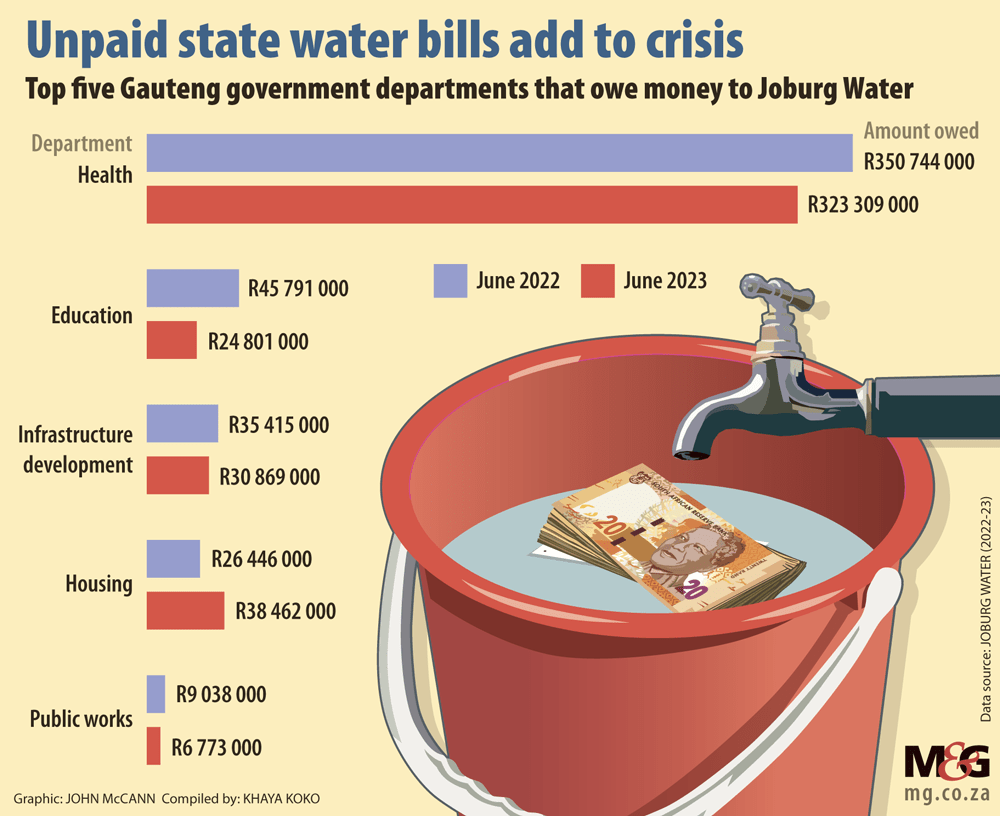
According to its 2022-23 financial report, Johannesburg Water’s operational and financial problems are exacerbated by more than R602.9 million that the entity is owed by Gauteng government departments and other state entities as of 30 June last year.
The company is also saddled with irregular expenditure of R2.1 billion, which is up from R418 million in the 2017-18 reporting period.
Commenting on the company’s financial performance, Shabalala said: “Notwithstanding normal business challenges, the company is satisfied with its operational and financial management.”