The chick after the mouse attack that wounded it's neck
Researchers on South Africa’s sub-Antarctic territory of Marion Island last month discovered a wandering albatross chick that had been eaten by invasive house mice. By the following day, the four-month-old chick, which had wounds to its neck, was dead.
There has been an “accelerating series” of these attacks by the rodents, according to the Mouse-Free Marion Project, a partnership between the department of forestry, fisheries and the environment and BirdLife South Africa.
Marion Island is home to a quarter of the world’s wandering albatrosses and is a crucial breeding site for the species, categorised as vulnerable according to the IUCN Red List of Threatened Species. Every individual death is significant for the resilience of their global breeding population.
Wandering albatrosses generally breed only once every two years and raise a single chick.
House mice were accidentally introduced to Marion Island by sealers in the early 1800s.
Photographs of the chick are a reminder of “what’s happening, what’s at stake and the importance of getting rid of the mice” for Anton Wolfaardt, the manager of the project, which is one of the world’s largest mice eradication drives.
“It’s a reminder that it is obviously a huge conservation issue, but it’s also an issue that is impacting individuals of these remarkable seabirds that are dying these gruesome deaths because of the mice,” he said.
Seabird researchers Rhiannon Gill, of South African Polar Research Infrastructure, and Vanessa Stephen, of the FitzPatrick Institute of African Ornithology at the University of Cape Town, found and photographed the chick at Macaroni Bay on the island’s eastern coast, in one of three wandering albatross colonies that have been monitored since the early 1980s.
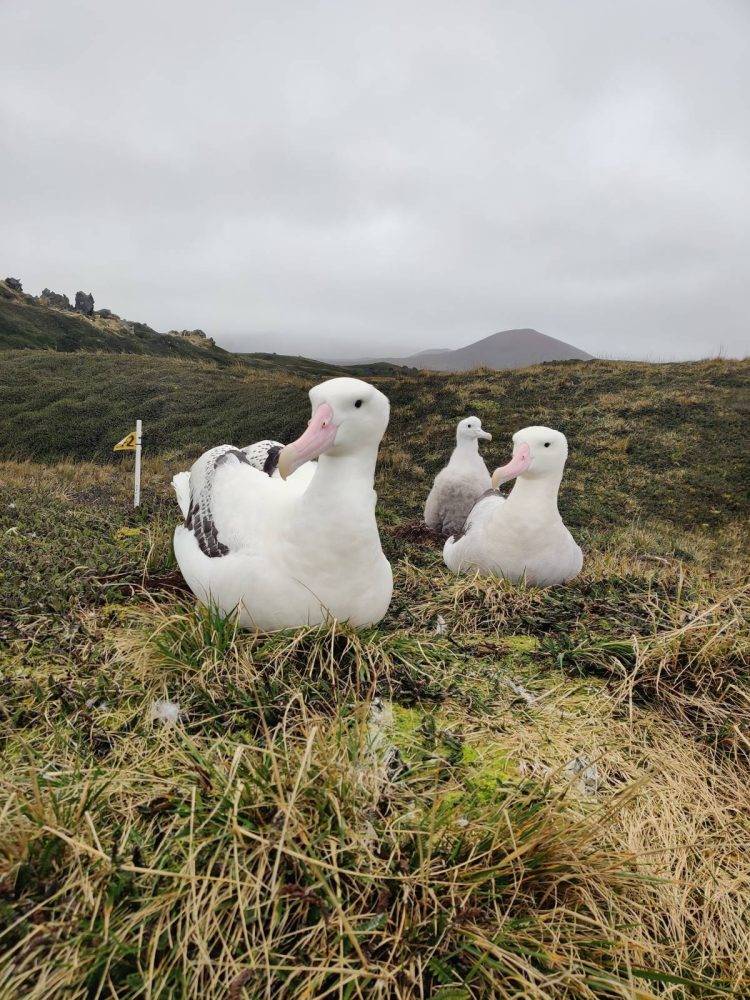 The chick with its parents days before the mouse attack.
Gill and Stephen are spending a year on the island as part of the monitoring work of the colonies. The nature of the chick’s wounds align with observed mouse attacks and with attacks on chicks photographed at night, the researchers said. The chick was seen the week before the attack, in good health and with both its parents, “demonstrating the speed at which mouse predation can result in death”.
Without any intervention, experts predict that the mice may cause the local extinction of 19 of Marion Island’s 29 bird species, including the wandering albatross.
The mouse eradication plan builds on more than 60 years of experience and scientific research from more than 700 island rodent eradications that have succeeded — and the few that have not. At 30 000 hectares — the equivalent of more than 42 000 football pitches — mouse eradication on Marion Island will be larger than any previous effort undertaken.
Within the next three years, helicopters guided by GPS and equipped with application buckets will spread a specially formulated bait across the island to ensure that every mouse territory is treated. It’s the only method that has proven successful at eradicating rodents from large islands.
The project is regarded by many as one of the world’s most important bird conservation projects, said Mark Anderson, the chief executive of BirdLife South Africa.
“If you ask anyone to name a seabird, the one they come up with is the wandering albatross and on the two islands — Marion and Prince Edward — we’ve got just over half of the world’s breeding population … and they are being eaten alive by the mice,” he said.
House mice have been recorded preying on seabird chicks and adults since 2003.
“These birds … are so naive because they’ve evolved in an environment without terrestrial predators and they don’t know how to respond,” said Anderson.
Climate change is favouring mice; as the island becomes warmer and drier, their breeding season lengthens and their summer populations increase.
Predation incidents have increased in winter, when mice have fewer alternative foods such as invertebrates and plant seeds. Besides eating birds, the mice have also impoverished the island’s habitat and reduced the populations of native invertebrates.
“We’ve got this dreadful situation where these mice are just doing what they do to survive,” Wolfaardt said. “They’re very adaptable. There’s a large population of birds that do not consider mice a threat and the mice have learnt that these birds are a viable protein source.”
Mouse attacks on adult wandering albatrosses are spreading across the island this winter. This alarms Wolfaardt and his team because adult birds are important to the demography of these populations.
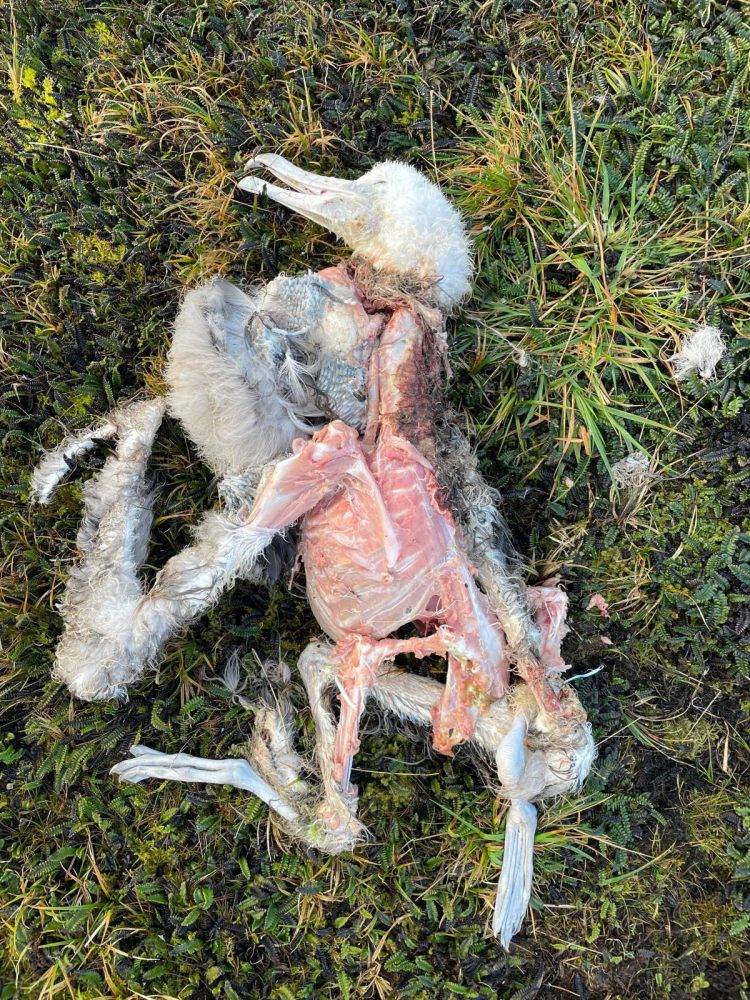 Within a day of the attack, the chick died and its body was scavenged by other seabirds
“These birds live a long time and need to live a long time for those populations to remain stable to increase. As soon as you start increasing adult mortality, you have a much more rapid impact on the population,” the team said.
The budget target for the project is $29 million, with a quarter of these funds raised so far.
“We are putting a lot of effort [into fundraising],” Anderson said. “We’ve got three people in our fundraising team; they’re working very hard and we’ve got a lot of support.”
That Prince Edward, the Duke of Edinburgh, is the royal patron helping the project, is important, as is the support of other high-profile people.
Anderson said the eradication project has to unfold because of the severe effect on the vegetation, invertebrates and the seabirds.
“Once we pull this project off successfully, the ecology of the island will recover. It’s a restoration project, a rewilding project essentially.
“When there’s a threat like this that can be solved, that’s really what drives all of us in the project,” Wolfaardt added, saying it is a project of hope.
The fate of Marion Island’s seabirds “lies in our hands”, he said. “I’d suggest that future generations would neither understand nor forgive us if we carelessly lose this opportunity to address this threat to solve it once and for all.”