Precarious: Intense weather resulted in the April 2022 floods in KwaZulu-Natal, which led to 459 deaths and damage to infrastructure amounting to about R17 billion. Photo: X/KwaZulu-Natal government
James Kruger thought he was dreaming when he heard the first “crack” in the early hours of last Thursday morning.
But the second crack at about 4am — the death knell of a neighbouring house collapsing behind the Elder’s Voice retirement home in Amanzimtoti, where Kruger lives — certainly woke him up.
“It sounded like the glass shower doors had broken. I woke up and I saw just this river literally coming down the corridor. We couldn’t think about rescuing anything,” he said.
The house behind the retirement home had collapsed, which sent a mudslide raging through the property.
“There is a staircase in the home down to the bottom level and we were all trying to get through, but at that stage, the water was up to our hips and the mud about to our knees,” Kruger said.
“The mud had obviously blocked the door — mature men got hysterical, and one of the guys just screamed for help. We eventually managed to break down the door.”
He and six other able-bodied residents then went to help a live-in carer evacuate seven frail residents.
Kruger and his fellow residents were among the lucky people of KwaZulu-Natal who escaped last week’s flash floods relatively unscathed.
Last week, six people were known to have died in the province. On Tuesday night, five were washed into a canal in Lamontville, south of Durban, and a sixth person died in Chatsworth when rain again hammered the city, flooding bridges and roads, said ALS Paramedics director Garrith Jamieson.
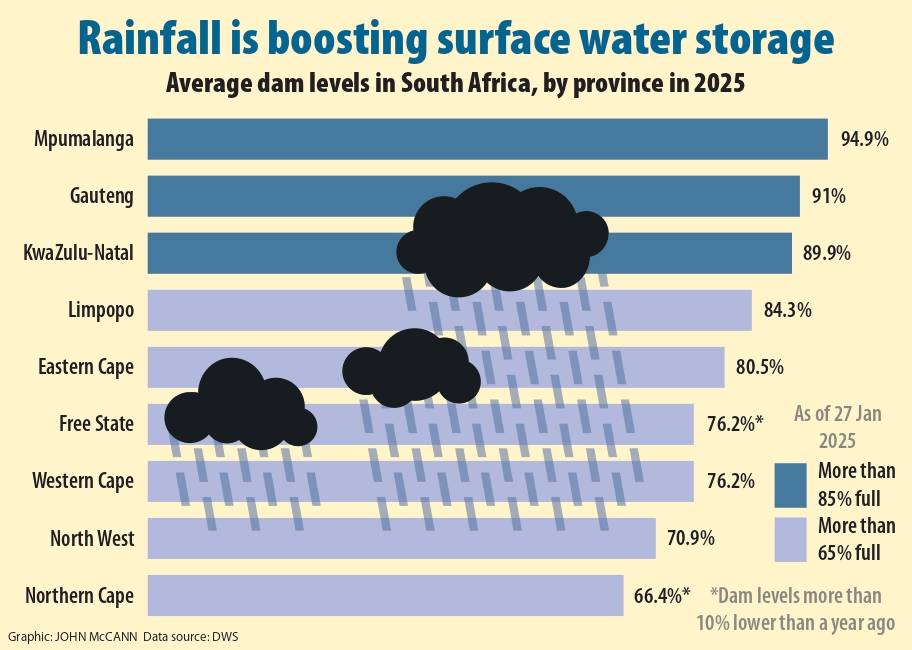 (Graphic: John McCann/M&G)
This comes after the devastating April 2022 floods that killed 459 people and caused at least R17 billion damage to property and infrastructure in KwaZulu-Natal.
Extreme weather incidents — which have always occurred in South Africa — are becoming more intense because of climate change, University of Cape Town climate scientist Peter Johnston warned this week, urging cities to become “climate resilient” so as to bounce back afterwards.
He said the country’s summer rainfall regions such as KwaZulu-Natal and Gauteng could expect wetter than usual weather during the closing weeks of the season. Cape Town, on the other hand — despite experiencing flooding in 2023 and 2024 — faces risks of a rising water table, extremely high temperatures, drought and fires.
Johnston said cities such as Cape Town, Johannesburg and Durban had assessed their vulnerabilities to these extreme weather events to improve resilience but he doubted whether smaller coastal cities such as East London and Gqeberha had done so.
“Resilience is a word in scientific literature, and essentially it encompasses three other words: one is the hazard, one is the exposure and that becomes known as the vulnerability.”
Cities must examine their exposure to potential extreme weather hazards, including identifying people living in high-risk areas such as flood plains and on steep cliffs or where stormwater drains are blocked, to assess their vulnerability, he said.
It was also crucial for cities to learn from previous extreme weather incidents to improve future responses, Johnston added.
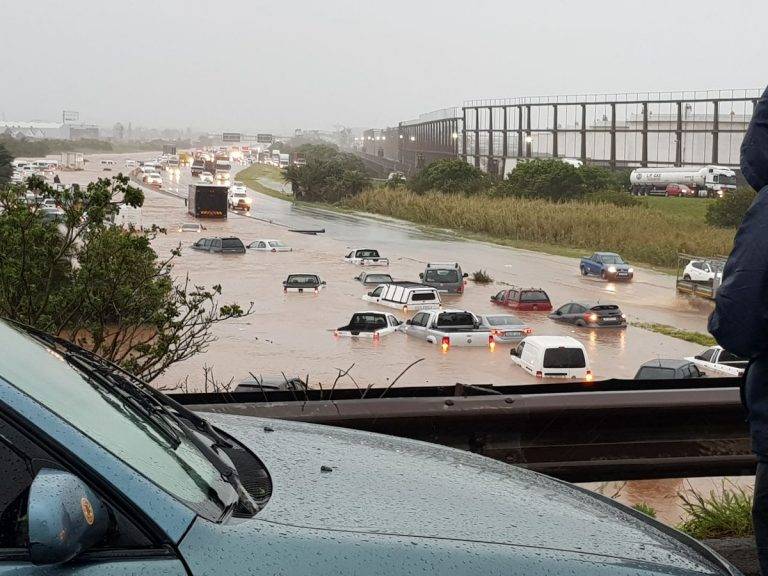 Awash: Durban’s roads were flooded in October 2017. (KwaZulu-Natal EMS)
“Climate change is not causing the floods,” he said. “What’s causing the floods is extreme events that may have something to do with climate change … they are exacerbated by other causes, which are overcrowding, blockage of river waterways and settlements that are built in the wrong area.
“Everyone who is living in a flood plain is vulnerable. Everyone living near a river is vulnerable. Everyone living in a place where waterways and stormwater drains are blocked from litter and rubbish becomes vulnerable.
“We have seen in KZN, for example, that quite formal settlements and houses built in risky areas, on steep slopes also become vulnerable.”
This was because the whole of KwaZulu-Natal is exposed to vulnerability during heavy rainfall, Johnston said. “They’re subjected to coastal lows and thunderstorms. They get affected by tropical cyclones moving down the Mozambique Channel.”
Despite being vulnerable, cities are not being proactive enough to mitigate future risk of disasters, said Tafadzwa Mabhaudhi, a professor at the London School of Hygiene and Tropical Medicine and University of KwaZulu-Natal and the executive director of the Institute of Natural Resources.
“We are caught up in a cycle of responding. We’ve not really done anything structurally, even in terms of re-looking at urban town planning and realising relative to risk assessments how we should plan our cities better and where people should be located,” he said.
Furthermore, infrastructure is neglected in major cities.
“Just maintaining the existing infrastructure like stormwater drainage: how well are we maintaining that? Are we adding in new infrastructure in areas that we know now regularly receive high rainfall; are we rehabilitating the environment by clearing alien, invasive species and rehabilitating riparian zones and wetlands so that they’re able to buffer some of these excess rains?”
People living in high-risk areas need to be sensitised to the dangers of climate change and be taught how to respond when a warning is raised by the South African Weather Service or disaster management services, Mabhaudhi said.
Major hurdles need to be overcome to reduce disaster risk and build urban climate resilience in major metros that are already dealing with old, dilapidated infrastructure. This, itself, is a “symptom of years of under-investment” in infrastructure and its maintenance.
“Now that infrastructure basically needs to be revised and made resilient. They are dealing with issues of lack of capacity in terms of the human resources — people who are trained in very specific ways who can make certain types of decisions [and] who can conceptualise solutions in this space of climate change,” Mabhaudhi said.
Cities also need to be innovative in terms of funding models, he added.
“This is saying, ‘If we cannot get it from the government, who else can we partner with?’, including looking at public-private partnerships, looking at the cities themselves accessing international climate finance to do specific projects. Again, it then becomes an issue of capacity: Do we have the sort of people within the municipalities who will be able to champion these sorts of things?”
How South Africa’s cities can build resilience is, for local areas, a resource question, said Meggan Spires, the director of climate change, energy and resilience at ICLEI – Local Governments for Sustainability, an NGO that promotes sustainable development.
“As they’re being struck by more climate change impacts, it’s either the infrastructure itself that is getting badly damaged — you can just think of the Durban cases recently with the multiple floods — and then they’ve got to rebuild,” she said.
“But they’ve got to rebuild in smarter ways — low-carbon ways — so that we’re not further contributing to causing climate change, and also in ways that are in better locations but also more resilient infrastructure itself.”
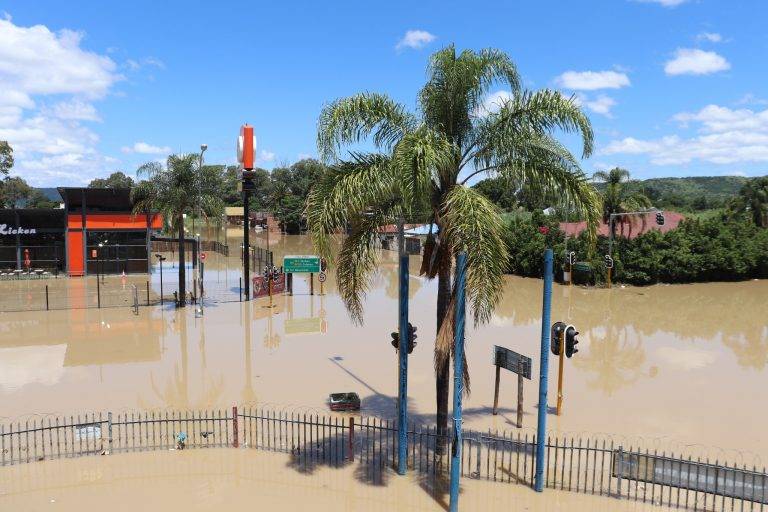 Ladysmith was swamped in January 2022. (KwaZulu-Natal’s department of cooperative governance and traditional affairs)
Often, this costs more money — raising the question of where it is going to come from.
Municipalities and governments have to get their houses in order to deal with the gap in urban finances, she said.
“The age-old things of good governance, good policies in place, institutional structures that work — that’s pivotal in building resilience.”
The second is finding additional funding.
Spires said there is a long-term goal to change the global international financial architecture so funding can flow directly to cities, but the focus must be on the reality of the here and now.
“We’re also looking at what is possible in the here and now. Often that’s just related to ownership models. Maybe it isn’t the municipality itself that takes the loan because they’re not creditworthy or they have not got a clean audit and there’s a private sector partner that can play a role. And who are the key partners — the Development Bank of Southern Africa and others that are doing good work in this space.”
eThekwini spokesperson Gugu Sisilana said the metro has a Durban Climate Change Strategy and Durban Climate Change Implementation Plan, on which it reports every six months.
The city is developing a resilience framework for vulnerable settlements, such as the Quarry Road community-based flood early warning system that has been effective in saving lives through evacuation.
Other priorities include programmes to protect rivers by restoring natural ecosystems, working with residents and integrating climate change adaptation strategies into river management.
“Clearly we are in a period where there are annual extreme weather events, whether that be recent floods, the tornado of 2024 or April 2022’s cut-off low disaster,” Sisilana said.
“We critically need resources, human capacity and finance to implement key programmes in the city, many of which have started, but which will mature over years.”
One programme involved a study with Dutch assistance, outlining engineering work that is required in the South Durban Basin to reduce the risk of future flooding after it was hard hit during the April 2022 event.
City of Johannesburg spokesperson Nthatisi Modingoane said adverse effects on infrastructure because of flooding happen in two ways: the optimal functioning of infrastructure and the washing away of infrastructure.
Flood events in the metro generally affect sewage infrastructure rather than the potable water supply infrastructure, he said.
“The stormwater finds itself into the open manholes and broken pipes and then ends up causing sewer spillages and affecting the performance of wastewater treatment works processes, resulting in the pollution of streams.”
The city’s infrastructure is susceptible to this because of vandalism and the removal of manhole covers, Modingoane noted.
The washaway of infrastructure by floods generally affects old sewer infrastructure running next to or crossing streams. These pipes are usually rerouted and directed away from the river floodplains when repair works or upgrades are done.
He said the city and the broader Gauteng region are already water-stressed because of high non-revenue water and high consumption and demand.
“Water consumption in Johannesburg is significantly higher than the national average, driven by both a very high population density and high per capita daily consumption.” A drought would exacerbate the water-stressed state and the risk of demand exceeding available supply.
Modingoane said Johannesburg Water is working on projects to upgrade infrastructure; repairs and maintenance of networks; water quality assurance; and awareness campaigns on the importance of wise water use and conservation.
In 2021, the city developed a climate action plan that has two main goals: achieving carbon neutrality and a resilient city by 2050. Modingoane said achieving climate resilience requires a focus on people and the environment and buy-in from all citizens.
The plan includes actions to ensure that Johannesburg has a reliable availability of water to meet the city’s needs in terms of quantity and quality, while its focus on resilient human settlements promotes climate-sensitive urban planning and management. It includes actions to safeguard hard and ecological infrastructure.
Alongside the plan the city has developed a water security strategy “that incorporates resilience issues”.
“Among the actions stemming from these strategies is the ongoing scaling urban nature-based solutions for climate adaptation in Sub-Saharan Africa (Suncasa) and C40 Cities (CFF) finance facility projects, which aim to build resilience and adaptation against flooding impacts along the Jukskei River by implementing nature-based solutions,” Modingoane said.
“Suncasa and CFF will support the revitalisation of the upper Jukskei River catchment by decreasing flooding, improving urban heat management, enhancing water security, supporting livelihoods, expanding green areas and protecting biodiversity.”
A water security forum has been established to ensure strategic alignment between departments in the city to improve urban water resilience, he added, while more than 250 communal gardens have been developed over the past five years.
“The city is experiencing rapid urbanisation, leading to increased demand for housing and resources such as water and electricity.
“Sometimes, the demand for these necessities is not met, resulting in informal settlements developing on floodplains. These issues complicate efforts to build resilience in the city.”
The City of Cape Town learned valuable lessons on preparedness from the one-in-400-years drought of 2015 to 2018, when it averted running out of potable water, dubbed “day zero”, spokesperson Luthando Tyhalibongo said.
The city’s climate change action plan highlights reducing demand and finding alternative sources to ensure water security during drought.
“The city’s water demand management programme focuses on reducing demand to ensure sustainability of supply,” he said.
“The programme mainly consists of pressure management and zone metering and maintaining and upgrading water infrastructure to prevent water loss.
“Lessons learned from the drought highlighted the need to explore alternative water sources to ensure the city remains resilient and is well prepared.
“The city is working towards augmenting and increasing water supplies to achieve 99.5% assurance of supply, through implementing a new water programme.”
This programme will develop an additional 300 million litres of water supply from desalination, groundwater use, water reuse and invasive species management by 2030.
Tyhalibongo said flooding in Cape Town remained a risk during extreme rainfall events.
“Programmes that address flood risk therefore continue to be implemented with a particular focus on improving catchment management through green and hybrid infrastructure solutions, stormwater master planning and an aim to implement a water-sensitive city approach.”
He said the Liveable Urban Waterways programme is being implemented to reduce flood risk by restoring and rehabilitating waterways and ecological functions across 11 catchments in Cape Town.
“The development and implementation of a water-sensitive city plan to prioritise water-sensitive urban design remains a priority. The development of this plan is, however, budget dependent, and the city is aiming to secure support in the form of technical assistance from key international partners.”
Tyhalibongo said a task team was also cleaning, unblocking and repairing storm water infrastructure and canals and working on pumping storm water run-off away from settlements and roads.