Load shedding: Donald Trump’s withdrawal of the US from decarbonisation commitments reduces the pledges to South Africa from $13.8 billion to $12.8 billion. Photo: Delwyn Verasamy
The withdrawal of the United States from the Just Energy Transition Partnership (JETP) with South Africa will not thwart the country’s decarbonisation commitments, experts say.
The US announced the termination of its membership of the International Partners Group (IPG) for energy transition partnerships in South Africa, Indonesia and Vietnam, as part of executive orders issued by President Donald Trump.
South Africa’s JETP was announced at the United Nations Climate Change Conference (COP26) in Glasgow in 2021, with an initial $8.5 billion funding package from the US, the United Kingdom, the European Union, Germany and France. The Netherlands and Denmark subsequently joined the partnership, bringing the pledges to $13.8 billion.
The withdrawal of the US has reduced these pledges to $12.8 billion, largely in respect of commercial investment potential, the just energy transition project management unit in the presidency said in a statement.
The US’s 2021 pledges to South Africa’s just energy transition investment plan (JET IP) comprised $56 million in grant funds and $1 billion in potential commercial investments by the US International Development Finance Corporation. Washington offered no concessional loans to South Africa for the plan, which requires R1.5 trillion from diverse sources.
“South Africa remains steadfast in its commitment to achieving a just and equitable energy transition,” said Joanne Yawitch, the head of the project management unit. “All other IPG partners remain firmly committed to supporting South Africa’s JET IP.”
The unit is working with other grant-making organisations to source alternative funding for transition projects previously designated for support from the US grant funding.
With the US’s withdrawal, associated financial pledges are also withdrawn, according to the department of international relations and cooperation.
“Grant projects that were previously funded and in planning or implementation phases have been cancelled,” the department said.
It added that South Africa remains committed to the implementation of international agreements, including decisions taken at the historic Paris climate change conference.
“South Africa and other international partners will evaluate the implications of the US withdrawal from the JETP.”
The energy transition investment plan funding programme is R1.5 trillion over five years and the IPG contribution to that was only 10%, or roughly — depending on the exchange rate — R150 billion out of that R1.5 trillion, said Mark Swilling, the co-director of the Centre for Sustainability Transitions at Stellenbosch University.
“And the US contribution to that R150 billion is $1 billion, so it’s not that attractive; we can get that debt in many other places. This is not going to derail us. We’re not throwing up our arms in horror that now everything we’ve planned is going to have to shut down; nothing like that, not even close,” he added.
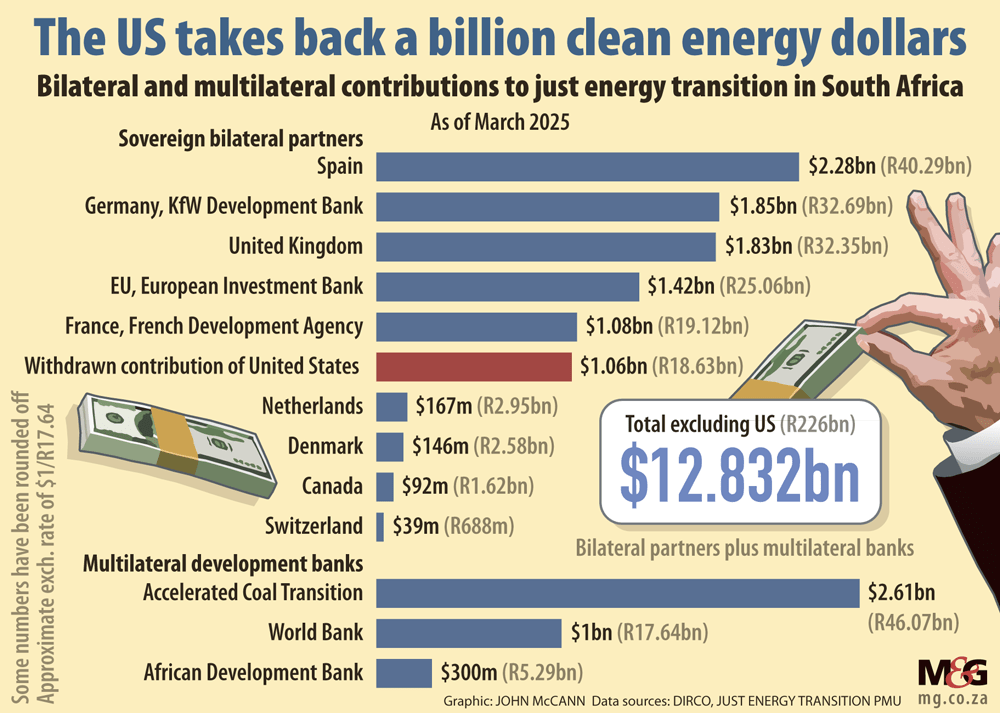 (Graphic: John McCann/M&G)
The Presidential Climate Commission, which this week issued a call to strengthen multilateralism and global climate action, expressed disappointment on the US exit.
“South Africa remains steadfast in its commitment to achieving a just and equitable energy transition and has made significant strides on this journey, and we call upon all other IPG partners to remain committed to supporting South Africa’s decarbonisation efforts,” its executive director Dorah Modis said.
South Africa regards the United Nations Framework Convention on Climate Change and its mechanisms as central to tackling climate change and the only credible platform which brings together all countries at the highest level to discuss and collaborate on climate action and in keeping multilateralism alive, Modise said.
“We remain behind our governments’ efforts in mobilising global and domestic action to address climate change and urge our development partners locally and globally to remain on course.”
The US withdrawal from South Africa’s just energy transition partnership signals a “troubling retreat” from global climate leadership and an abandonment of vital financial commitments to the world’s most climate-affected nations, said the environmental organisation 350Africa.
It added that the pullback marked a dangerous precedent as the world faces an escalating climate crisis and growing inequality, and called on South Africa and its remaining international partners to ensure the momentum of the energy transition did not stall.
“South Africa’s commitment to a clean and equitable energy future is more important than ever, and efforts must be made to secure alternative sources of funding to fill the gap left by the US’s retreat.”
Dean Bhekumuzi Bhebhe, the senior just transitions and campaign adviser at Power Shift Africa, said the answer to whether other countries would also pull out was “No.”
“We’ve got some reaffirmed commitments from everybody else who’s involved within the JETPs, which is amazing,” he said.
“But the question then becomes when exactly will we have a scenario where we have the funds actually being released … because it has been quite slow. It’s giving off the idea that ‘we want to do it as a tickbox exercise at the moment but we don’t really want to action it’. That’s how it fundamentally looks.”
“We do see an opportunity again to say we are in a climate crisis; we have an energy supply crisis across Africa, it’s not a South African problem. The US has pulled out and this is actually an opportunity to have a new leader when it comes to these discussions.
“It’s negative because significant money has been lost out of the JETPs so we need to find other avenues to compensate for the money that has been lost, but beyond that it’s also an opportunity for a new narrative for the Global North — essentially in Europe and the EU and other actors — to step up and fill the gap that the US has left.”
It is in times of crisis when one sees how broken or how robust a system is, he said. “How the rest of the world responds to this would actually help us see the fragmented issues that are actually currently prevalent within the global financial architecture.
“The question is, will everyone else step up or will everyone else hide and use the US as an excuse?”
Swilling said that rather than any of the other international partners pulling out of the deal with South Africa, the reverse might happen “out of a kind of solidarity and resistance to the state capture in the US”.
He noted that although the war in Ukraine could influence the flow of funds, it would not necessarily affect the commitments.
“At the same time, if the US starts spending less on renewables, that’s going to bring down the prices, which means that whatever we do get from Europe can go further.”
The head of the European Commission recently announced arenewables plan, which Swilling described as very ambitious.
“One of the consequences of the Ukraine war is Europe’s desire to be less dependent on fossil fuels because they get a lot from Russian gas. They want to be far less dependent on that … and also on imports of oil,” Swilling said.
Most countries had increased their renewable energy targets, he said, citing as an example Germany’s Easter Package, which focused on expanding renewables and envisions at least 80% of the country’s gross electricity consumption to stem from renewables by 2030.
“This … package was a massive increase in their targets for renewals because they were really not happy that they had to increase coal imports to refire some of their coal-fired power plants; they’ve reduced that now,” he said.
Two things are happening now in Europe, Swilling added. “One is the military rearmament of Europe and the other is the greening of their economies, and these two can be mutually reinforcing, and that would have positive consequences for us and our green industrialisation programme.”