While acknowledged in the Sona, Johannesburg’s water woes continue to threaten public health and equity, prompting demands for emergency funding, accountability and sustainable infrastructure Photo: Delwyn Verasamy
At 5am on Tuesday, Sherisse Davids* was jolted awake by what has become an unfamiliar sound: water running through the pipes of her council flat in the Johannesburg suburb of Claremont.
The mother of three leapt out of bed, grabbed every container she could find and frantically filled them. It was the first time in more than two weeks that water had flowed from her taps.
But her relief didn’t last long. “The water came back for about five minutes and then it was dead again,” said Davids, sitting outside on the cracked concrete steps of her block with her toddler son. “We just want to open a tap, run a bath, and soak — and live like human beings again.”
She and her neighbours live in a small pocket of council flats that has not had a reliable supply of water for more than a decade. For her, Tuesday’s fleeting trickle was yet another cruel reminder of their daily struggle.
“The residents in this area have endured 12 years without water, so we’ve adopted to a bucket system,” said Claudette Abrahams, who lives on the top floor of Davids’ block. “The water comes on at like 1am, 2am, for an hour … For the last two weeks, it’s been dry land and dry taps.”
Drained and exhausted, Abrahams’ words carried the heaviness of someone who had been fighting this protracted battle for far too long. “We are tired. Twelve years is a long time. We don’t even know if our geyser works anymore.”
While wealthier suburbs install boreholes (many of them without authorisation) or buy bottled water amid Johannesburg’s ongoing water crisis, families here live by the water tanker’s schedule — or wake up every hour hoping for a brief surge of low-pressure water. For more than two weeks, the taps have been bone-dry. Daily life has become a punishing ritual: queuing, fetching, carrying and rationing.
Earlier this month, Claremont residents barricaded a road in the area with rubble and burning tyres, demanding immediate restoration of water after weeks without supply.
Then, last Wednesday, fed-up residents of Westbury, Coronationville and surrounding suburbs took to the streets again demanding clean, reliable water. They faced tear gas, rubber bullets and a heavy police presence as the demonstrations turned violent.
The unrest pushed Johannesburg mayor Dada Morero to meet residents and promise water would be restored within seven days. Johannesburg Water has since sent 21 tankers to provide emergency relief to Coronationville and Westbury.
Morero was due to return to Coronationville on Thursday to talk to residents about the ongoing crisis and update them on what is being done to “stabilise the water supply and outline the city’s continued efforts to ensure sustainable water delivery”.
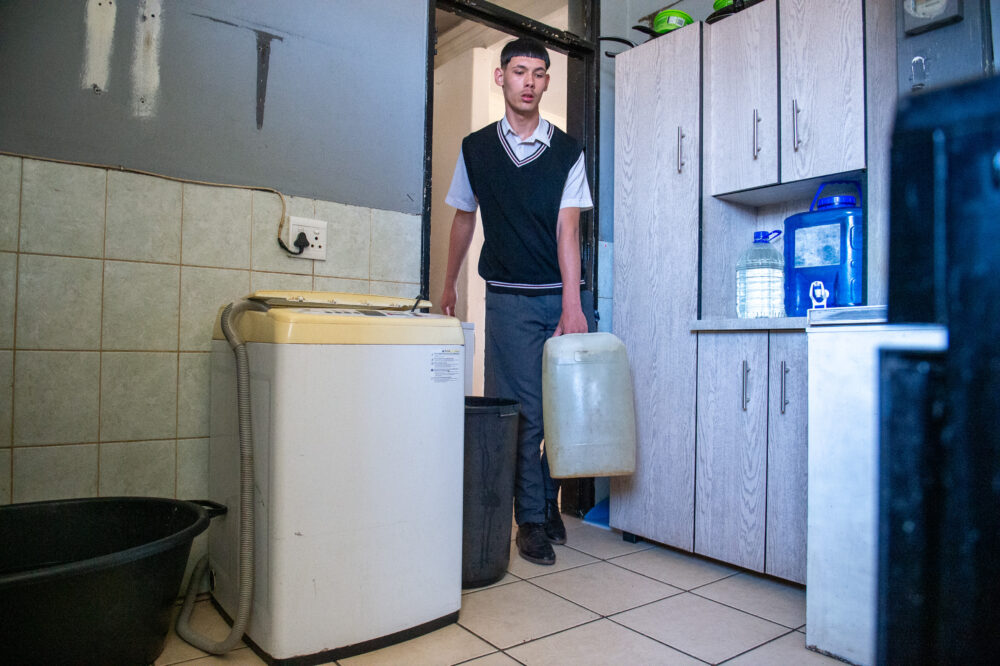 Weighty: After the water tanker has arrived in the Johannesburg suburb of Claremont and Claudette Abrahams has filled the containers, her teenage son Luciano has to carry the water containers up the stairs to their flat. Photo: Delwyn Verasamy
While Claremont residents say the new roaming tanker that Johannesburg Water has dispatched is more reliable, it’s no substitute for working taps. “We can’t even go to work,” Abrahams said. “We have to sit and wait for the truck to come. If you miss him, you miss him.”
Her family of seven uses multiple 25-litre containers, but the supply doesn’t last. “It will last until tomorrow morning and then I have to wait all the way till tomorrow when there is a truck again. You can’t do washing, you can’t do anything. We have to share bath water and it’s disgusting. There’s no hygiene; you can’t flush the toilet properly.”
Abrahams’ teenage son, Luciano, carries the containers up the stairs after school, leaving him with back pain. “If I have to get the young ones around here to carry, I must pay them between R5 and R10 a bottle. The old people are charged R20 to carry a 25-litre. Most of them [youngsters] are on drugs, so they have to support their habits,” she says.
For Mazarette Chadinha-Gates, who lives in a neighbouring block of flats, each day begins with one thought: water. “Most of our prayers are just, ‘Please, let me wake up to a bit of water.’ When you open the tap and there’s nothing, it’s depressing and soul-crushing.”
Her husband leaves for work in Sandton each morning carrying four or five empty 25-litre containers. “He fills them up at work and brings them home at night,” she said. A few years ago, she broke her shoulder and the tanker is of no use to her. “So, every night after work he has to carry five 25-litre containers upstairs.”
The Joburg Crisis Alliance said Morero has promised residents of Claremont, Westbury and Coronationville that water will be restored within seven days. It intends to hold him to his promise. These residents have lived with intermittent water for more than a decade. Most recently, they’ve been without any water for many days at a time, it said.
Not having water is not just inconvenient — it’s a public health crisis. “Families cannot cook, clean or care for their children safely without reliable access to water … The lack of a reliable clean water supply is a systemic crisis with deep roots across the city,” the alliance said.
At the alliance’s recent summit, residents from neighbourhoods including Snake Park, Coronationville, Westbury, Kensington and Langlaagte North raised concerns about water quality, water outages, low pressure, bills with no supply, contaminated water, the ongoing bucket system, leaks and wastage, water tanker corruption and the lack of borehole management.
The alliance said water is a constitutional right being denied to residents while others profit. Older people, children and the poor suffer the most, forced to pay for water they cannot afford, queue for hours, wake up at night to fill buckets and rely on illegal connections.
“The mayor must stand by his commitment. If water is not restored in seven days, he must resign. The current crisis is evidence of systemic failure,” the alliance said.
It also called for the resignation of Johannesburg Water’s board and the MMC for environment and infrastructure services “if they can’t provide sustained leadership”.
“The city has shown it is not fit to host a prestigious event like the G20 when it cannot cater for the basic needs of its citizens,” the alliance said, adding that funds earmarked for sprucing up the city must be redirected to crucial needs.
Johannesburg Water’s spokesperson, Nombuso Shabalala, said the problem lies with the city’s fragile Commando System, which supplies large parts of Johannesburg, including Mayfair, Westbury, Claremont, Braamfontein and Sophiatown.
The system has been buckling under population growth for many years. “The main challenge for the system is insufficient bulk infrastructure — reservoirs, bulk lines and pump stations — making it enormously vulnerable to any disruptions.”
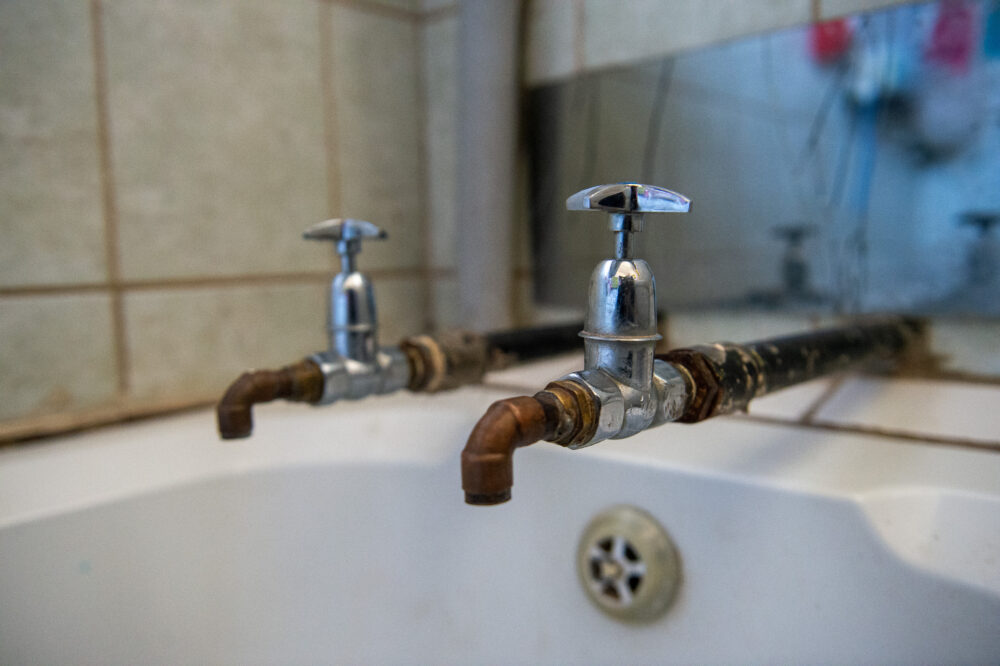 For more than two weeks, the taps in Claremont have been bone-dry. Photo: Delwyn Verasamy
Johannesburg Water is investing R800 million in upgrades, including a new 26-megalitre Brixton reservoir and 2.2-megalitre tower, due by October. A new bulk line and two new pump stations are planned for completion by December next year.
A contractor has been appointed to refurbish the Hursthill 2 reservoir by May, with work on Hursthill 1, currently on bypass because it is leaking, set to begin in November and finish by October 2026.
Shabalala said these improvements will “alleviate the system’s sensitivity to interruptions” but admitted recovery after outages will remain slow until upgrades are complete.
Abrahams said Claremont’s residents just want answers. “Johannesburg Water tells us that because we’re on high land, the pressure doesn’t really come up to us. But there are blocks of flats higher than us that get water while we don’t.”
Chadinha-Gates agreed. “The biggest problem is throttling. They switch the water off at night, then throttle us until the next morning. Some who get water in the early hours don’t receive water at all now. It’s been about 18 days without one drop of water.”
Water activist organisation WaterCAN has been working with Claremont residents to pinpoint the causes. Their investigations found the problem wasn’t solely about high-lying areas, as the city claimed.
“The issue in Claremont has been that for about eight to 10 years they haven’t been able to get water to the area,” said Ferrial Adam, the executive manager of WaterCAN. “If you think about the Commando System, they are fed by Hursthill 1 and for a long time now, Hursthill 1 has not been operational so they’re on bypass.”
From Crosby pump station to Claremont, the system is gravity-fed, leaving high-lying areas at a disadvantage. “It’s almost as if they’re at the end of the line and they’re not getting any flow.
“We, as WaterCAN, took engineers and we basically went and did a whole assessment with the community … where we mapped out the area and then mapped out the flats that don’t have water, and then we could isolate actually where issues were.
“We did get Joburg Water in at one point to help us and they found it was a closed valve — when they opened that valve they got water. So it has come down to a few blocks … We’ve been able to now take pressure tests and we can see that it’s one or two valves that’s the issue.”
Adam said the slow restoration was caused by officials not listening to the experience of residents.
“When I first met the group, they knew what the problem was. They could pinpoint exactly what was going on. All we did was get an engineer to verify what they were saying. For all that time Johannesburg Water just brushed off the community and said it was because of high-lying areas. We have proven that the geography is not the issue — it’s the poor infrastructure,” she said.
The toll on residents is more than physical. Abrahams recalled collapsing at work last year from stress and exhaustion. “We don’t get sleep here — you sleep maybe two hours a night because you’re checking on water. The pressure is so low that filling four 25-litre buckets takes two and a half hours.”
She feels as if she is living in a dead zone. “We cannot have braais, celebrate birthdays, say goodbye to our dead — all the things that make you human. So, we’re just dead.”
Outside their block, a donated water tank stands empty. “It gets [urinated] in, papers are thrown in it, so it’s not like we can use it,” Abrahams said.
Berenice Felix, her face etched with deep lines, said the daily struggle to fetch water is punishing. “My shoulders are sore and it breaks your back if you must bend to pick up heavy containers and carry them upstairs.”
Abrahams added: “A lot of old people just wait until they find the strength [to collect water]. After four days without water, they’ll say, ‘I’m hungry for water now, not just thirsty,’ and go fetch it themselves.”
Community WhatsApp groups help residents track the tanker’s location and make sure it stops in the right streets.
“It’s not about the trucks, it’s wanting water in our taps,” said Chadinha-Gates. “After nine, 10 years of struggling without water during the day or early morning hours, and now no water at all — we also deserve water. Why isn’t this problem looked at? It’s only four blocks.”
Tensions often flare. “When the tankers come, people start fighting and swearing, saying you’re taking too much water,” she said. “But four 25-litres isn’t enough to sustain a family of four or five people for a day. We barely make it with five.”
In nearby Sophiatown, Warren Canham filled his collection of containers from a tanker. “This morning, there was only water in the fire hydrants so people were taking water from there to do washing. We have no other choice.”
He has two small children. “They mess their clothes, so I also had to take water from the fire hydrants. There hasn’t been water in the fire hydrants for a few weeks so it seems to be getting better.”
The taps in his flat are dry. “There’s been nothing for weeks. Yesterday the water from the tanker came slightly brown. I couldn’t drink it. I just had to use it for washing and to flush the toilets.”
He also collects drinking water from a borehole at work. “Whenever there’s a water issue in Joburg, this area [Sophiatown] is affected. They keep saying it’s because we are higher up — it’s very frustrating.”
At the same tanker, Lydia Ncube expertly placed her full container on her head and carried another in her arms. “It’s very bad. It’s hard not having water for three weeks. I’m carrying buckets three times a day. The tanker comes every day now but there’s no water in the flat.”
Johannesburg Water’s Shabalala said high-rise buildings such as these experience poor pressure because of insufficient bulk infrastructure. “The Hursthill 1 reservoir, which supplies Sophiatown, is leaking and on bypass mode.
Back in Claremont, there’s little faith in Morero’s promise of full water restoration. “We feel like a forgotten community,” said Davids. “We’ll be waiting for water until kingdom comes.”
*Not her real name.