In Mpumalanga and Limpopo, the floods killed at least 38 people. The Kruger National Park was forced to close. (SANParks)
Severe flooding in Limpopo has claimed 11 lives, including a five-year-old child and damaged more than 1 600 homes following days of relentless rainfall across the province.
Limpopo premier Phophi Ramathuba confirmed the extent of the disaster during a briefing on Friday, after President Cyril Ramaphosa visited affected areas in the Vhembe and Mopani districts to assess the damage on Thursday.
“We gather here today under a dark cloud that has unleashed astonishing rains, unprecedented in their intensity, measuring up to 400mm,” Ramathuba said. “The devastation inflicted upon our communities, our infrastructure and, tragically, the loss of lives cannot be overstated.”
The South African Weather Service has upgraded its warning to a Red Level 10 — its highest and most dangerous alert — for Limpopo and Mpumalanga, for conditions that continue to pose a severe risk to life, livelihoods and infrastructure.
Ramathuba said the severe weather began on December 25 in the Waterberg and Capricorn districts before intensifying last week and spreading to Vhembe, Mopani and Sekhukhune.
Roads have been washed away, bridges destroyed and entire communities cut off from essential services, including schools, clinics and police stations.
The Limpopo premier noted that the scale of the damage far exceeds the province’s emergency funding capacity. “The sheer scale of the damage makes it impossible for the province and affected municipalities to respond alone.”
She estimated that about R1.7 billion would be required to repair damaged roads, adding that assessments were still under way. The South African National Defence Force (SANDF) has been deployed to assist with the temporary restoration of access routes.
More than 1 600 homes have been damaged, many of them completely destroyed or washed away.
“In some areas, you cannot even see where houses once stood; that there were people residing there. Some homes, in some areas, remain submerged, with water reaching roof level, which has already jeopardised their structural integrity,” Ramathuba said.
Education has also been severely disrupted. The reopening of about 1 400 schools has been delayed. “It’s not that they are damaged by storms but we had to suspend teaching, which is very painful for us, but children’s safety comes first.”
She said that at least 31 schools have been damaged and added that catch-up plans would be implemented once conditions stabilised.
Status of Letaba High Water Bridge today. (SANParks)
Flooding has also affected healthcare services, particularly in Mopani, where seven hospitals and 19 clinics have sustained infrastructural damage caused by the flooding “not forgetting we have a number of clinics that have become inaccessible because of the damaged roads and bridges”. Damage is estimated at R7 million to some of the facilities.
“Overflowing rivers have damaged bridges and made impassable roads that have restricted access to multiple healthcare facilities, affecting patient care and staff movement,” she said.
Agriculture has not been spared “and we know that without this sector, none of us can survive”. Ramathuba said vegetable crops — including cabbage, spinach, butternut and cucumber — had been damaged, along with farm roads, bridges, storage facilities and other infrastructure.
The overall cost of the disaster is estimated at more than R4 billion, with assessments continuing. Emergency relief has been provided by the South African Social Security Agency and municipalities, including food parcels, shelters, blankets and mattresses.
Ramathuba urged residents in low-lying areas and near rivers to move to safer ground, warning that further rainfall is forecast. “The South African Weather Service projects that we may face additional rain and more damage,” she said.
During his visit on Thursday, Ramaphosa described the destruction as catastrophic.
“We have seen houses flooded, possessions lost, and in some areas homes completely wiped away,” he said, praising the response of emergency services, including SANDF and the South African Air Force, which carried out helicopter rescues of people stranded on rooftops and in trees.
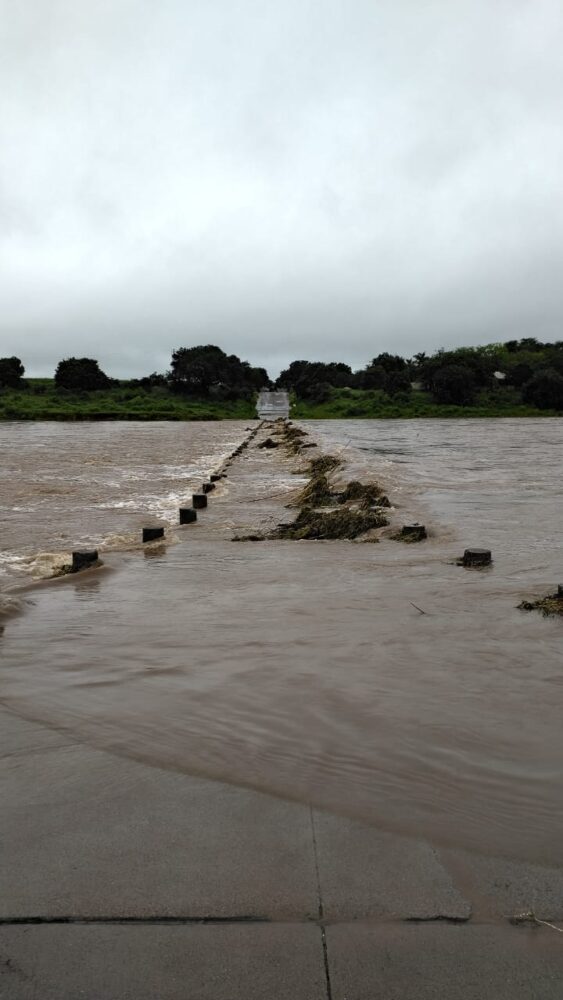 Crocodile Bridge today as at 08:00. (SANParks)
“The effects of climate change are now truly beginning to show,” Ramaphosa said. “When 36 houses are wiped away by rain, that is something we have never really experienced before.”
Amnesty International South Africa said the floods underscored the growing human-rights impacts of extreme weather events.
“The floods in Limpopo and Mpumalanga highlight the impact of extreme weather on people’s rights to life, shelter, food, water and livelihoods,” Amnesty International South Africa executive director Shenilla Mohamed said.
She called on the government to urgently adopt a human-rights-based approach to climate change and disaster risk reduction, including the mobilisation of adequate financial and technical resources to protect vulnerable communities.
The United Nations in South Africa also expressed condolences and solidarity with affected communities, warning that climate-related disasters are becoming more frequent and severe.
“The floods have brought immense grief and disruption and the shared task is clear: protect people now and rebuild smarter,” said Nelson Muffuh, the UN resident coordinator in South Africa, calling for coordinated efforts to restore services, safeguard livelihoods and strengthen resilience to future climate extremes.
Meanwhile, South African National Parks SANParks said on Friday that persistent rainfall continues to affect large parts of Limpopo and Mpumalanga, including several areas within the Kruger National Park.
“As a result of ongoing heavy rains and saturated infrastructure, the temporary suspension of day visitation to the Kruger National Park remains in place until further notice,” spokesperson JP Louw said, adding that this measure was implemented in the interest of guest and staff safety.
“The public is requested to note that with immediate effect, access to the park will be strictly limited to essential delivery vehicles, airport transfers, subject to proof of confirmed flight bookings, guests with existing overnight bookings at Berg en Dal, Pretoriuskop and Skukuza rest camps as well as essential staff members.”
Louw said the northern regions of the Kruger remained inaccessible because of flooding and road damage.
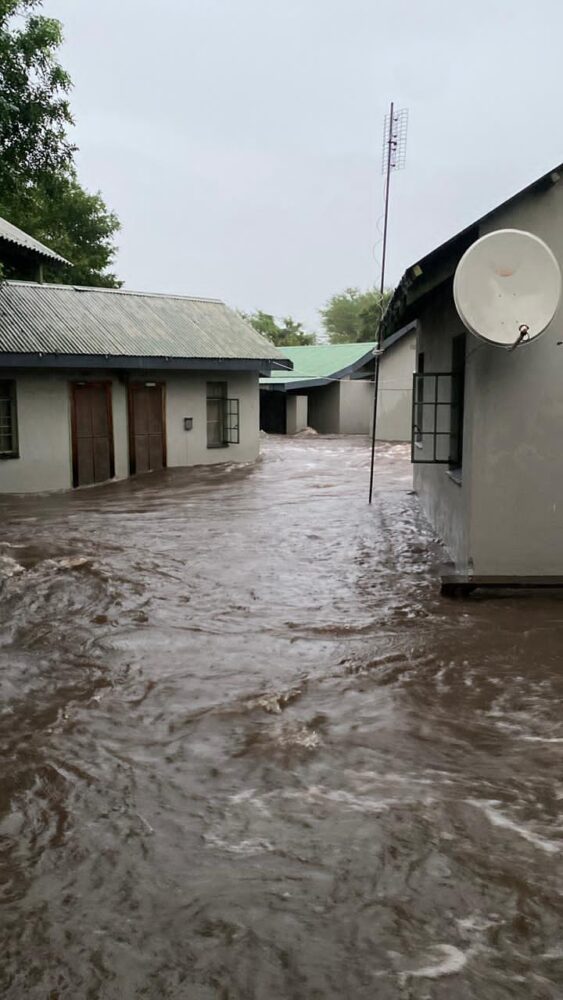 Satara Staff Living Quarters. (SANParks)
“SANParks confirms that a new development has arisen at Satara rest camp, where staff living quarters are currently under water,” Louw said. “As a precautionary and safety measure, affected staff have been successfully evacuated.”
No injuries have been reported and the Satara rest camp will be closed as water supply and electricity is disrupted.
All tourism activities, including guided game drives and bush walks, remain suspended. Many internal roads are saturated, damaged, or inaccessible, making it unsafe to conduct these activities at present.
“Guests exiting the park are urged to monitor updates on road conditions outside the Kruger National Park, as several provincial and regional routes are also affected by flooding.”
On Thursday, Forestry, Fisheries and the Environment Minister Willie Aucamp expressed deep concern over the severe weather conditions and flooding affecting sections of the park, saying this underscored the growing challenges posed by climate variability and climate change.
“Extreme rainfall and flooding events are becoming more frequent and severe, placing pressure on infrastructure and visitor safety,” Aucamp said. “At the same time, such natural events can contribute to ecosystem renewal, replenishing water systems and supporting biodiversity in the longer term.”
While disruptive, these events highlight the importance of resilience and adaptive management in conservation areas, he added.