Zero censure: An AU Summit in
Ethiopia. The AU’s non-interference
has evolved into a protective
doctrine for incumbency. (GCIS)
The AU presents itself as the institutional embodiment of Africa’s collective aspirations for unity, sovereignty, self-determination and democratic governance.
Born from the Organisation of African Unity (OAU), which was established in 1963 to support liberation movements and protect newly independent states, the AU was meant to reflect a more ambitious post-Cold War vision — one centred not only on sovereignty but on peace, development and accountable governance.
Yet six decades after the founding of the OAU and more than 20 years after the creation of the AU, it is increasingly difficult to avoid an uncomfortable question: Who does the AU serve — African citizens or African incumbents?
This is not a question of symbolism or rhetoric. It is a question of outcomes.
Across much of the continent, democratic governance remains the exception rather than the norm. Peaceful transfers of power are rare. Leaders routinely govern for decades. Elections are frequently contested, constrained or manipulated. Civil liberties are fragile and opposition politics is often criminalised and in many of the cases, the AU— the continent’s highest political body — has been either silent or conspicuously restrained.
Democracy as an exception, not a standard
Africa is home to more than 1.4 billion people and 55 states, yet only a small number can credibly claim to meet basic democratic benchmarks consistently. Botswana, Namibia and post-1994 South Africa are often cited as examples of relative democratic stability but the fact that the cases are repeatedly highlighted underscores a deeper problem: democracy in Africa is celebrated as exceptional rather than expected.
By contrast, in Western Europe, democratic governance is treated as a baseline requirement for legitimacy, not an aspirational achievement. No European leader could plausibly shut down the internet during an election, detain opposition figures en masse and expect regional endorsement.
In Africa, such actions have become disturbingly routine. The disparity is not merely economic or historical; it is institutional and it raises a critical issue: Why are African leaders held to a lower governance standard by their own continental body?
The politics of incumbency
The AU’s most persistent defence of its inaction is the principle of non-interference in the internal affairs of member states. Originally conceived as a safeguard against neo-colonial intervention, non-interference has gradually evolved into something else entirely: a protective doctrine for incumbency.
Nowhere is this more evident than in Uganda. President Yoweri Museveni has been in power since 1986. In recent elections, the government imposed internet shutdowns, restricted opposition campaigning and detained critics.
Despite widespread concerns raised by civil society and international observers, Museveni was declared the winner and congratulatory messages followed, including from fellow African leaders.
The pattern is not unique. In Cameroon, President Paul Biya has ruled for more than four decades. In Equatorial Guinea, political power has been effectively hereditary. In Gabon, leadership passed from father to son.
In each case, the AU offered no meaningful censure, no sustained pressure and no institutional consequences. The result is a continental system that functions less as a guarantor of democratic norms and more as a club of mutual political insurance, where leaders protect one another from scrutiny under the banner of sovereignty.
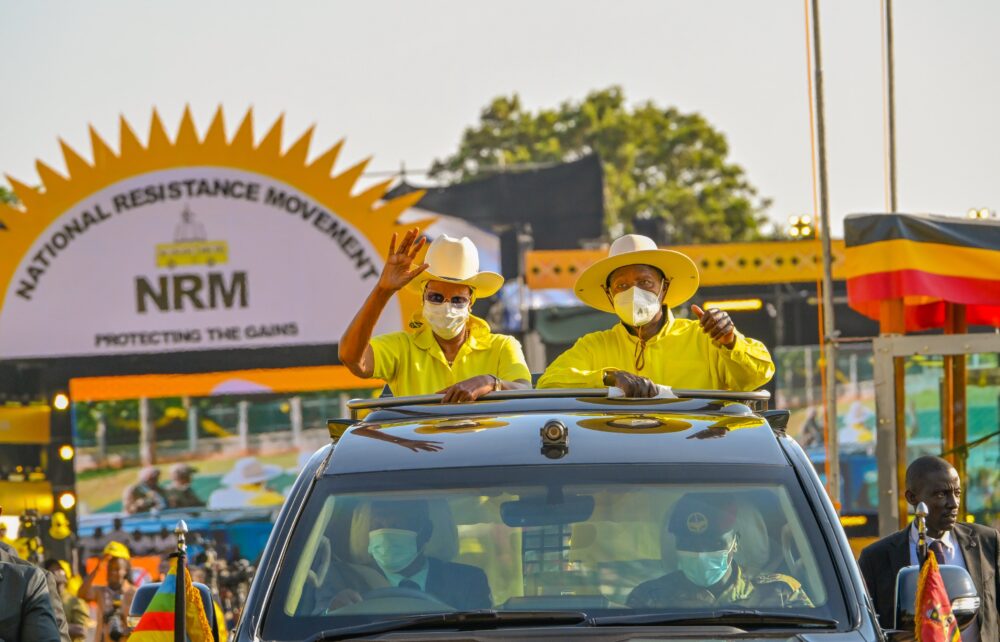 Uganda. President
Yoweri Museveni, left, has been
in power since 1986. (X)
Uganda. President
Yoweri Museveni, left, has been
in power since 1986. (X)
Sudan and the limits of ‘African solutions’
The case of Sudan exposes the moral limits of the arrangement. Former president Omar al-Bashir was indicted by the International Criminal Court for genocide and crimes against humanity in Darfur. Yet for years, he remained a member in good standing within the AU, welcomed at summits and defended by peers who framed accountability as a Western imposition.
The AU’s resistance to international justice was often justified as a commitment to “African solutions to African problems”.
But the question remains: Solutions for whom? For victims of mass violence or for leaders
seeking immunity?
When sovereignty is used to shield alleged atrocity rather than protect citizens, it ceases to be a principled stance and becomes a political convenience.
The Mandela precedent and its rejection
There was, briefly, an alternative vision. As president of South Africa, Nelson Mandela demonstrated a willingness to publicly condemn unconstitutional changes of government elsewhere on the continent, including Nigeria in the 1990s. His stance was not welcomed. Many African leaders viewed it as a violation of continental solidarity.
The backlash to Mandela’s position helped solidify an unwritten rule that persists today: African leaders do not criticise one another in public, especially on international platforms. The norm has endured, even as governance failures have multiplied.
The cost of the silence is borne not by presidents or ministers but by ordinary Africans — voters, journalists, activists and opposition figures — whose rights remain institutionally unprotected.
Unity without accountability
To be clear, the AU has not been entirely inactive. It has supported peacekeeping missions, facilitated dialogue processes and advanced important frameworks on development and integration. The efforts should not be dismissed. But institutional success cannot be measured by activity alone. It must be measured by whether stated principles translate into lived realities for citizens.
On this measure, the AU’s record is deeply uneven. Elections that are neither free nor fair are routinely endorsed. Coups are condemned inconsistently. Long-serving leaders face no term-limit enforcement and when protests erupt over governance failures,
continental solidarity often tilts toward the state, not the public.
This raises a fundamental contradiction at the heart of the AU: It speaks the language of democracy while structurally privileging sovereignty over accountability.
A question the AU cannot avoid
The question is no longer whether Africa faces governance challenges — these are self-evident. The question is whether the AU, as currently constituted, is capable of addressing them. If the AU cannot meaningfully defend electoral integrity, condemn repression or set minimum democratic standards for its members, then its legitimacy must be reassessed — not by external actors but by African citizens themselves.
Continental unity without accountability risks becoming an empty slogan. Sovereignty without consent is not liberation; it is insulation.
Africa does not lack frameworks, charters or declarations. What it lacks is institutional courage — the willingness to prioritise citizens over incumbents.
Until the AU confronts the imbalance, it will continue to escape accountability while claiming moral authority and African citizens will remain spectators in a continental project that was meant to serve them.
Lungisani Mngadi is an independent political analyst and researcher in Johannesburg, with a focus on African foreign policy, global power shifts and
post-liberation governance.