Masego at last year’s Cape Town International Jazz Festival.
For just over a quarter of century, the Cape Town International Jazz Festival (CTIJF) has been one of the most recognisable music events in Africa.
But this year a curious development has unsettled the local industry. A new international festival, that is linked to the renowned Montreux brand, has been scheduled for the very same weekend of the CTIJF, roughly 70 kilometres away.
In the months leading up to its launch, several senior staff members defected from the established festival to the newbie. In the entertainment industry, there is a word for aggressive competition. But, this raises a more uncomfortable question: When does competition begin to look like sabotage?
“Not at all,” says the Montreux Jazz Festival founder, Mark Goedvolk, two weeks and three reminders later.
“The Cape Town International Jazz Festival is a well-established and important event on South Africa’s cultural calendar.
“Montreux Jazz Festival Franschhoek offers a very different format and experience. It’s a more intimate, lifestyle-driven festival set in the Franschhoek Valley, in a village setting, with a curated programme that blends live performances, DJs, hospitality experiences and the broader cultural offering of the region.
“In that sense, we see it as complementary to the broader ecosystem of music festivals in the country.”
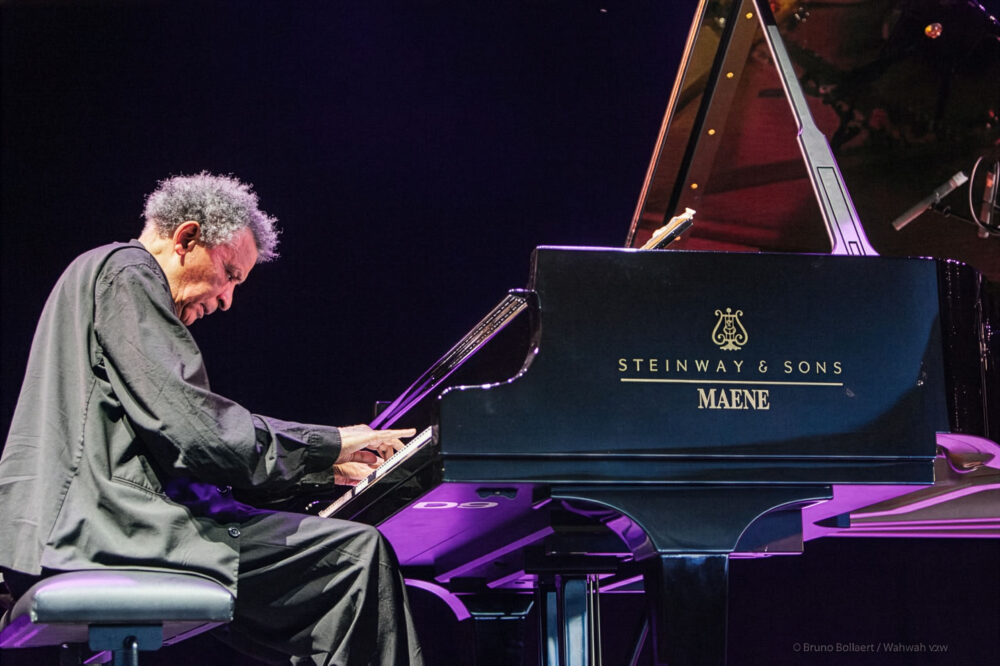 Heavy artillery: Abdullah Ibrahim will perform at the Cape Town International Jazz Festival this year. Photo: Bruno Bollaert / Wahwah vzw
The Montreux Jazz Festival Franschhoek (MJFF) is part of the global Montreux Jazz Festival family (Rio, Miami, China and Japan). The original festival in Switzerland was founded in 1967 by Claude Nobs and remains one of the most respected music festivals in the world.
The Franschhoek edition is an official collaboration under license that brings the Montreux spirit to African soil for the first time, while also celebrating the incredible depth of talent and musical culture found across the continent.
Goedvolk was a regular attendee of Montreux Jazz in Switzerland. The idea to bring the festival to Africa became more concrete over the last three to four years.
“The opportunity to host it in Franschhoek emerged through conversations between the Montreux organisation in Switzerland and us, with us both agreeing that the valley’s unique combination of culture, hospitality, food and wine made it a natural fit.
From there it became a process of careful planning – building the right partnerships, securing venues, curating the programme and ensuring that the festival reflects both the heritage of Montreux and the extraordinary musical culture of Africa.”
It is indeed a well-curated programme with an impressive heavy hitting lineup featuring the likes of Wet Wet Wet, Robert Glasper, Bilal, Thandiswa Mazwai, Stacey Kent, Ezra Collective and Eddie Henderson, to name but a few.
Ticket prices for this event have been more elusive than Fana Hlongwane at the Zondo Commission. It took a while for organisers to come clean about just how pricey the affair would be. And that delay may prove costly.
At R2250 for a single-day pass (with no food or drink included) and the VIP weekend packages ringing in at R12 000, it will be fascinating to see who actually shows up. Accommodation prices have also rocketed in that Small France valley called Franschhoek.
Hotels like La Residence are charging a minimum of R15 000 per person, per night. Granted the average accommodation rate is at around R2600 per night for your lesser classy establishments. That. Is. A. Lot. Of. Money!
May this not prove to be another inception of the infamous Fyre Festival.
That said, the CTIJF, as mentioned earlier, lost several key staff members (programming and operations), including its long-standing PR company to the MJFF. Regardless, they remain optimistic that the MJFF will have minimal impact on their operations.
“The planning cycle for an event of this magnitude is quite extensive. For the 2026 Cape Town International Jazz Festival, the strategic groundwork actually began in mid-2024, when the initial dates were first tabled for discussion.
“Following that internal phase, espAfrika and the CTICC officially confirmed the 2026 dates in the final weeks of 2024, to allow for international artist routing and tourism planning,” explained Georgia Jones, one of the co-directors of the CTIJF, 24 hours after I had sent the questions.
“It is important to note that the dates for the CTIJF have historically been anchored in the final weekend of March for over two decades. Despite this long-standing presence on the City of Cape Town’s annual events calendar, no prior consultation was sought by the Montreux organisers regarding these dates.
“Furthermore, no direct communication was initiated with espAfrika to inquire about our historic scheduling or to mitigate the inevitable clash that has now occurred.”
 Attraction: Mandisi Dyantyis on the lineup of the Montreux Jazz Festival 2026. Photo: Supplied
In the spirit of collaboration, CTIJF met with MJFF’s Goedvolk at the end of 2025. During that sit-down, it became clear that the MJFF team had actively chosen to move forward with the same dates as the CTIJF.
The MJFF team explained that based on their predictive weather tests, the weekend of 27 and 28 March was the most ‘suitable’ for them. They also mentioned that they could not move their dates because they had already booked an international artist.
The weekend of 27 and 28 March promises to be a fascinating one for both festivals. The CTIJF has also rolled out its heavy artillery in terms of artists: Abdullah Ibrahim, Jacob Collier, Yussef Dayes, Nduduzo Makhathini, Tutu Puoane, Scorpion Kings, Sipho “Hotstix” Mabuse, Sibusiso “Mash” Mashiloane, Manana and more. It’s war. Or perhaps I’m being overly dramatic. There is no war here.
 International: Róisín Murphy will feature at the Montreux Jazz
Festival 2026.
International: Róisín Murphy will feature at the Montreux Jazz
Festival 2026.
The CTIJF will likely do what it has done for years, pull in its 30 000-plus crowds. Since Covid, there has been a lingering air of this-might-be-the-year-it-fails but the attendance numbers and the vibes have largely remained the same. If anything, what’s needed are better queue-management systems and easier access to certain performances.
Perhaps the CTIJF should even borrow a page from the MJFF and take the festival outdoors. Since “borrowing” seems to be the en vogue thing at jazz events like these. That aside, the CTIJF has outgrown the CTICC.
The CTIJF, by comparison, comes in at roughly half the price of the MJFF. Day passes are priced at R1350, while VIP packages start at R4950.
Back to politics. Although I was quick to identify the possibility of sabotage in my intro, I am not ignorant of the CTIJF’s history. History can be quite harsh. It bears grudges like an elephant. Its memory is loooong.
Festivals like these are built around personalities. It is not only a strong lineup that attracts people; it is the personality at the helm. It is personal.
No one knows who Mark Goedveld is. Google says a distinguished entrepreneur and globally experienced business leader based in Saudi Arabia. So how now brown cow are we doing a jazz festival in Africa?
These things are built on personalities. These are big things. The CTIJF creates more than 3 000 temporary jobs and bolsters the Western Cape economy with a contribution of about R500 million and an estimated R685 million to South Africa’s GDP.
That said, I am hopeful that my media accreditation for both these events will not be compromised by my words above.
May the best festival win!